


The inbox is a battlefield. In an era where the average person receives over 120 emails per day, simply sending an email is not enough. You must win the subject line skirmish before you can even begin to win the conversion war. For years, marketers relied on intuition, a handful of best practices, and manual A/B testing, a process that is slow, biased, and fundamentally unscalable.
The introduction of Artificial Intelligence has fundamentally shifted this dynamic, turning the subject line into a data-driven science. AI doesn't rely on guesswork; it analyzes billions of data points, emotional sentiment, and real-time subscriber behavior to craft subject lines that are statistically optimized to trigger an open. If you’re not using AI for subject line optimization, you’re leaving a 30% open rate increase on the table.
Defining the "30% Open Rate" Benchmark
Why 30%? This number represents a massive leap for most industries. The average email open rate across all industries typically hovers between 21% and 23%. Achieving a 30% boost (meaning, if you started at 20%, you'd be reaching 26%, or if you started at 25%, you're hitting 32.5%) is often the difference between a successful campaign and one that barely breaks even. This achievable benchmark requires marginal, data-driven gains across multiple touchpoints.
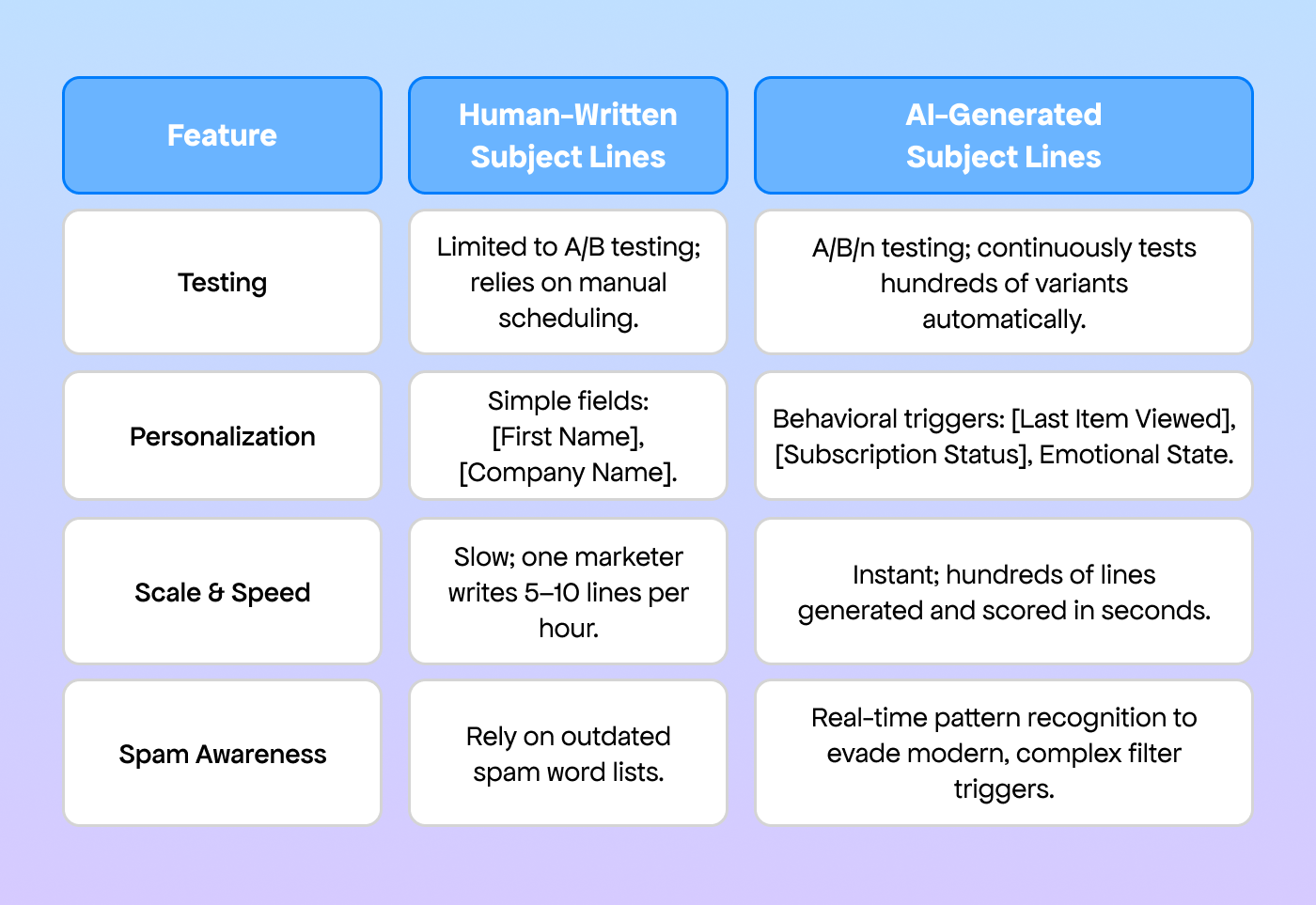
The Core Difference Between AI- and Human-Generated Subject Lines
The 10 AI Subject Hacks for Exponential Open Boosts
Implementing these ten techniques with the aid of AI tools is how you automate your way to a 30%+ open rate.
Hack 1: Hyper-Personalization: Moving Beyond First Names (Behavioral AI)
Traditional personalization died the moment every marketer started using Hi [First Name]. Modern personalization requires context. AI tools analyze recent purchase history, browsing behavior, demographic data, and even inactivity to generate a subject line relevant right now.
How the AI does it: The algorithm identifies a unique behavior trigger (e.g., visited the pricing page three times in the last 48 hours but didn't convert) and crafts an ultra-specific, timely subject line.
Hack 2: Sentiment Analyzer: Testing for Positive vs. Negative Emotional Hooks
Should your subject line be positive (value-driven) or negative (fear/problem-driven)? Manually testing this is exhaustive. AI sentiment analysis allows you to rapidly test both tones simultaneously, optimizing for your specific audience’s emotional resonance.
How the AI does it: The tool generates variations focused on scarcity (Negative Sentiment: "Your Last Chance to Get X Before the Price Hike") and variations focused on gain (Positive Sentiment: "Unlock Immediate Access to Your Next Level of Success"). The AI then tracks which sentiment delivers the highest open rate in the first 30 minutes and automatically shifts testing focus.
Hack 3: Urgency Calibration: Finding the Perfect Fear of Missing Out (FOMO) Ratio
Urgency drives action, but too much urgency triggers cynicism. AI calibrates the intensity of FOMO language (e.g., "Last Chance," "Expires Today," "48 Hours Only") against your historical open and spam complaint rates.
How the AI does it: The AI scores subject lines based on an "urgency factor" that declines with audience fatigue. It ensures you use high-urgency language only for high-value events and automatically softens the language for routine emails to preserve trust.
Hack 4: Query-Based Copywriting: Leveraging AI to Answer Pre-Sale Questions
Instead of pushing content, pull subscribers in by framing the subject line as the solution to an unasked question. This hack targets high-intent users whose behavior suggests they are in a research phase.
How the AI does it: The AI analyzes your best-performing FAQ content and generates subject lines that mirror the specific phrasing of those questions, such as: "Is a $1,000 Setup Cost Worth It? (The Math is Inside)" or "Stop Wasting Time: The Fastest Way to Achieve a Goal
Hack 5: Micro-Segmentation Testing: Generating Unique Lines for Specific Customer Groups
If you have 10 segments, you need 10 subject lines. AI scales this by generating and testing subject lines tailored to segments that are often too small for human testing, such as "Users who downloaded the ebook but never signed up for the free trial."
How the AI does it: The tool identifies commonalities within the micro-segment (e.g., all live in a coastal area, all purchased a low-cost item) and generates a geographically or contextually relevant line, dramatically boosting relevance.
Hack 6: Emoji Optimization: Predicting Which Icon Will Convert Best
Emojis can increase open rates by 56% or send your email straight to spam. The key is context and device rendering.
How the AI does it: The AI analyzes the email content, brand tone, and target segment demographics to recommend emojis that fit the narrative and, crucially, automatically tests how the emoji renders across Gmail, Outlook, and mobile interfaces to prevent display errors that hurt trust.
Hack 7: Spam Filter Evasion: Using AI to Audit Copy Before Sending
Modern spam filters use sophisticated AI to flag emails based on patterns, not just keywords. This hack uses AI to audit your generated subject line against millions of known spam patterns.
How the AI does it: The tool assigns a Spam Score based on overuse of ALL CAPS, excessive punctuation ($$$, !!!), or phrasing common in phishing scams. This proactive audit helps you rewrite the line before it gets flagged, ensuring deliverability.
Hack 8: Question vs. Statement Testing: Identifying the Ideal Interrogative Hook
Questions create curiosity, but statements deliver clear value. The optimal approach differs by campaign.
How the AI does it: The AI continuously tests whether a declarative statement (e.g., "We Just Dropped Prices by 40% Today") outperforms an interrogative question (e.g., "Is it Time to Upgrade to our 40% Off Plan?"). The machine learning model identifies the preferred pattern for that specific audience segment.
Hack 9: Reverse Psychology Hooks: Generating Lines that Defy Expectation
This hack relies on generating subject lines that feel so counterintuitive or honest that they stand out (e.g., "Don't Open This Email." or "We Might Be Too Expensive For You.").
How the AI does it: The AI utilizes its sentiment analysis (Hack 2) but intentionally pushes the boundaries of negative or counter-intuitive language, monitoring the spike in opens (due to curiosity) against any slight increase in unsubscribes.
Hack 10: Event-Triggered Timing: Using AI to Predict the Perfect Send Time
Even the best subject line is useless if the user is asleep or busy. AI is far superior to manual timing optimization.
How the AI does it: Instead of sending all emails at 10 AM, the AI tracks the exact minute each individual subscriber tends to open your emails (and interact with other apps) and queues the email for that personalized moment, dramatically increasing the open window.
The Preheader Partnership (Hack 11)
The preheader text is the 50-100 characters immediately following the subject line. This is arguably Hack #11, and top competitors often neglect it.
How to exploit it: Use the subject line to pose the question (e.g., "Is a $1,000 Setup Cost Worth It?") and use the preheader to immediately offer the hook or social proof (e.g., "See how 3,000 users saved $50k in the last quarter—without a huge initial spend."). AI should be used to test the subject line + preheader pairing as a single unit, maximizing their combined curiosity factor.
Implementation & Strategy: Tools to Maximize Your Boost
The effectiveness of these hacks depends entirely on the tools you use. You need a platform that moves beyond simple text generation to actual predictive performance scoring.
Essential AI Tools for Subject Line Generation & Testing
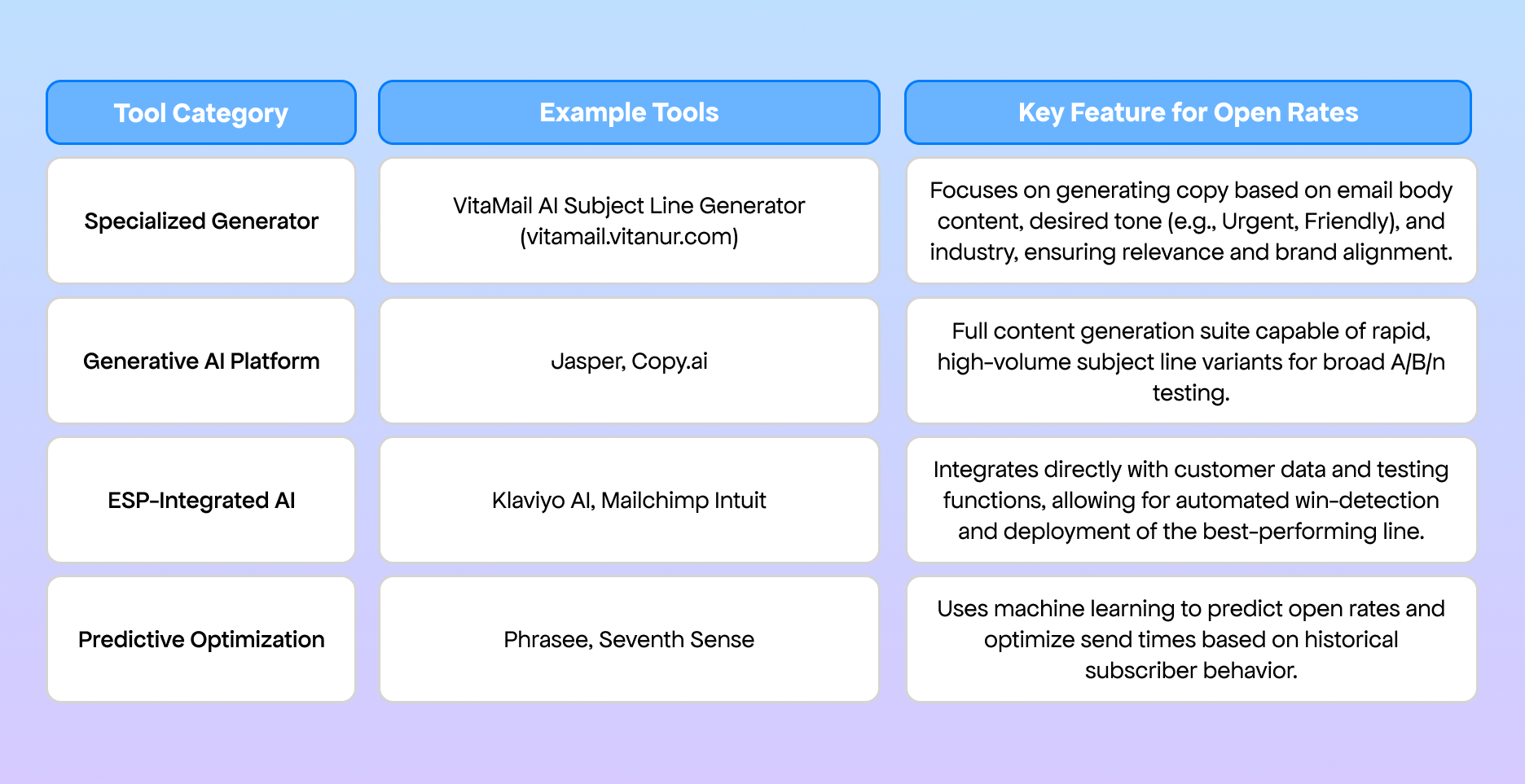
Selecting the right tool depends on whether you prioritize raw generation power, integrated testing, or pure data analysis. Here is a breakdown of essential AI tools, including one that excels at generating the core copy:
The Critical Role of A/B/n Testing Automation
The "n" in A/B/n is critical. You are not just testing A vs. B; you are testing A vs. B vs. C vs. D... and letting the AI model test dozens of variables against a control. This automation process works in three steps:
- Exploration: The AI sends a small portion of the audience (e.g., 5%) several variations of subject lines.
- Exploitation: The model identifies the winning subject line based on the highest open rate within the first hour.
- Automatic Shift: The remaining 95% of the audience receives the winning subject line, maximizing the open rate for the entire campaign automatically.
Measuring Success & Ethical Considerations
Open Rates vs. Click-Through Rates (CTR)
The goal of subject line optimization is to boost the open rate, but CTR is the real prize. If a subject line promises a 40% discount but the email content is irrelevant, the CTR (and conversion rate) will suffer. Always check your AI-generated lines against the following formula:
$$\text{Subject Line Open Rate} \propto \text{Email Content CTR}$$
A successful AI subject line must create a promise that the email content immediately fulfills. Use AI to test subject lines and preheaders that align perfectly with the email's value proposition.
The Ethical Edge: AI, Personalization, and Data Compliance
The line between hyper-personalization and being "creepy" is thin. You must address the ethical side of AI subject lines, especially when leveraging deep behavioral data:
- Transparency: Be transparent about the value you provide. If the line is too personal (e.g., referencing a very specific purchase), it can erode trust.
- GDPR/CCPA Compliance: Ensure your AI tools are pulling and utilizing data only with explicit user consent. High-level personalization requires careful auditing of your data infrastructure.