




The best AI cold email software in 2026 does more than schedule sequences and insert a prospect's first name.
Modern outbound platforms can help you find prospects, verify contact data, research companies, generate personalized messages, manage multiple sending inboxes, monitor deliverability, classify replies and automate follow-ups.
But not every platform does all of those things equally well.
Some are built primarily for high-volume sending. Others start with a large B2B contact database. Some focus on multichannel sales engagement, while newer AI-native platforms attempt to manage the entire workflow from identifying an ideal customer to sending the final follow-up.
The right choice depends less on which platform has the longest feature list and more on where your outbound process currently breaks.
If prospect research takes too long, prioritize AI research and lead sourcing.
If messages sound generic, prioritize deeper personalization.
If campaigns are reaching spam, focus on verification, authentication, mailbox health and sending infrastructure.
If your team is stitching together five separate tools, an all-in-one platform may reduce both complexity and cost.
This guide compares six major approaches to AI-powered cold email and explains exactly what to evaluate before choosing one.
Best AI Cold Email Software in 2026: Quick Comparison
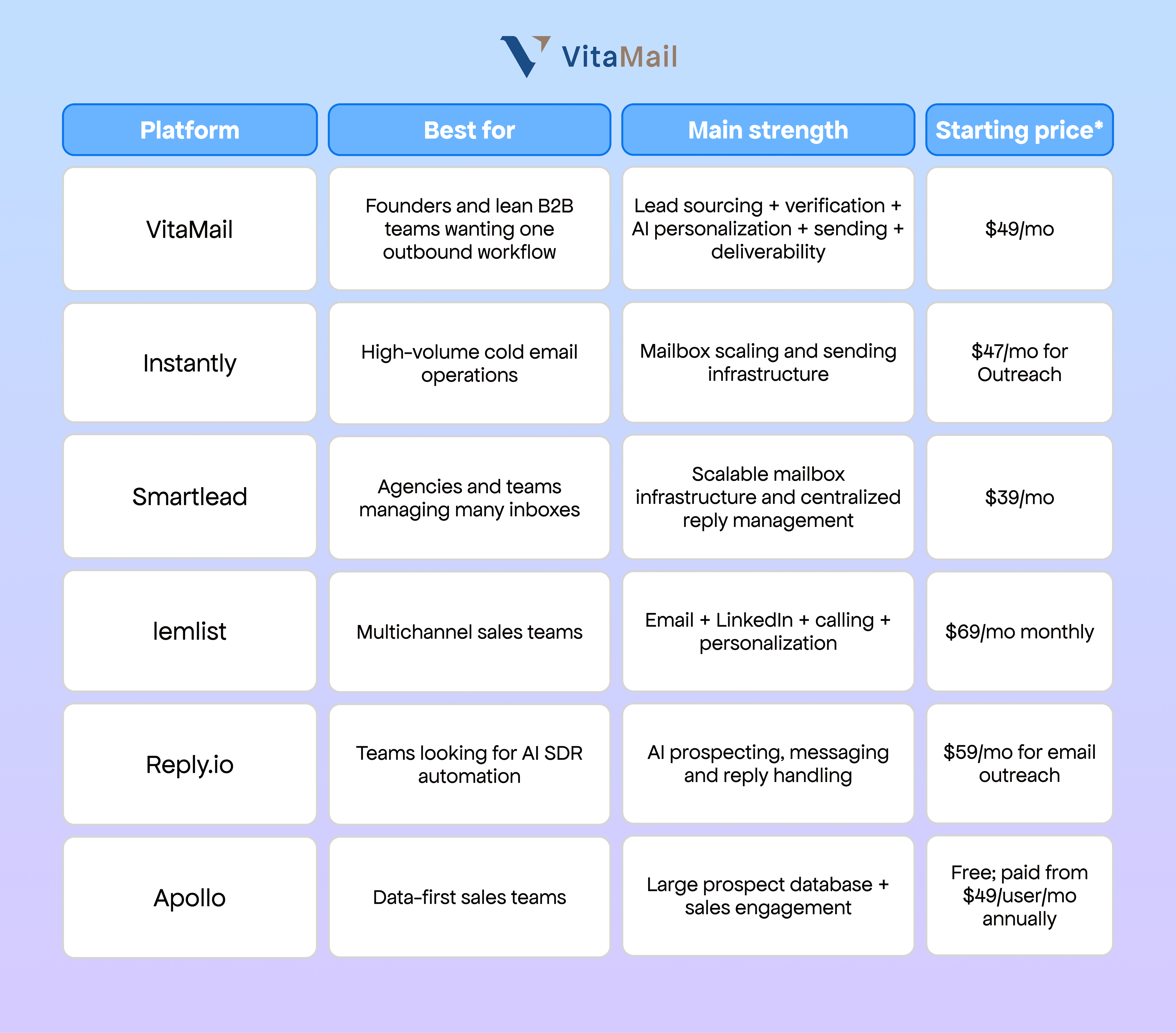
*Pricing shown is based on publicly available vendor pricing as of September 2026 and can change. Some platforms charge separately for data, enrichment, AI credits, mailboxes or additional channels.
The quick answer
There is no universal winner.
Choose VitaMail if you want a lean all-in-one workflow where the platform can understand your offer, identify prospects, verify them, personalize outreach and run campaigns without requiring a large outbound stack.
Choose Instantly if scaling cold email across many sending accounts and large email volumes is your main priority.
Choose Smartlead if you manage substantial outbound infrastructure, particularly across multiple clients or large numbers of mailboxes.
Choose lemlist if cold email is only one part of a multichannel sequence that also includes LinkedIn, calling or other touchpoints.
Choose Reply.io if you want to move further toward autonomous AI SDR workflows.
Choose Apollo if prospect data and sales intelligence are more important to your team than having a cold-email-specific platform.
How We Evaluated These AI Cold Email Platforms
A comparison is only useful if every platform is evaluated against the same questions.
We looked at eight areas that have the largest impact on a real outbound workflow:
1. Prospecting and lead data
Can the platform help identify the right companies and contacts, or do you need to import leads from another tool?
2. AI personalization depth
Does "AI personalization" mean rewriting a template, or can the system use actual prospect and company context to produce meaningfully different emails?
3. Email verification
Can invalid addresses be identified before a campaign begins?
4. Deliverability infrastructure
Does the platform help with inbox warm-up, domain health, authentication, sending limits and mailbox reputation?
5. Campaign automation
Can users create sequences, schedule follow-ups, rotate sending accounts and automatically react to campaign conditions?
6. Reply management
Can the system centralize, classify and prioritize replies instead of forcing users to monitor individual inboxes?
7. Scalability
How well does the platform handle additional users, sending inboxes, clients and campaign volume?
8. Total cost
The subscription price alone is misleading. We also consider whether a team is likely to need separate subscriptions for prospect data, verification, enrichment, warm-up or AI personalization.
Editorial disclosure: VitaMail publishes this guide and is one of the products included in the comparison. Where another platform is better suited to a particular use case, we say so. The comparison is based on currently published product documentation, feature information and pricing rather than undisclosed hands-on benchmark testing.
1. VitaMail: Best for a Lean, All-in-One AI Cold Email Workflow
VitaMail takes an AI-first approach to cold outreach.
Instead of beginning with a CSV upload, users can enter their website and let VitaMail analyze what the business sells and who is most likely to buy it. The system then helps define an ideal customer profile and can pull fresh prospects rather than relying solely on a static stored list.
The bigger difference is what happens after the lead is identified.
VitaMail says its personalization can use information such as a prospect's website, company news and technology stack to generate prospect-specific outreach rather than simply inserting variables into a fixed template.
Its workflow also combines:
- ICP-based lead sourcing
- Email verification
- AI email generation
- AI subject line generation
- Campaign creation
- Multiple sending inboxes
- Automated warm-up
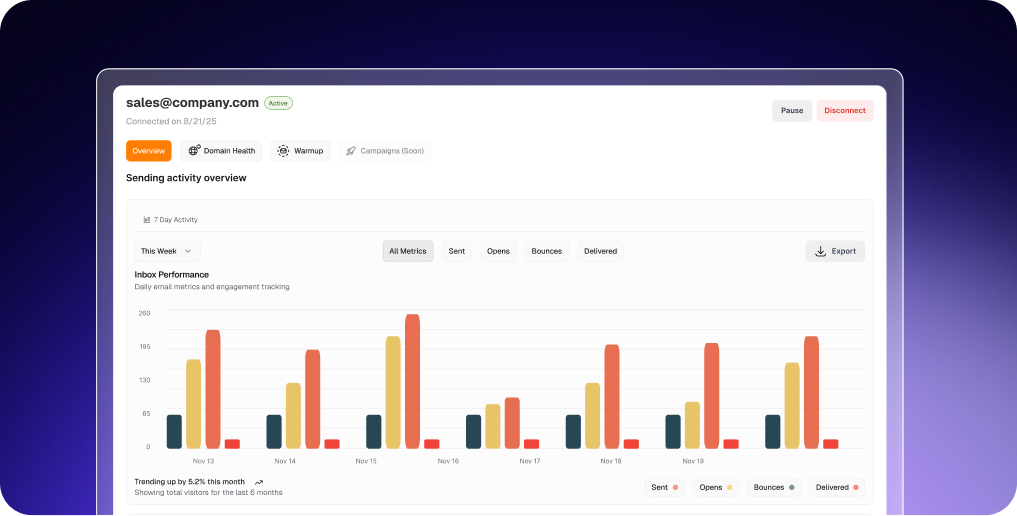
- Domain health monitoring
- SPF, DKIM and DMARC checks
- Follow-up sequences
- Reply tracking
That combination makes VitaMail particularly relevant to founders, small sales teams and businesses that do not want to build an outbound process from multiple standalone products.
The Business plan currently starts at $49 per month, while a free tier provides access to tools such as validation, AI email generation, subject line generation and domain health checks.
Where VitaMail is strongest
Its main advantage is workflow consolidation.
A smaller team may otherwise need one platform for prospect data, another for email verification, another for warm-up, another for personalization and another for campaign sending.
VitaMail tries to move those steps into one workflow.
Where VitaMail may not be the best fit
Companies operating hundreds of sending mailboxes, complex client workspaces or very large agency-scale campaigns may prefer infrastructure-heavy platforms such as Smartlead or Instantly.
Likewise, a sales organization that depends heavily on phone, LinkedIn and CRM workflows may want a broader multichannel platform.
Best for: founders, SMBs and lean sales teams that want to go from ICP to campaign without assembling a large outbound technology stack.
2. Instantly: Best for High-Volume Cold Email
Instantly has become heavily associated with scaling cold email across multiple sending accounts.
Its Outreach Growth plan currently starts at $47 per month and includes unlimited email accounts, unlimited warm-up, up to 1,000 uploaded contacts and 5,000 monthly emails. Higher tiers dramatically increase sending capacity.
Instantly has also expanded beyond sending infrastructure.
Its separate credit system provides access to features such as:
- B2B lead search
- Lead enrichment
- Lead verification
- Web research
- AI email writing
- AI reply handling
- Company news and technology enrichment
This makes Instantly much closer to a complete outbound ecosystem than earlier generations of cold email senders.
Where Instantly is strongest
Mailbox and volume scaling remain major strengths.
If your operation needs to distribute campaigns across many sending accounts while keeping infrastructure centralized, Instantly is one of the most obvious platforms to evaluate.
What to watch
The product is increasingly modular.
The core Email Outreach plan and the credits used for prospecting, research and AI capabilities can be separate subscriptions. For example, both Outreach Growth and Growth Credits currently start at $47 per month.
That means the apparent starting price and the cost of the full outbound stack may be different.
Best for: outbound teams where email volume, mailbox scaling and sending infrastructure are the primary considerations.
3. Smartlead: Best for Agencies and Mailbox Scale
Smartlead is another infrastructure-focused cold email platform, particularly strong where teams need to manage many sending accounts.
Its Base plan currently starts at $39 per month, with larger plans increasing contact and email capacity. Smartlead states that plans include unlimited email accounts rather than charging for every connected mailbox.
The platform also includes a Master Inbox that brings replies from multiple sending accounts into a centralized interface.
Replies can be filtered and organized by factors such as sender, campaign, context and intent. Smartlead also supports automated reply categorization and workflows triggered by reply content.
Its campaign infrastructure includes:
- Automated warm-up
- Mailbox rotation
- Sending safeguards
- Multi-step sequences
- AI-assisted writing
- Centralized reply management
- APIs and webhooks
- Agency-oriented workspaces and dashboards
Where Smartlead is strongest
Smartlead becomes particularly compelling as outbound complexity grows.
A solo founder may not need advanced mailbox infrastructure. An agency managing campaigns across multiple clients often does.
What to watch
Smartlead's core strength is infrastructure and orchestration. Teams seeking deep prospect research and highly contextual AI personalization may still use enrichment systems or external data workflows alongside it.
Best for: lead generation agencies, experienced outbound teams and organizations managing many inboxes or client campaigns.
4. lemlist: Best for Multichannel Personalization
lemlist is broader than a pure cold email sender.
Its Email plan currently starts at $69 per month on monthly billing and includes 50,000 emails per month, unlimited users and senders, lead data, AI agents, a unified inbox, deliverability tools and warm-up.
Its Multichannel plan extends outreach into:
- Calls
- SMS
- WhatsApp integrations
- Task management
This matters because a prospect may ignore an email but respond after seeing the sender on LinkedIn or receiving a well-timed follow-up through another channel.
lemlist has also historically emphasized personalization more heavily than many pure sending platforms.
Where lemlist is strongest
The platform makes the most sense for sales teams that do not view cold email as an isolated channel.
If your workflow combines research, email, LinkedIn and calling, lemlist can reduce the need to maintain separate sequence tools.
What to watch
Teams that need only basic cold email may end up paying for capabilities they do not use.
Conversely, high-volume email operations may evaluate tools such as Instantly or Smartlead where mailbox infrastructure is closer to the center of the product.
Best for: sales teams running coordinated multichannel outbound.
5. Reply.io: Best for Teams Moving Toward an AI SDR
Reply.io represents another stage in the evolution of cold email software.
Its traditional sales outreach product supports email automation, warm-up, deliverability tools and multichannel engagement. Email-focused plans currently start around $59 per month on monthly billing.
But Reply.io's more distinctive product in 2026 is Jason AI SDR.
Jason is designed to automate much more of the SDR workflow, including:
- Building an ICP
- Finding prospects
- Generating sequences
- AI personalization
- Detecting intent
- Handling responses
- Running multichannel outreach
The AI SDR product currently starts considerably higher, from $500 per month on annual plans.
Where Reply.io is strongest
Reply.io is worth considering when your goal is not simply to make an SDR faster but to automate a larger portion of SDR activity.
That is a different buying decision from choosing a $40 to $100 cold email sender.
What to watch
AI SDR automation carries a much higher price and requires confidence in the data, instructions and guardrails being given to the system.
High-value accounts may still benefit from human review rather than fully autonomous communication.
Best for: teams actively exploring AI SDR automation rather than only AI-assisted cold email.
6. Apollo: Best for Data-First Sales Teams
Apollo approaches the problem from the opposite direction of many cold-email-first platforms.
Its foundation is sales intelligence and B2B prospect data.
Users can identify contacts and accounts, enrich records and then move those prospects into automated sales sequences involving email, calls, tasks and LinkedIn activities.
Apollo also offers AI-assisted sequence creation, personalization and sales research.
Pricing currently includes a free tier, with Basic starting at $49 per user per month when billed annually, Professional at $79 and Organization at $119 with a three-seat minimum.
Where Apollo is strongest
Apollo is particularly attractive when prospect data is the center of the workflow.
Instead of exporting leads from one database and importing them into another outreach platform, teams can keep much of the prospecting and engagement process together.
What to watch
A broad sales engagement platform must solve more problems than a specialized cold email product.
Teams whose primary priority is sophisticated mailbox rotation or agency-level cold email infrastructure may prefer a more specialized sender.
Best for: B2B sales organizations that place prospecting data, enrichment and CRM-connected workflows ahead of specialized cold email infrastructure.
How to Choose AI Cold Email Software
Comparing feature checklists is not enough.
Here are the questions that actually reveal whether a platform fits your workflow.
1. How Deep Is the AI Personalization?
Almost every cold email product now uses the word "AI."
That does not mean the underlying personalization is equally sophisticated.
Level 1: Variable personalization
The email changes basic fields:
Hi Sarah, saw you're VP of Sales at Acme.
Useful, but this is essentially modern mail merge.
Level 2: Segment personalization
Different industries, roles or ICP segments receive different messaging.
A VP of Sales at a SaaS company gets different positioning from an agency owner.
Better, but still mostly template-driven.
Level 3: Prospect-level AI personalization
The system researches the individual company and uses signals such as:
- Recent company announcements
- Website messaging
- Technology stack
- Hiring activity
- Industry
- Role
- Business model
- Trigger events
The resulting message should be meaningfully different for every prospect.
A simple test is to generate ten emails from the same campaign and read them consecutively.
If the structure and argument are almost identical, the software is probably generating variables rather than true personalization.
2. Where Do the Leads Come From?
The best-written cold email cannot fix poor targeting.
Ask whether the platform:
- Includes a prospect database
- Finds contacts from live sources
- Enriches imported leads
- Builds lists from your ICP
- Uses intent signals
- Verifies addresses before adding them to campaigns
The answer changes your total technology cost considerably.
A $40 sending platform may become a $200 outbound stack after adding data, enrichment and verification.
3. Is Verification Built Into the Workflow?
Email verification should happen before sending, not after bounce rates start increasing.
Look for systems that can:
- Detect invalid addresses.
- Identify risky or uncertain addresses.
- Prevent obviously bad contacts from entering campaigns.
- Reverify older lead lists when necessary.
Verification does not guarantee inbox placement, but sending repeatedly to invalid addresses is an unnecessary risk to sender reputation.
4. Does the Platform Manage Deliverability or Only Sending?
These are not the same thing.
A sending tool can technically deliver a message to Gmail while still providing little help with the infrastructure that determines whether that message reaches the inbox.
Look for:
- SPF checks
- DKIM checks
- DMARC checks
- Domain health monitoring
- Automated warm-up
- Mailbox reputation monitoring
- Bounce detection
- Sending limits
- Mailbox rotation
- Spam-rate monitoring
- Automatic campaign pausing when health declines
Deliverability should be treated as infrastructure, not a setting you configure once.
5. Can It Handle Multiple Inboxes Properly?
Serious outbound rarely scales by sending thousands of messages through one mailbox.
As your operation grows, evaluate whether the platform can:
- Connect multiple inboxes
- Rotate sends automatically
- Set different limits per account
- Warm each mailbox independently
- Detect unhealthy inboxes
- Pause or reroute sending
- Centralize replies
The right infrastructure becomes increasingly important as volume increases.
6. What Happens After Someone Replies?
A platform can generate thousands of personalized emails and still fail operationally if positive responses get buried across 20 inboxes.
Look for:
- Unified inbox
- Interested/not interested classification
- Out-of-office detection
- Automatic unsubscribe processing
- Lead assignment
- Follow-up tasks
- CRM syncing
- AI-generated suggested replies
For larger teams, reply management can matter almost as much as campaign creation.
7. Does It Fit Your Existing CRM and Sales Stack?
An all-in-one platform is valuable only if consolidating tools actually improves your workflow.
If HubSpot, Salesforce or another CRM is already your source of truth, check the depth of the integration.
Does the platform simply export contacts?
Or can it synchronize replies, lead status, campaign activity and ownership?
The bigger your sales organization, the more important this becomes.
What Changed for Cold Email in 2026?
The technology changed, but so did the inbox.
Deliverability requirements are stricter than they were a few years ago.
Gmail is enforcing sender requirements more aggressively
Google's sender requirements apply to anyone sending to personal Gmail accounts, with additional requirements for senders approaching or exceeding 5,000 daily Gmail messages.
Those higher-volume requirements include SPF, DKIM and DMARC authentication, alignment requirements, low reported spam rates and easier unsubscribe mechanisms for applicable marketing and subscribed messages.
More importantly for 2026, Google states that it began ramping up enforcement against non-compliant traffic in November 2025, including temporary and permanent rejections.
Yahoo expects stronger authentication from bulk senders
Yahoo requires bulk senders to implement SPF and DKIM, publish a valid DMARC policy, provide easy unsubscribe options and maintain spam complaint rates below 0.3%.
Outlook.com also tightened authentication
Microsoft introduced stricter authentication requirements for domains sending more than 5,000 messages per day to Outlook.com consumer addresses.
SPF, DKIM and DMARC became mandatory for these high-volume senders, with enforcement beginning on May 5, 2025.
What this means when choosing software
The practical implication is simple:
Buying a cold email platform based only on how many messages it can send is increasingly the wrong evaluation method.
The better question is:
How safely can this system help me scale while protecting domain and mailbox reputation?
Sending capacity without verification, authentication, reputation monitoring and quality targeting creates risk faster than it creates pipeline.
Which AI Cold Email Platform Is Best for Your Situation?
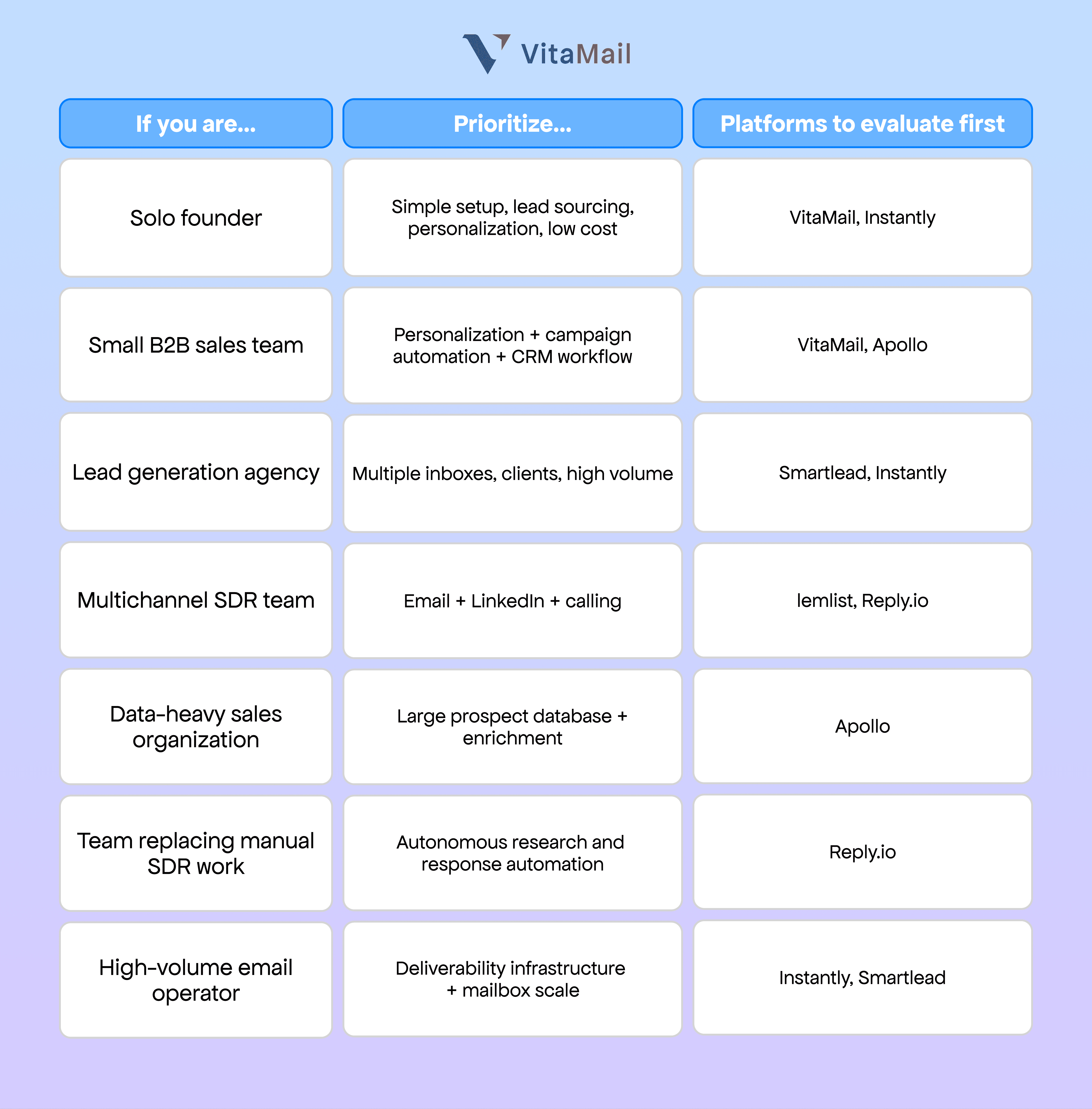
Do not pay for advanced multichannel automation if your real problem is bad prospect data.
Do not buy the world's largest prospect database if you already have a strong data provider but cannot maintain sender reputation.
And do not optimize for maximum email volume if your messages are poorly targeted.
7 Red Flags When Choosing AI Cold Email Software
1. "AI personalization" means adding variables
If the system only changes first name, company and job title, it is not doing much that cold email tools could not do years ago.
2. Deliverability claims have no underlying tools
"High deliverability" should be supported by specific capabilities such as authentication checks, warm-up, mailbox monitoring, sending limits or inbox testing.
3. Verification happens outside the campaign workflow
Every unnecessary export and import introduces another place for stale or invalid data to enter your campaigns.
4. The cheapest plan requires four additional subscriptions
Calculate total stack cost rather than subscription price.
5. AI sends high-value messages without review controls
Automation should not remove your ability to review or constrain AI output.
Company news can be misunderstood. Prospect information can be outdated. Tone can be wrong.
AI assistance is valuable precisely because it removes repetitive work, not because humans should lose visibility.
6. The platform promises guaranteed inbox placement
No legitimate platform controls Gmail, Microsoft or Yahoo's final placement decisions.
A platform can improve infrastructure and reduce risk. It cannot guarantee that every message reaches the primary inbox.
7. Scaling is measured only in "emails sent"
The correct outcome is qualified replies and pipeline.
Sending 100,000 irrelevant emails is not better than sending 5,000 highly targeted ones.
When an All-in-One AI Cold Email Platform Is Not the Best Choice
Consolidating your outbound stack sounds attractive, but it is not always the correct decision.
Suppose your team already has a mature workflow built around:
- A dedicated prospecting database
- Clay or another enrichment layer
- A specialized email verifier
- Smartlead or Instantly for sending
- HubSpot or Salesforce for CRM
- Custom automation through APIs, Make or n8n
Replacing that entire system simply to reduce the number of tools may create more disruption than value.
All-in-one platforms make the most sense when they remove genuine operational complexity.
They make less sense when a mature team has already optimized each layer independently.
The same logic works in reverse.
A founder sending a few thousand emails per month probably does not need six subscriptions and a custom automation architecture.
The best outbound stack is not the one with the most software.
It is the one that reliably moves a qualified prospect from:
targeting → research → verification → personalization → sending → reply → sales conversation
with the least unnecessary friction.
Final Verdict: Choose the Workflow, Not the Feature List
AI is becoming standard across cold email software, which means the phrase "AI-powered" alone is no longer enough to differentiate one platform from another.
What matters more is how much of the outbound workflow a platform can handle effectively and how well it supports the infrastructure behind successful outreach.
If you already have strong prospect data and mainly need to scale sending across multiple inboxes, platforms such as Instantly or Smartlead are worth evaluating.
If your outreach strategy combines email with LinkedIn, calling and other sales touchpoints, lemlist or Reply.io may be a better fit.
If access to a large B2B contact database and sales intelligence is your main priority, Apollo remains a strong option.
But if your biggest challenge is managing too many separate tools for prospecting, verification, personalization, deliverability and campaign execution, VitaMail offers a simpler alternative by bringing those steps into one AI-powered outbound workflow.
Instead of asking:
"Which AI cold email platform has the most features?"
Ask:
"Which platform removes the most friction between finding the right prospect and starting a real sales conversation?"
For founders and lean B2B teams that want to move from ICP → verified leads → personalized emails → campaigns without building a complicated outbound stack, VitaMail is designed for exactly that workflow.
Ready to simplify your cold email stack? Try VitaMail and start building AI-powered outbound campaigns from one platform.

