



Most marketers don't think about email marketing compliance until something goes wrong — an unsubscribe link that doesn't work, a list from a third-party source, a follow-up sent to EU prospects without consent. Small oversights that quietly accumulate until a regulator or inbox provider forces you to pay attention.
Email marketing compliance isn't a legal specialty. It's a sending discipline. And in 2026, with eight new state privacy laws having taken effect in 2025 alone, the bar for what counts as "compliant" has never been higher.
This guide covers what the CAN-SPAM Act, GDPR, and other key email marketing regulations actually require — and what happens when you get it wrong.
Key Takeaways:
- Over 50% of purchased email lists contain non-compliant or inaccurate data, increasing spam complaints and risk.
- GDPR requires clear consent before sending emails, while CAN-SPAM allows sending but requires easy opt-out.
- Most compliance issues don’t trigger fines first — they destroy your email deliverability and keep your messages out of the inbox.
- Missing or complicated unsubscribe options are one of the main reasons users mark emails as spam.
- Clean lists, verified consent, and honest messaging are not just legal requirements — they directly improve inbox placement and performance.
Why Email Compliance Is an Operational Problem, Not Just a Legal One
Forget the fines for a moment.
The most immediate consequence of non-compliance isn't a regulator knocking on your door — it's your emails quietly disappearing. Inbox providers like Gmail and Outlook now use AI to detect non-compliant sending patterns, and 99% of phishing and non-compliant emails are filtered before they ever reach the inbox.
That means a poorly maintained list, a missing unsubscribe link, or a deceptive subject line doesn't just create legal exposure — it actively destroys deliverability. Non-compliance on unsubscribe mechanisms alone accounts for 27% of spam filter hits. And once your sender reputation takes a hit, recovering it takes months, not days.
There's also a consent problem specific to how most outreach lists get built. 59% of purchased lists contain inaccurate or non-compliant data. If you're importing contacts from third-party sources without verifying their consent origin, you're not just risking fines — you're sending to people who will mark you as spam, which feeds directly back into your deliverability score.
About 54% of email users will report a message as spam if they never gave permission to be emailed, and 49% will do so if the email lacks an unsubscribe option. These aren't edge cases — they're the majority of recipients when you skip the email marketing compliance basics.
The legal risk is real too. GDPR enforcement accelerated sharply through 2025 and into 2026, with regulators developing faster investigation processes and increasingly targeting email marketing practices, cookie consent, and data transfers. In 2024, a major U.S. retailer was fined $1.2 million by the California Attorney General specifically for failing to maintain adequate records of email consent and opt-out handling.
But the point isn't to scare you into compliance. It's to reframe it: every email marketing law on the books — CAN-SPAM, GDPR, CASL — essentially codifies the same principle. Send to people who want to hear from you. Make it easy to leave. Be honest about who you are. Follow those principles operationally, and the legal side largely takes care of itself.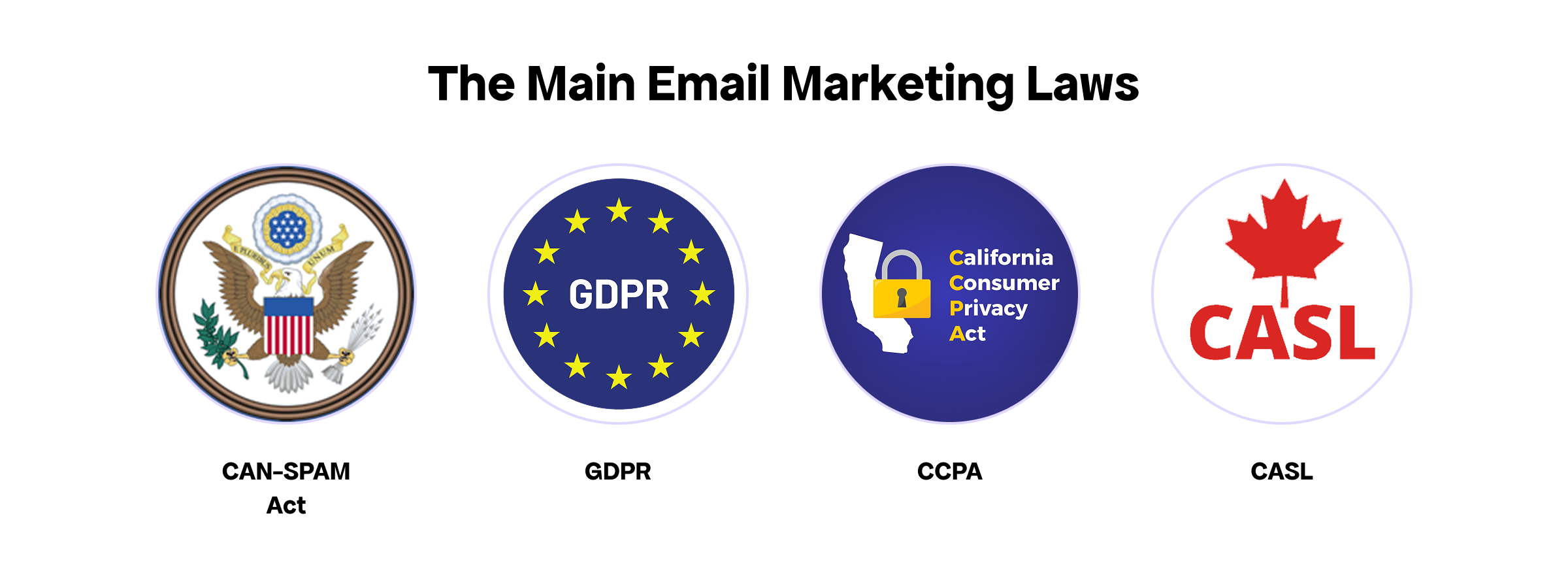
What Is the CAN-SPAM Act?
The CAN-SPAM Act (Controlling the Assault of Non-Solicited Pornography And Marketing) is the primary federal email marketing law governing commercial email in the United States. Passed by Congress in 2003, it addresses the problem of consumers receiving unwanted commercial electronic mail messages.
One common misconception: many senders assume the CAN-SPAM Act only applies to consumer newsletters or promotional blasts. In reality, it covers virtually all commercial email — including B2B cold outreach.
CAN-SPAM Act Requirements: The 7 Rules You Must Follow
1. Don't use false or misleading header information Your "From," "To," and routing information must accurately identify who is sending the email. 71% of consumers mark emails as spam based on the "from" name alone — deceptive sender details are both a legal violation and a deliverability killer.
2. Don't use deceptive subject lines Your subject line must accurately reflect the content of the email. The Washington Supreme Court ruled in 2025 that any false or misleading information in commercial email subject lines violates the state's Commercial Electronic Mail Act — a signal that CAN-SPAM-style enforcement is expanding at the state level.
3. Identify the message as an advertisement If your email is a commercial message, it must be disclosed as advertising in some form, though the law gives flexibility in how you do this.
4. Include your physical mailing address Every commercial email must contain a valid physical postal address — a current street address, a registered P.O. Box, or a private mailbox registered with a commercial mail receiving agency.
5. Tell recipients how to opt out Your email must include a clear, conspicuous mechanism for recipients to opt out of future emails. 45% of email recipients cite difficult unsubscribe processes as a reason to mark emails as spam.
6. Honor opt-out requests promptly The CAN-SPAM Act requires that unsubscribe requests be honored within 10 business days. You cannot charge a fee, require a login, or ask for any information beyond an email address to process an opt-out.
7. Monitor what others do on your behalf If you hire an agency or third party to run your email campaigns, you remain legally responsible. Both the company whose product is promoted and the company sending the email can be held liable.
CAN-SPAM Penalties
The CAN-SPAM Act is enforced by the Federal Trade Commission (FTC) and carries penalties up to $53,088 per violating email as of 2026. For a campaign sending to thousands of contacts, a single compliance gap can translate into catastrophic exposure.
GDPR and Email Marketing
If you have any subscribers in the European Union, the General Data Protection Regulation (GDPR) applies to you — regardless of where your business is headquartered.
GDPR requires a lawful basis for processing personal data. For marketing emails, this typically means obtaining explicit consent before sending, granting EU individuals strong rights over their data including access and deletion, and maintaining full transparency about how that data is used.
Opt-In vs. Opt-Out: The Fundamental Difference
This is where GDPR diverges sharply from the CAN-SPAM Act as an email marketing regulation. CAN-SPAM operates on an opt-out model — you can email someone until they ask you to stop. GDPR operates on a strict opt-in model — you must have documented, explicit consent before you send a single marketing email.
Pre-checked consent boxes, consent buried inside terms of service, and purchased email lists all violate GDPR. This distinction matters enormously for anyone running outreach to mixed global audiences.
GDPR Penalties
GDPR penalties are tiered based on severity. Businesses can face fines of €10 million (roughly $10.8 million USD), or 2% of prior-year global turnover, for lower-severity violations. More serious breaches can reach €20 million or 4% of global annual revenue.
These aren't theoretical. The French CNIL fined Orange €50 million in late 2024 after finding the company placed advertisements in users' inboxes that were visually indistinguishable from regular emails. Italy's DPA fined Telecom company TIM €27.8 million for mass marketing to millions of recipients without consent.
Difference Between GDPR vs. CAN-SPAM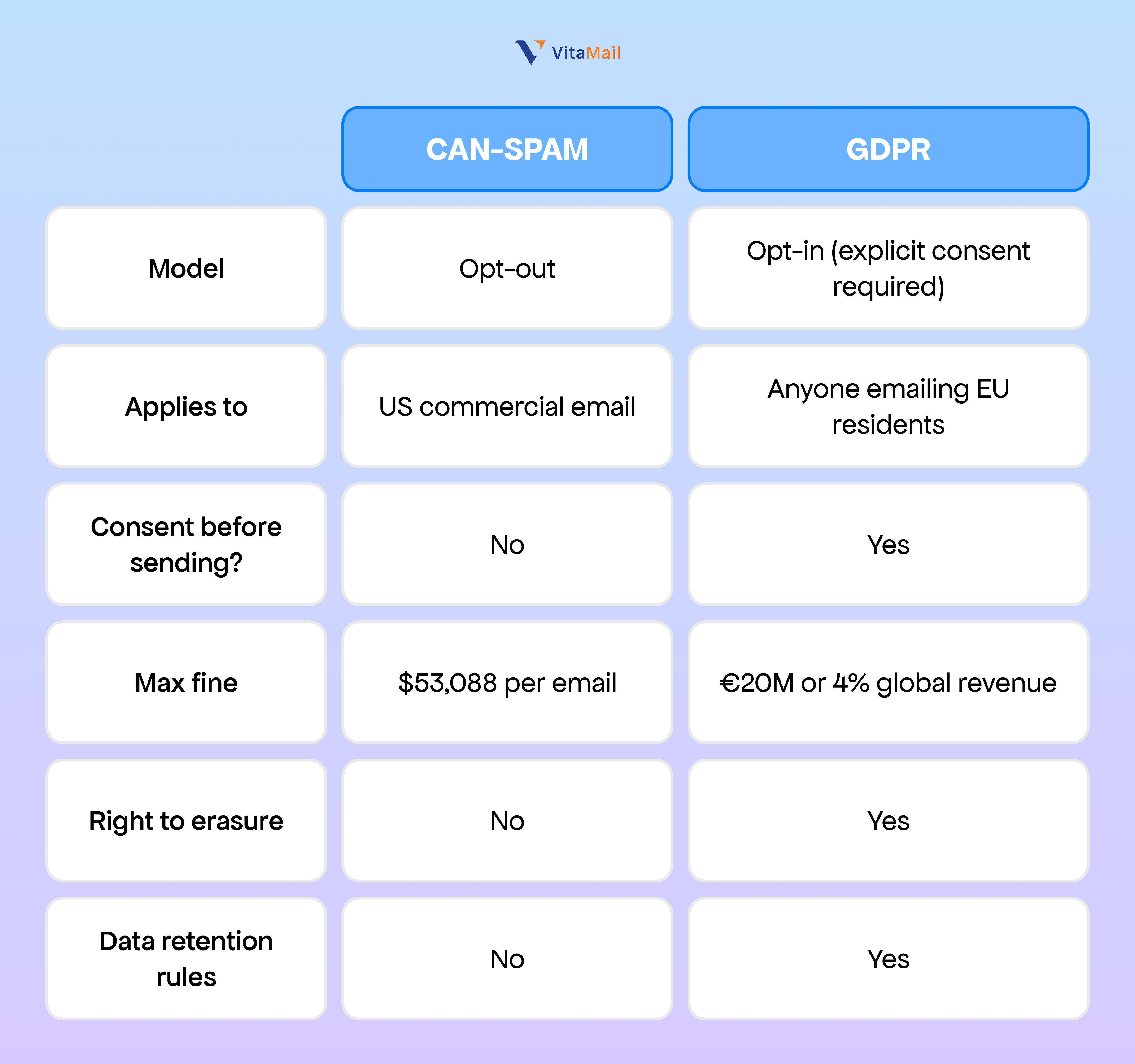
Other Email Marketing Laws to Know
Email marketing regulations don't stop at CAN-SPAM and GDPR. Depending on where your subscribers are located, additional laws apply.
CASL (Canada) — Canada's Anti-Spam Legislation is one of the strictest email marketing laws globally. CASL requires detailed sender identification in every email and specific express consent language. Penalties can reach $10 million CAD, and enforcement has extraterritorial reach — it applies to any business whose emails land in Canadian inboxes.
PECR (United Kingdom) — Post-Brexit, the UK operates its own version of GDPR alongside the Privacy and Electronic Communications Regulations. UK rules closely mirror EU GDPR, requiring opt-in consent for all marketing emails.
Australia's Spam Act — Australian regulators have levied over $6.5 million AUD in fines for Spam Act breaches in recent years, including a food delivery company fined $2 million AUD and a multinational bank penalized $3.5 million AUD.
U.S. State Laws — CAN-SPAM is federal, but state-level email marketing regulations are layered on top and growing stricter. Following California's CCPA, states including Virginia, Colorado, Connecticut, and Utah have enacted their own privacy laws, creating a patchwork of rules that businesses must navigate based on where their recipients are located.
Email Marketing Compliance Best Practices
Understanding email marketing laws is step one. Operationalizing them is what actually protects your business — and your deliverability.
1. Use double opt-in A double opt-in process — where subscribers confirm their email after signing up — is the gold standard for consent documentation. It validates the address and creates a clear consent record, which is critical under GDPR if you're ever audited.
2. Build your list organically 59% of purchased lists contain inaccurate or non-compliant data. Buying contacts is a compliance risk under both GDPR and CASL, and a deliverability disaster regardless of jurisdiction. Every contact on your list should have a clear, documented source.
3. Make unsubscribing frictionless Every email must include a visible, one-click unsubscribe link. An EU-based e-commerce company was fined €10 million in early 2024 specifically for failing to provide a clear unsubscribe option — one missing link, one very expensive lesson.
4. Honor opt-outs within 10 business days This is a hard CAN-SPAM Act requirement. Under GDPR, the expectation is faster — process requests as soon as technically feasible.
5. Document your consent Over 60% of organizations facing regulatory investigations in 2024 identified poor documentation as a primary compliance gap. Log when, how, and where each subscriber gave consent — this is your legal defense in an audit.
6. Use honest subject lines and sender names Never use misleading "from" names or deceptive subject lines. This violates both the CAN-SPAM Act and GDPR, and it's one of the fastest ways to destroy your sender reputation.
7. Include your physical mailing address Required under CAN-SPAM on every single send. Put it in your email footer and don't remove it.
8. Audit your list regularly Remove inactive subscribers, hard bounces, and anyone who hasn't engaged in 6–12 months. One U.S.-based SaaS company saw a 25% improvement in deliverability after adopting strict data minimization practices and routine list cleaning in 2024.
How Compliance Improves Email Deliverability
Here's the reframe that changes everything: email marketing compliance and deliverability aren't separate concerns — they're the same concern.
When you follow the core email marketing regulations — clean lists, verified consent, easy opt-outs, honest sender information — you're sending exactly the signals that inbox providers use to classify you as a trustworthy sender. The result is better inbox placement, higher open rates, and campaigns that actually reach people.
The rules for being GDPR compliant follow best practices for email deliverability — minimizing the risk of your messages bouncing or being flagged as spam. This isn't a coincidence. Regulators and inbox providers are both trying to solve the same problem: protecting recipients from unwanted, deceptive email.
Compliance isn't a constraint on your marketing. It's the infrastructure that makes your marketing work.
Conclusion
Email marketing compliance in 2026 isn't about memorizing regulation numbers or hiring a lawyer before every send. It's about building a clean, permission-based operation from the ground up — one where every contact on your list chose to be there, knows who you are, and can leave whenever they want.
The CAN-SPAM Act, GDPR, CASL, and the expanding wave of state-level email marketing laws all point in the same direction. Senders who respect that signal get better inbox placement, stronger engagement, and zero regulatory exposure. Those who don't eventually pay — in fines, in reputation damage, or in campaigns that simply stop working.
Start with the checklist above. Audit your current list. Fix your unsubscribe flow. Document your consent. That's where email marketing compliance actually begins.