





Instantly is a solid tool to start with — quick setup, a clean interface, and warmup infrastructure that works out of the box. Where people start looking elsewhere is usually one of three points: the entry-tier plans cap contacts and monthly sends faster than expected, the lead database is a separate paid add-on rather than bundled in, and managing outreach for multiple clients means a separate workspace and subscription per client rather than one consolidated bill.
None of that makes Instantly a bad product. It means the right alternative depends on which of those three constraints is actually the one costing you money or time.
Why Teams Look for an Alternative to Instantly
The recurring reasons that show up across user discussions and reviews:
- Contact and send caps on lower tiers — entry plans are built for smaller lists, and the next tier up is often a large price jump rather than a gradual one.
- Lead database sold separately — sourcing a prospect list and sending to it are treated as two different purchases.
- Deliverability concerns on shared infrastructure — pre-warmed, shared-IP inboxes are convenient to start with, but several users report inbox flags on accounts sending low daily volume.
- Agency/multi-client cost — a separate workspace and subscription per client adds up fast for agencies running outbound on behalf of others.
- AI personalization that's largely variable-based — subject-line assist and merge-tag personalization rather than genuinely different message content per recipient.
Quick Answer: Best Instantly Alternatives at a Glance
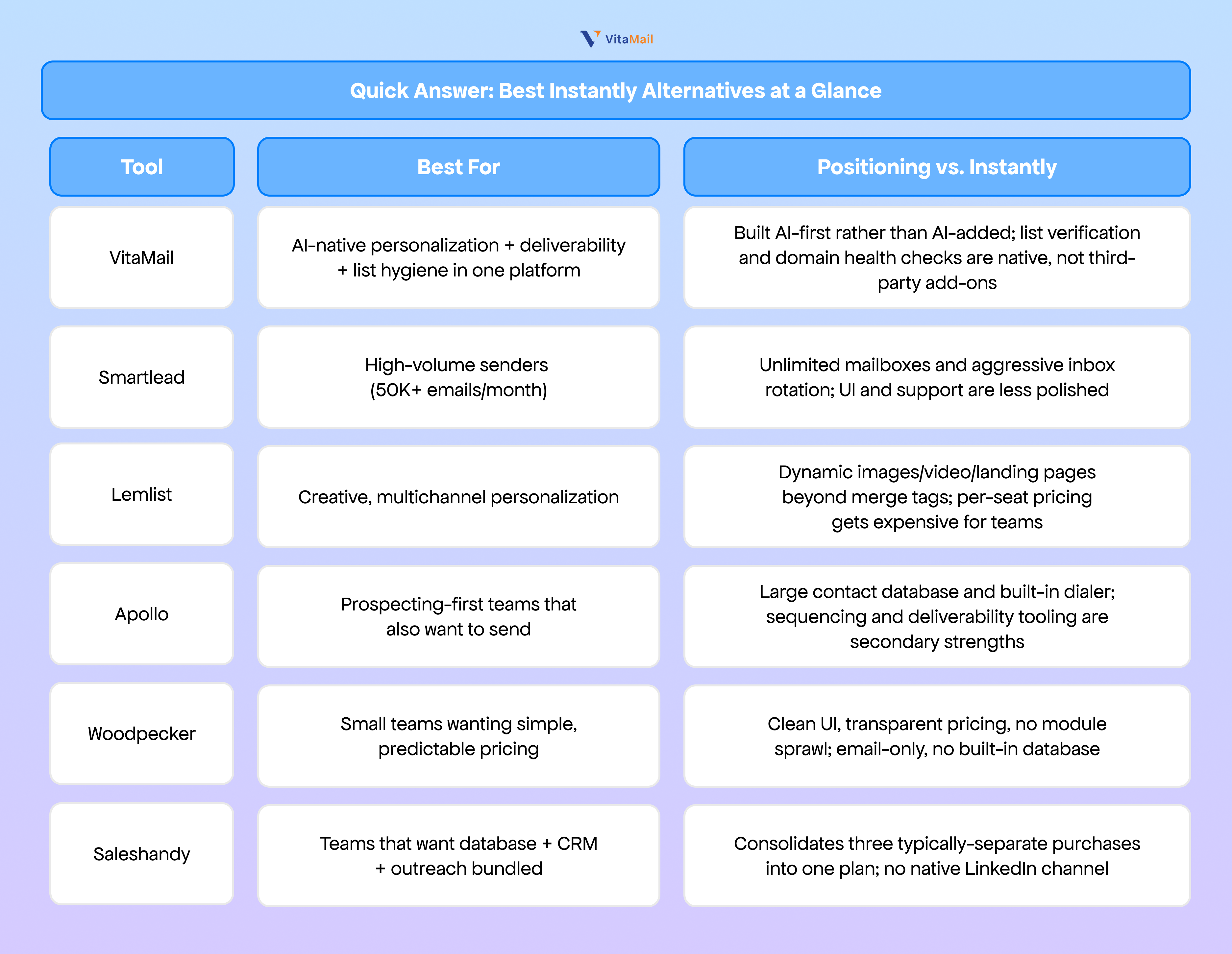
How Each Alternative Compares
1. VitaMail: AI-Native Personalization and Deliverability, Bundled
VitaMail is built around three things being core product functions rather than add-ons: AI-generated personalization, deliverability infrastructure, and list verification.
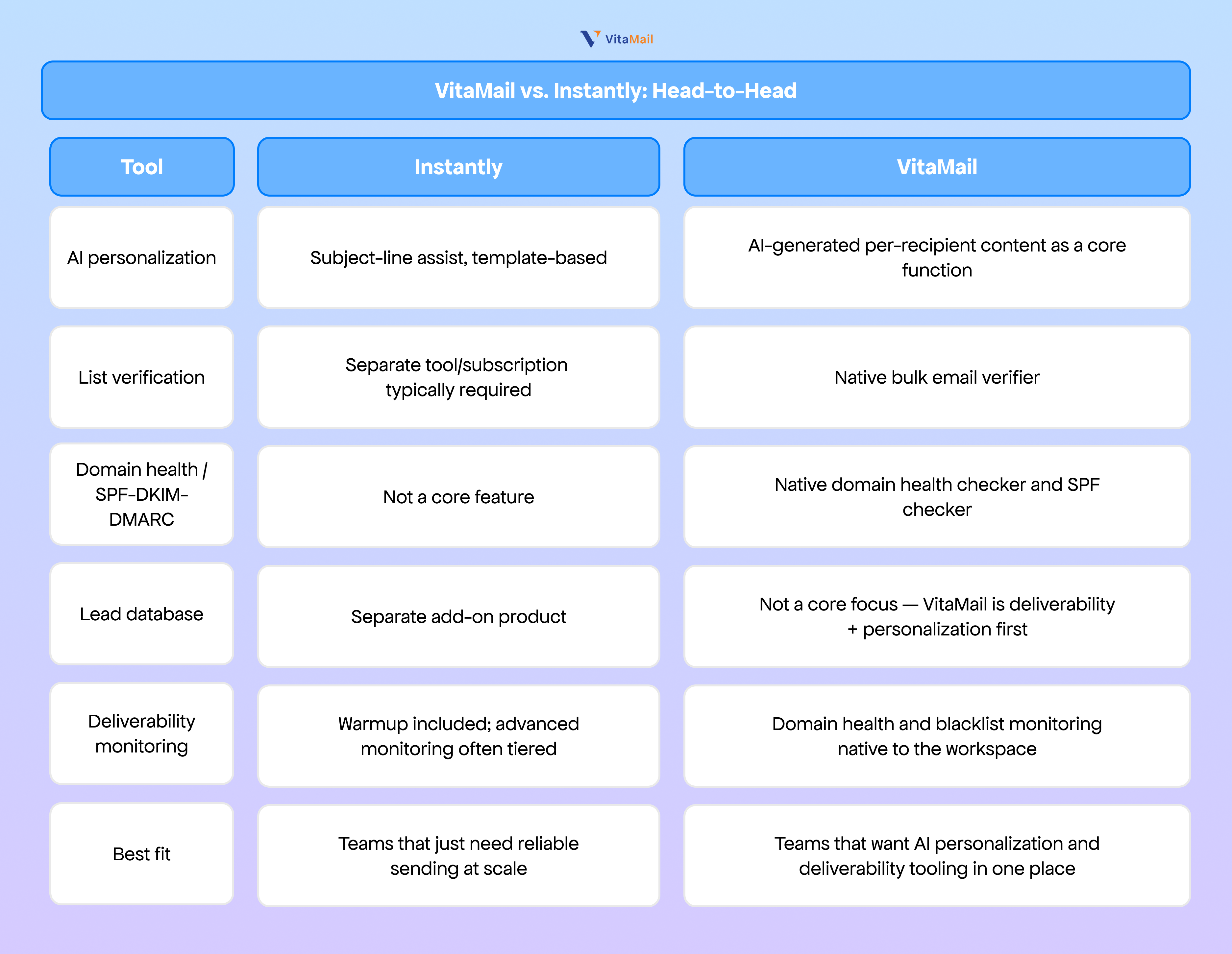
The practical difference versus a sequencing-first tool like Instantly: personalization isn't a subject-line suggestion layered onto a template. The AI email generator produces genuinely different opening content per recipient based on prospect data, and it sits in the same workspace as domain health monitoring, SPF/DKIM/DMARC checks, and bulk list verification — so there's no separate subscription for deliverability tooling or a different tool for list hygiene.
Where VitaMail is the stronger fit: teams whose main friction with Instantly is thin AI personalization or wanting deliverability/list-verification tooling in the same place they're sending, rather than stitched together from two or three subscriptions.
Try it directly before switching anything: run your own list and domain through the free bulk email verifier, domain health checker, and AI email generator to see the output against what you're currently getting.
2. Smartlead: Best for High-Volume Sending
Smartlead is built for teams sending high volumes across many mailboxes. Unlimited mailboxes, inbox rotation, and a unified reply inbox across all connected accounts are the core strengths, and pricing tends to scale by active leads rather than by seat, which suits agencies running large volume more predictably than per-seat pricing would.
The trade-off users commonly cite: the interface is functional rather than polished, and warmup is sometimes a separate cost depending on plan tier — worth checking against the current pricing page rather than assuming it's bundled at every level.
Best for: teams where raw sending volume matters more than personalization depth or UI polish.
3. Lemlist: Best for Creative, Multichannel Personalization
Lemlist's differentiator is personalization that goes beyond merge tags — dynamic images, auto-generated video, and landing pages that adapt per recipient, combined with multichannel sequences across email, LinkedIn, and calls.
The trade-off is pricing: Lemlist uses per-seat pricing, which scales quickly for larger teams, and its enrichment features often run on a separate credit system on top of the seat price.
Best for: teams where reply rate depends on high-effort creative personalization rather than volume.
4. Apollo: Best for Prospecting-First Teams
Apollo flips the usual order: it starts with a large contact database and lets you sequence from inside the same tool, rather than assuming you've already sourced a list elsewhere. The built-in dialer and firmographic filtering are strong for SDRs who spend as much time prospecting as sending.
The trade-off: native email warmup is limited or absent depending on plan, and sequencing/deliverability tooling isn't the platform's primary strength — it was built database-first.
Best for: teams where sourcing accurate contacts is the bigger bottleneck than the email itself.
5. Woodpecker: Best for Small Teams Wanting Predictable Pricing
Woodpecker's appeal is transparency: a clean interface, human-like sending pacing built for deliverability, and pricing that doesn't fragment into a dozen paid add-ons. A/B testing and warmup are typically included rather than gated.
The trade-off: no built-in lead database, no LinkedIn or multichannel steps, and no deep AI personalization — it's built to do email-only outbound reliably and nothing more.
Best for: solo founders or small teams who want dependable sending without managing a feature-heavy platform.
6: Saleshandy: Best for Bundling Database + CRM + Outreach
Saleshandy's positioning is consolidation: a large B2B contact database, a built-in outbound CRM for tracking replies and pipeline stages, and sequencing under one plan — three things that are often three separate subscriptions elsewhere.
The trade-off: no native LinkedIn channel, and AI features are generally lighter-weight (subject-line and copy variants) compared to platforms built AI-first.
Best for: teams currently paying separately for a lead database, a CRM, and an outreach tool who want to consolidate.
VitaMail vs. Instantly: Head-to-Head
How to Choose the Right Instantly Alternative
Three questions, in order:
1. What's the actual bottleneck — sending volume, personalization quality, or tooling fragmentation? If it's volume, Smartlead. If it's personalization depth, Lemlist or VitaMail. If it's paying for three separate subscriptions (database, CRM, deliverability), Saleshandy or VitaMail consolidate that differently — Saleshandy around database+CRM, VitaMail around AI copy+deliverability+list hygiene. SaaS teams running in-house outbound tend to land on the personalization-depth question first — see AI email for SaaS.
2. Do you need a channel beyond email? If LinkedIn or multichannel sequencing matters, Lemlist and Apollo support it natively; Woodpecker, Smartlead, Saleshandy, and VitaMail are currently email-focused. Agencies running outbound across several clients usually weigh this alongside per-client cost — see AI email marketing for agencies.
3. How much manual review do you want before AI-generated copy sends? Platforms differ in whether AI output is meant to send automatically or as a draft for human review. Test this directly — a free AI email generator run against your own prospect data shows you the actual output quality faster than any feature comparison table.
For the fuller picture of what separates AI-native platforms from legacy sequencers with AI added on, see the AI cold email software guide.
See how VitaMail compares on your own list
Run your list and domain through VitaMail's free tools before deciding: Bulk Email Verifier · Domain Health Checker · AI Email Generator

