



TL;DR: Prospective customer ICP criteria scoring is the practice of ranking sourced leads against weighted attributes that define your ideal customer profile, then prioritizing outreach by score. A workable model assigns 100 total points across four layers: firmographic fit (40), intent signals (30), title and tech match (20), and engagement history (10). Teams that ship this framework typically cut outreach volume by 40% and lift reply rates 2x to 3x.
You have 10,000 prospects in a CSV and 200 SDR hours this quarter. Treating every name as equal weight is how outbound teams burn through TAM, tank deliverability, and ship campaigns that reply at 0.4%. ICP scoring fixes the math. This guide covers the scoring model VitaMail customers use to rank prospects before they enter a sequence, the four signal categories that predict replies, and how to operationalize scores so they actually drive who gets contacted next Monday.
Key Takeaways:
- ICP scoring can cut outreach volume by 40% while doubling or tripling reply rates.
- Score every prospect out of 100: 40 points for firmographic fit, 30 for intent signals, 30 for title, tech, and territory match.
- Prospects scoring under 55 should be parked or dropped from outreach entirely, not sent lower-priority emails.
- To find real weighting criteria, compare your last 50 closed-won and closed-lost deals and see what shows up 70%+ in wins but under 30% in losses.
- Sending 200 emails a day to well-scored prospects beats sending 1,000 emails a day to an unsorted list.
- Recalibrate scoring weights every quarter using actual meeting and conversion data, not gut feel.
What is prospective customer ICP criteria scoring?
Prospective customer ICP criteria scoring assigns a numeric value to each prospect based on how closely they match a defined Ideal Customer Profile. Higher scores route to outreach. Lower scores get parked, nurtured, or excluded entirely.
The mechanics are simple: define 8 to 15 criteria, weight each by its predictive value, score every prospect, then sort. The discipline is where most teams fail. Without scoring, an SDR's "good list" is whoever happened to populate from Apollo last Tuesday. With scoring, the list is the math.
Three things make ICP scoring different from a gut sort:
- Criteria are documented, not living in someone's head.
- Weights are explicit. Industry fit is not "more important" than company size, it is worth 25 points to size's 10.
- The score is a single number, sortable, filterable, and routable into an outreach tool.
ICP scoring vs lead scoring: what is the difference?
ICP scoring measures fit before any interaction. Lead scoring measures behavioral interest after engagement. Most teams need both, scored separately, never combined into a single number.
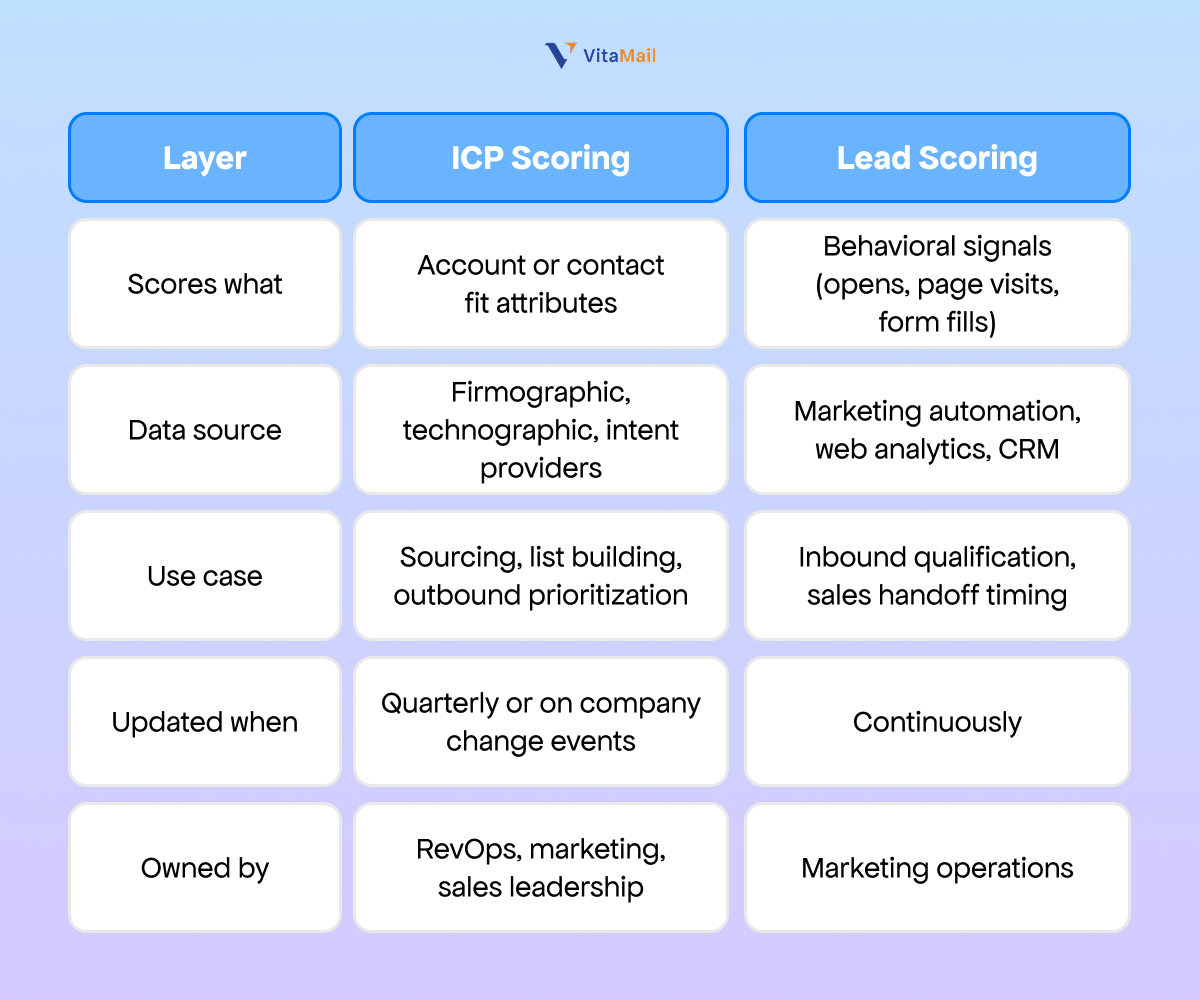
Conflating the two is the most common modeling mistake. An account can have a perfect ICP score and zero engagement (a great outbound target) or a low ICP score and high engagement (an inbound lead worth qualifying but not necessarily a long-term fit). Different scores, different actions.
The four signal categories every ICP scoring model needs
A scoring model that only looks at company size misses 70% of the picture. Use four layers, weighted by predictive strength against your historical closed-won data.
- Firmographic fit: industry, company size, revenue band, geography, funding stage.
- Intent signals: hiring for relevant roles, recent funding, tech adoption changes, public RFPs, leadership changes.
- Title and tech match: decision-maker title present, current tech stack compatibility.
- Engagement history: prior touches, opens, replies, website visits, content downloads.
Run a 60-minute exercise to surface your real weights. Pull the last 50 closed-won deals and the last 50 closed-lost. List every attribute both groups share. The attributes that appear in 70%+ of won deals and under 30% of lost deals are your highest-weight criteria. Everything else is noise dressed as signal.
How do you weight ICP scoring criteria?
Weight criteria by their statistical correlation with closed-won deals. Allocate 100 total points across four layers, then split each layer's allocation across 2 to 4 specific criteria.
A defensible starting allocation for B2B SaaS sold via cold outreach:
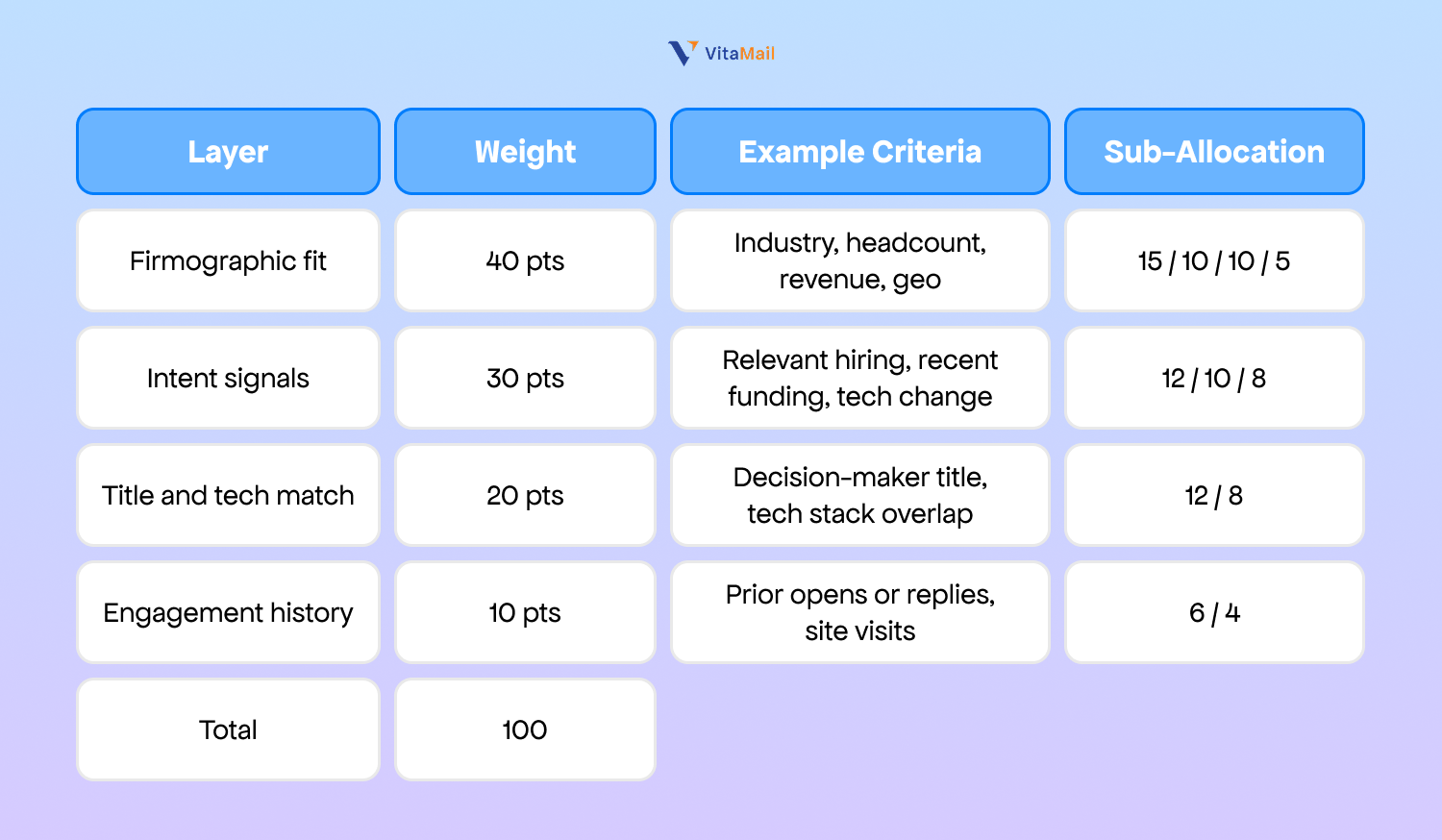
After three months, recalibrate. Pull the prospects that converted to meetings and see which score band they came from. If 80% of meetings came from the 70-plus band, the model is calibrated. If meetings are distributed evenly across score bands, the weights are wrong and you re-fit.
According to Gartner research, B2B buyers spend just 17% of their purchase journey meeting with potential suppliers. You get a single, narrow window with each prospect. Scoring decides who gets that window.
The FIT-100 Framework for prospective customer ICP criteria scoring
The FIT-100 Framework is a 100-point model VitaMail uses internally and recommends to outbound customers. Each layer feeds the next, scoring is additive, and routing thresholds are explicit so the model produces actions, not just numbers.
F: Firmographic foundation (40 points)
The non-negotiable account attributes. If a prospect scores under 25 here, do not contact them regardless of other signals. Score on industry match (15), employee count band (10), revenue or funding stage (10), and geography (5).
I: Intent and timing (30 points)
Signals that the prospect has an active or emerging need. Hiring for relevant roles (12), recent funding within 12 months (10), tech stack changes or new tool adoption (8). Intent signals are time-decayed: a signal from 30 days ago is worth full points, 90 days ago is worth half, beyond 180 days is worth zero.
T: Title, tech, and territory (30 points)
The contact-level filter. Decision-maker title verified (12), tech stack compatible with your product or addressable from your wedge (10), territory matches assigned rep (8).
Score-to-action thresholds
- 85 to 100 (Tier A): Personalized 1-to-1 outreach, founder or AE owned.
- 70 to 84 (Tier B): Standard SDR sequence with light personalization tokens.
- 55 to 69 (Tier C): High-volume sequence, generic templates, low priority.
- Under 55: Park in nurture or exclude from outbound entirely.
How do you operationalize ICP scores in cold outreach?
Operationalize ICP scores by routing tiers into different sequence intensity, inbox allocation, and reply handling. The score should change what gets sent, who sends it, and how often follow-ups fire.
A working operational setup looks like this:
- Score every prospect at import. Run scoring as a CSV enrichment step or via API before the prospect ever lands in a sequence tool.
- Map score tiers to sequences. Tier A goes to a 4-step personalized sequence. Tier B goes to a 6-step standard sequence. Tier C goes to a 3-step volume sequence with minimal touches.
- Allocate inbox capacity by tier. In VitaMail, A-tier prospects get assigned to your highest-warmed inboxes with conservative daily limits. C-tier flows through higher-volume inboxes where deliverability margins are tighter.
- Tie reply handling to score. Replies from Tier A get same-hour AE notification. Tier C replies go to a generic handling queue.
- Suppress low scores from re-import. If a prospect scored 35 last quarter, do not let them re-enter the workflow at 35 next quarter. The model already said no.
This is where ICP scoring stops being a spreadsheet exercise and becomes a margin multiplier. Sending 200 messages a day to 70-plus prospects produces dramatically better deliverability and pipeline than sending 1,000 messages a day to an unsorted list, and the underlying math is the score.
What are the most common ICP scoring mistakes?
Most ICP scoring models fail for one of five reasons. None of them are about the math.
- No feedback loop. If you do not recalibrate weights every quarter against actual won deals, the model drifts. Founders often refuse to demote a criterion they emotionally believe matters.
- Too many criteria. Beyond 15 inputs, the model becomes impossible to populate consistently and the marginal predictive lift approaches zero.
- Vanity criteria. "Has a marketing team" is not predictive. "Hired a head of demand gen in the last 90 days" is.
- Confusing score with priority. A high ICP score plus zero capacity to engage them this quarter is still zero pipeline. Route by score AND capacity.
- Manual scoring at scale. If scoring lives in an SDR's head, it does not exist. Push the math into your enrichment pipeline or your sequencer.
The teams that get this right treat ICP scoring as a quarterly engineering exercise. They commit, measure, and revise. The teams that get it wrong build a beautiful framework, use it once, and revert to vibes by week three.
Next step
ICP scoring is the difference between sending 10,000 cold emails that produce 40 replies and sending 3,000 cold emails that produce 90. The math compounds across every campaign. Document the criteria, weight them against your closed-won data, route scores into sequence intensity, and recalibrate quarterly. To see how VitaMail handles ICP-based segmentation, tiered inbox routing, and score-driven personalization inside a single workflow, visit vitamail.vitanur.com.