



B2B email marketing is not the same game as sending a well-written message to someone's inbox. You're selling to committees, not individuals. Sales cycles stretch across months, not minutes. And the person who opens your email is rarely the only one who decides whether to buy.
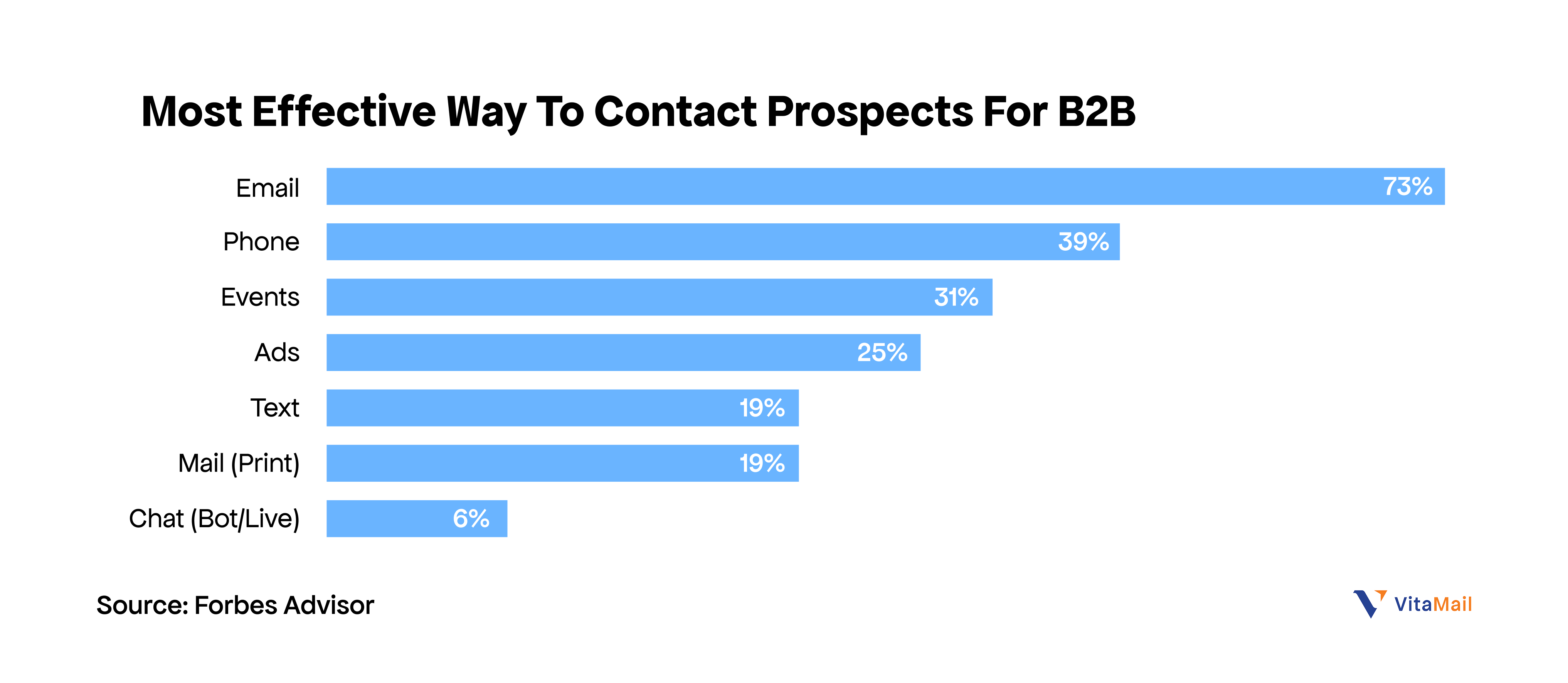
According to the Forbes Advisor email remains the highest-ROI channel in B2B generating roughly $36 to $42 for every dollar spent. The teams that win with b2b email marketing aren't just better writers. They understand how B2B buying actually works and build their campaigns around that reality. The winning tips below go beyond generic advice and focus on the strategies that move the pipeline: account-based targeting, buying committee mapping, multi-touch nurture architecture, and sales-marketing alignment.
Why Most B2B Email Campaigns Underperform
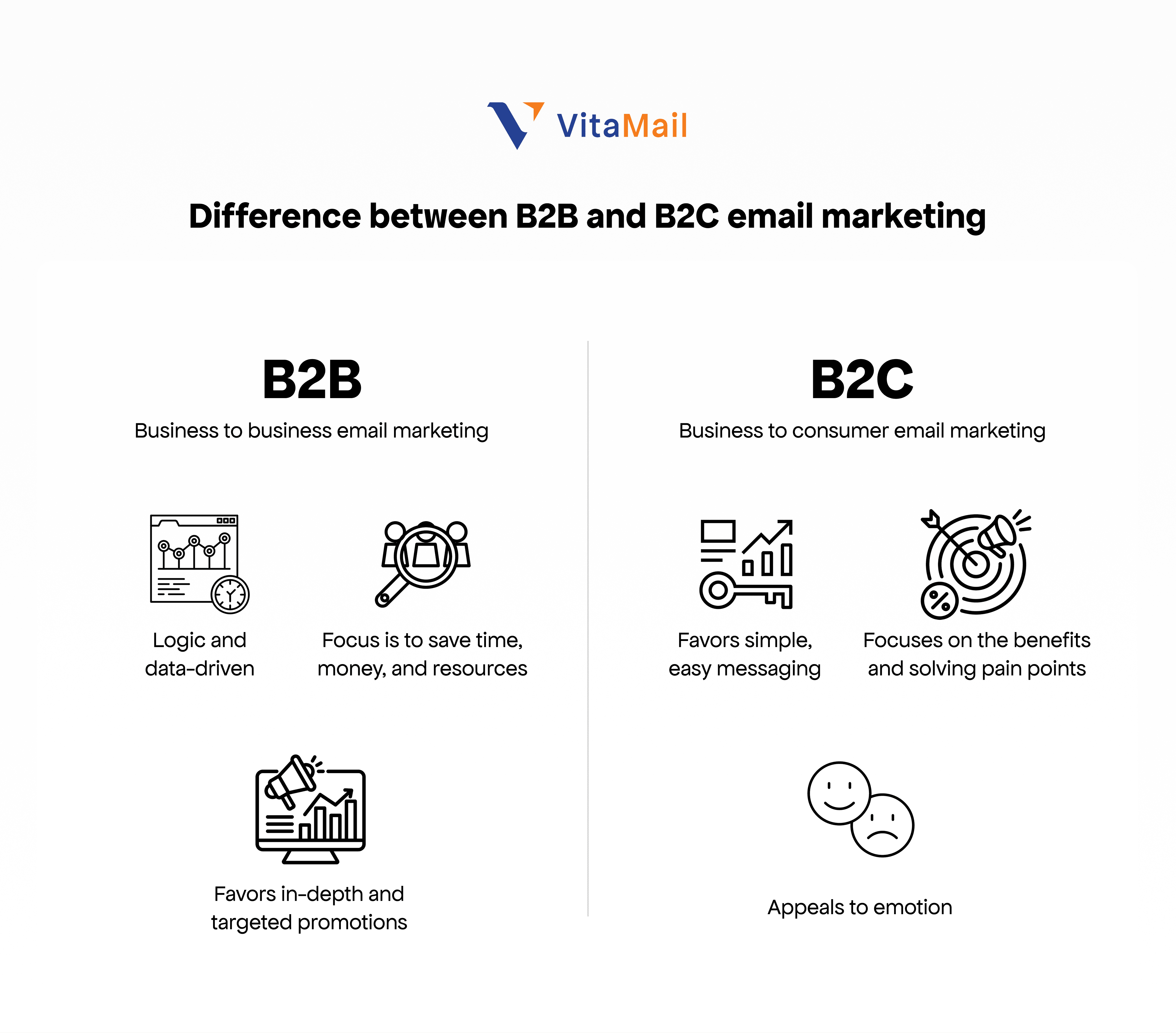
The biggest mistake in B2B email is treating it like B2C with a professional tone. B2B buying involves multiple stakeholders, longer evaluation periods, and higher stakes. A single clever email won't close a six-figure deal.
Difference between B2B and B2C Email Marketing
Most campaigns underperform because they ignore these dynamics. They blast the same message to an unsegmented list, treat every contact as if they have equal buying authority, and stop after one or two touches when the data shows it takes five to eight. The email marketing best practices below are built specifically for the complexity of B2B where timing, targeting, and trust matter more than volume.
Winning Tips for B2B Email Campaigns That Drive Pipeline
1. Build Your Campaigns Around the Buying Committee, Not a Single Contact
In B2B, one person rarely makes the purchase decision alone. A typical deal involves three to seven stakeholders: the economic buyer who controls the budget, the champion who advocates internally, the technical evaluator who assesses feasibility, and the end users who care about daily workflow impact.
Your email campaigns should reflect this. Map out the key roles in your target accounts and create messaging tracks for each. The CFO needs to see financial impact and risk mitigation. The department head needs to see operational efficiency. The IT lead needs to see security and integration details. Sending one generic sequence to every contact in an account is one of the most common and most expensive mistakes in b2b email marketing.
2. Adopt an Account-Based Email Strategy
Account-based marketing has transformed how the best B2B teams approach email. Instead of casting a wide net and hoping for individual responses, ABM focuses your efforts on a defined list of high-value target accounts and coordinates personalized outreach across multiple contacts within each one.
In practice, this means selecting your top 50 to 200 accounts based on firmographic fit and intent signals, identifying three to five contacts per account across different roles, and building email sequences tailored to each role's priorities. When the VP of Sales and the Head of RevOps at the same company both receive relevant, personalized emails within the same week, your brand occupies more mental real estate than a single cold email ever could. ABM email isn't about more volume it's about concentrated, strategic pressure on the accounts that actually matter.
3. Validate Your Contact Data Before Every Campaign Launch
B2B contact data degrades faster than most teams realize. People change roles, leave companies, and abandon inboxes constantly. Industry research shows that B2B email lists decay by 25 to 30 percent annually. Launching a campaign against stale data doesn't just waste sends — it actively damages your sender reputation with every bounce.
Make list validation a non-negotiable step before every campaign, not a quarterly cleanup task. Catch invalid addresses, spam traps, and role-based emails before they hit your sending infrastructure.
VitaMail's Email Validator checks every address in real time catching invalid, risky, and disposable emails before you launch. Clean data means better deliverability and more emails reaching real decision-makers.
4. Use Intent Data and Trigger Events to Time Your Outreach
Timing is everything in B2B, and the best teams don't rely on guesswork. Intent data signals that indicate a company is actively researching solutions in your category lets you prioritize accounts that are already in-market. Trigger events like new funding rounds, executive hires, product launches, or expansion announcements create natural conversation openers that make your outreach feel timely rather than random.
Build workflows that monitor your target accounts for these signals and automatically move them into active email sequences when a trigger fires. An email that arrives the week after a company announces a new VP of Sales feels relevant. The same email six months earlier feels like noise. This approach is one of the most underused b2b marketing strategies, yet it consistently produces the highest reply rates.
5. Architect Multi-Stage Nurture Flows for the Long Sales Cycle
B2B sales cycles run weeks to months. A single email or even a short three-email sequence won't carry a prospect from awareness to closed-won. You need multi-stage nurture flows that match the buyer's journey: awareness, consideration, evaluation, and decision.
At the awareness stage, share industry insights and original research that positions your brand as a thought leader. During consideration, introduce case studies and comparison frameworks that help the prospect evaluate their options. At evaluation, deliver ROI calculators, implementation guides, and social proof from companies similar to theirs. At the decision stage, provide direct access to sales, custom proposals, and urgency-creating offers. Each stage should have its own email sequence with content calibrated to what the buyer needs to move forward — not what you want to sell.
6. Align Sales and Marketing on Shared Email Workflows
One of the most damaging patterns in B2B is when marketing sends nurture emails and sales sends separate outreach to the same contacts with no coordination. The prospect receives conflicting messages, different CTAs, and sometimes completely different value propositions all from the same company.
Fix this by building shared workflows. Define clear handoff points: marketing owns the nurture until a lead hits a qualification threshold (MQL or engagement score), then sales takes over with a personalized sequence. Use a shared CRM or automation platform so both teams can see every touchpoint. Recruitment teams can apply a similar approach to their hiring efforts by using recruitment marketing strategies to attract candidates, nurture relationships, and maintain engagement throughout the hiring process. Agree on messaging pillars so the tone and positioning stay consistent regardless of who's sending. Sales-marketing alignment on email isn't a nice-to-have; it's the difference between a coordinated buying experience and a confused prospect who goes dark.
7. Score and Prioritize Leads Based on Engagement Signals
Not every email subscriber deserves the same level of attention. Lead scoring assigns point values to specific behaviors: opening emails, clicking links, downloading content, visiting pricing pages, replying so your team can prioritize the contacts most likely to convert.
A contact who opened your last three emails and visited your case study page is worth a personal follow-up from sales. A contact who hasn't engaged in 90 days needs a re-engagement sequence or should be moved to a low-frequency nurture track. Without lead scoring, your sales team wastes time chasing cold contacts while warm opportunities slip away. Implement even a basic scoring model and your pipeline efficiency will improve immediately.
8. Protect Deliverability with Proper Sending Infrastructure
B2B deliverability requires more than just writing good emails. Your technical infrastructure determines whether those emails reach the inbox or disappear into spam. At minimum, configure SPF, DKIM, and DMARC authentication on every sending domain. Use a dedicated subdomain for outbound campaigns to isolate reputation from your primary corporate domain. If you're launching outreach from a new domain, warm it up gradually over two to four weeks before scaling volume.
Monitor your domain health continuously. Sender reputation can shift based on bounce rates, spam complaints, and engagement metrics and once it drops, recovery takes weeks.
Tip: VitaMail's Domain Checker runs a free scan of your sending domain and flags SPF, DKIM, and DMARC issues before they tank your deliverability.
9. Create Role-Specific Email Content, Not Generic Templates
B2B buyers at different levels of the organization consume information differently. C-suite executives want strategic outcomes and business impact in three sentences. Directors and VPs want operational details and proof points. Individual contributors want technical specs and workflow implications.
Write separate email templates for each persona in your ICP. A cold email to a CTO should reference architecture, scalability, and security. The same campaign targeting a Head of Marketing should emphasize pipeline impact, reporting, and team productivity. This requires more upfront work, but role-specific messaging consistently outperforms one-size-fits-all templates by two to three times in reply rates.
Tip: Need help drafting persona-specific emails fast? VitaMail AI Email Generator professional, tailored B2B emails based on your target role, goal, and industry in seconds.
10. Run Controlled Experiments on Every Campaign Element
The best B2B email teams treat every campaign as a testing opportunity. But effective testing requires discipline: change one variable at a time and measure the right metric for that variable. The same principle applies to recruiting email templates, where testing different subject lines, messaging, and calls to action can help identify what drives more responses.
Test subject lines against open rates. Test CTAs against click-through rates. Test email length against reply rates. Test send days and times against engagement patterns for your specific audience. Run each test with a large enough sample to get statistically meaningful results — typically at least 200 to 300 recipients per variant. Document every test, build a shared knowledge base of what works for your ICP, and compound those learnings across every future campaign. The teams that systematize testing don't just improve incrementally they build a durable competitive advantage in their outbound engine.
B2B Email Mistakes That Quietly Destroy Pipeline
Even strong campaigns fail when these foundational errors are in play: targeting individual contacts without mapping the full buying committee at the account, sending the same nurture sequence to a CTO and a junior analyst, launching campaigns without validating contact data and watching bounce rates climb, running marketing and sales email sequences in parallel with no coordination, ignoring engagement signals and treating every lead with equal priority, and failing to authenticate your sending domain until deliverability is already damaged. Eliminating these mistakes often delivers bigger results than any single tactic.
Turn B2B Email into Your Most Reliable Pipeline Channel
B2B email marketing works when you treat it as a strategic system, not a series of isolated sends. Map your buying committees, align your sales and marketing workflows, build multi-stage nurtures that match the buyer's journey, and protect your deliverability with clean data and proper infrastructure. These aren't shortcuts, they're the compounding habits that turn email into a predictable, scalable revenue engine.
VitaMail gives you the complete B2B email toolkit from AI-powered email and subject line generation to real-time email validation and domain health checks. Build campaigns that reach the right people, land in the inbox, and convert. Start Today!