




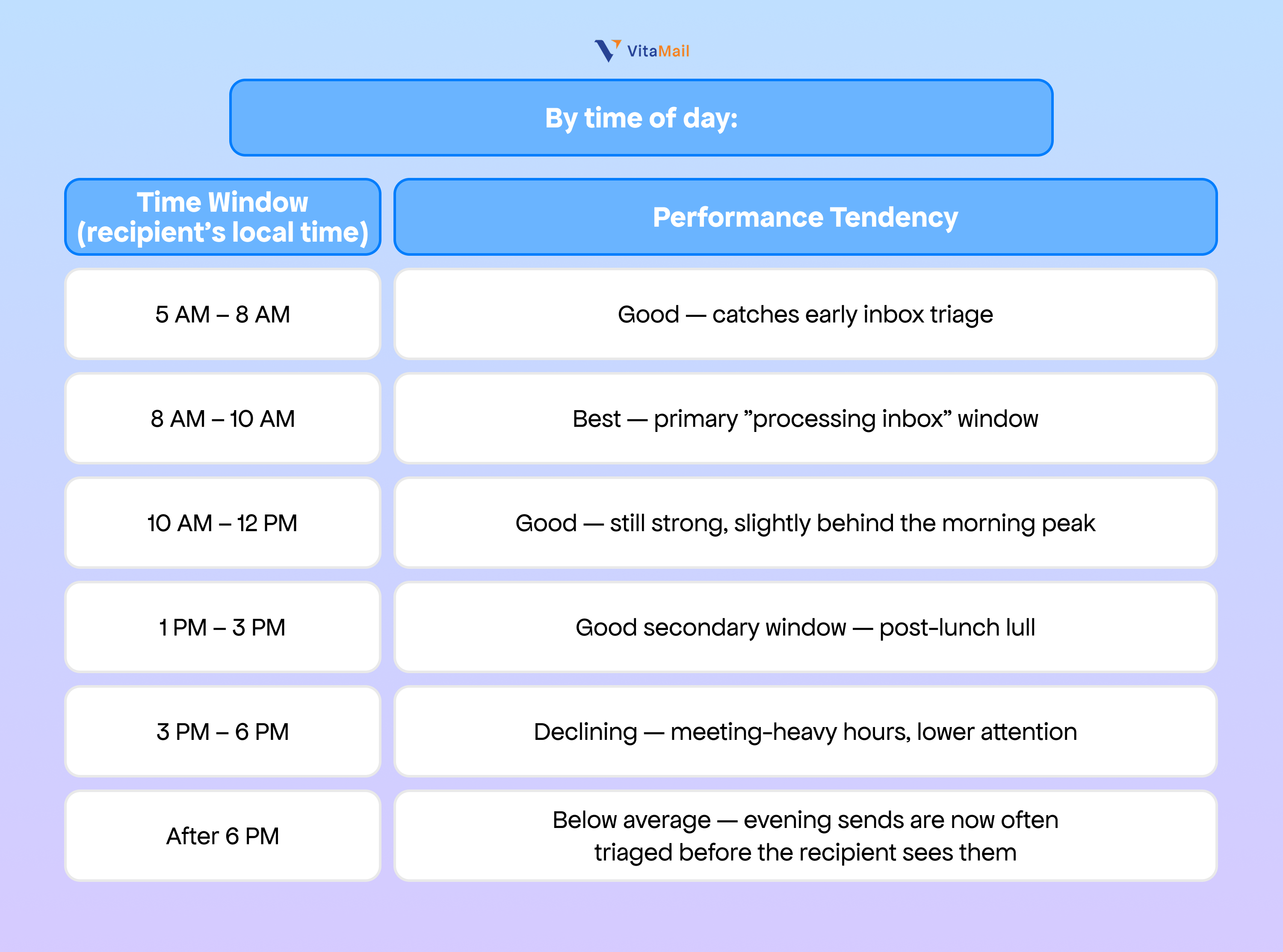
The best time to send cold emails is Tuesday through Thursday, between 8 AM and 10 AM in the recipient's local time zone, with a secondary window in the early afternoon around 1–3 PM. Wednesday most consistently edges out other days for reply rate, while Monday mornings and Friday afternoons are the two windows to actively avoid — Monday inboxes are backlogged from the weekend, and Friday attention is already checked out.
That's the answer you can act on today. The reasoning behind it — and why timing alone won't fix a campaign with the wrong list or generic copy — is below.
Best Days and Times: The Benchmark Data
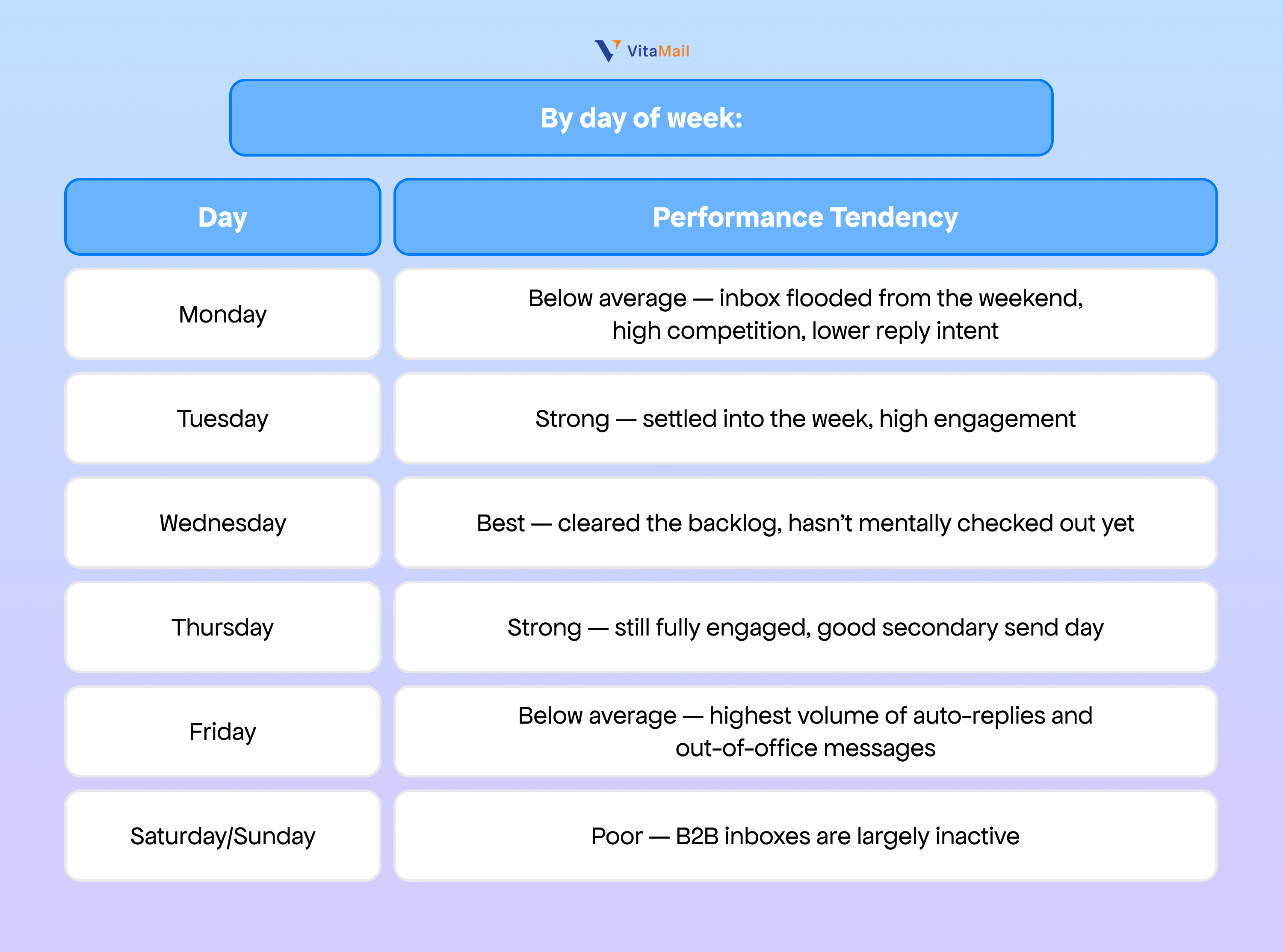
Cold email platform data analyzing billions of sends found Wednesday consistently delivers the highest engagement metrics because prospects have settled into the week but haven't yet started winding down for the weekend, while Friday sees the highest volume of auto-replies as prospects set out-of-office messages and prepare for the weekend. A separate 2026 benchmark analysis of B2B reply rates found that the best weekday for B2B email response rates is Tuesday, followed by Wednesday and Thursday, with reply rates 30% to 45% higher than Monday or Friday sends.
Why Timing Works This Way
Why does inbox competition change by hour?
Every inbox has a rhythm of attention, and cold email is competing against everything else arriving at the same moment — internal Slack-to-email escalations, calendar invites, newsletters, and other outreach. Sending into the 8–10 AM window means landing while the recipient is actively processing their inbox rather than sitting buried under dozens of messages that arrived overnight. Send later in a busy meeting-heavy afternoon and an email that would have gotten a glance at 9 AM gets scrolled past entirely.
Why is Monday morning bad and Friday afternoon worse?
Both are edge-of-week psychology problems, not deliverability problems. Monday morning inboxes are full of everything that accumulated over the weekend, so a new cold email competes with a backlog rather than getting first-look attention. Friday afternoon is the opposite problem — attention has already shifted to wrapping up the week, and Friday sends generate the highest share of auto-replies and out-of-office bounces of any day, meaning a real share of "sent" Friday emails never get a human read at all.
Does time zone matter more than day of week?
For any list spanning more than one region, yes — time zone alignment usually matters more than picking the "perfect" day. An email sent at the ideal Wednesday 9 AM Eastern slot lands at 6 AM Pacific or the middle of the night in Europe, which defeats the purpose of timing it at all. Segmenting a list by recipient time zone before scheduling is a bigger lever than debating Tuesday versus Wednesday.
Do executives and individual contributors behave differently?
Yes. Senior decision-makers tend to process email in tighter windows around meetings — often early morning before the day's calendar fills in, or late in the evening catching up — while individual contributors check email more continuously throughout the day. If your list skews toward VP or C-suite titles, the very-early-morning window (5–8 AM local) is worth testing specifically for that segment rather than assuming the general 8–10 AM benchmark applies uniformly across seniority levels.
Timing Isn't the Whole Story
Here's the part most timing guides skip: a perfectly-timed email still fails if it's sent to a bounced address, a contact who left the company eight months ago, or a generic pitch that doesn't match anything about the recipient's actual situation. Timing affects whether an email gets seen — it does nothing for whether the email is relevant once it is. Cold email platforms that have analyzed reply-rate data at scale consistently rank data quality and message relevance ahead of send timing; one 2026 benchmark study framed it directly: the priority stack is data quality first, then personalization and offer relevance, then timing, then follow-up cadence — timing is lever three, not lever one.
That ordering matters because timing has a ceiling. You can hit the ideal Wednesday 9 AM slot on every send and still post a flat 1% reply rate if half your list bounces or the message reads like it was written for anyone. Fresh, verified contact data and messaging that's actually personalized to the recipient move the reply-rate needle more than shaving an hour off your send window ever will — see our full breakdown of what counts as a good open and reply rate for cold email for the numbers behind that claim.
How to Actually Time Your Sends
- Segment your list by recipient time zone before scheduling anything — a single "send at 9 AM" rule across a multi-region list guarantees some recipients get it at 3 AM.
- Default to Tuesday–Thursday, 8–10 AM local time as your starting window, then let your own reply data adjust it.
- Avoid Monday before 10 AM and Friday after 1 PM unless your own data specifically shows otherwise for your audience.
- Stagger sends rather than batch-firing an entire list at one timestamp — natural, spread-out sending patterns look less automated and perform better than a single 6 AM blast.
- Test one variable at a time per segment — run the same message at two time windows on comparable audience slices for at least 2–3 weeks before drawing conclusions; anything under a few hundred sends per variant is noise.
- Track reply rate, not open rate, as your timing signal — open rate is increasingly inflated by automatic pixel loading and won't tell you if a human actually engaged.
- Automate send-time optimization once you have data, rather than guessing manually indefinitely — most sending platforms can stagger and schedule by recipient time zone automatically once you've defined the target windows.
Get the Timing Right, Then Fix What Timing Can't
Once your send windows are dialed in, the bigger unlock is making sure every one of those well-timed emails is actually landing on a real, current contact with a message built for them specifically. A perfectly-timed send to a stale or bounced address still wastes the slot — and no amount of subject-line testing recovers a reply rate capped by list decay. VitaMail's real-time lead verification checks contacts before they enter a sequence, so your best sending windows aren't spent on addresses that were never going to open anything. Paired with AI-personalized subject lines and copy, the goal is a campaign where timing gets the email seen and the message itself earns the reply. You can see how the two fit together on the VitaMail solutions page.

