



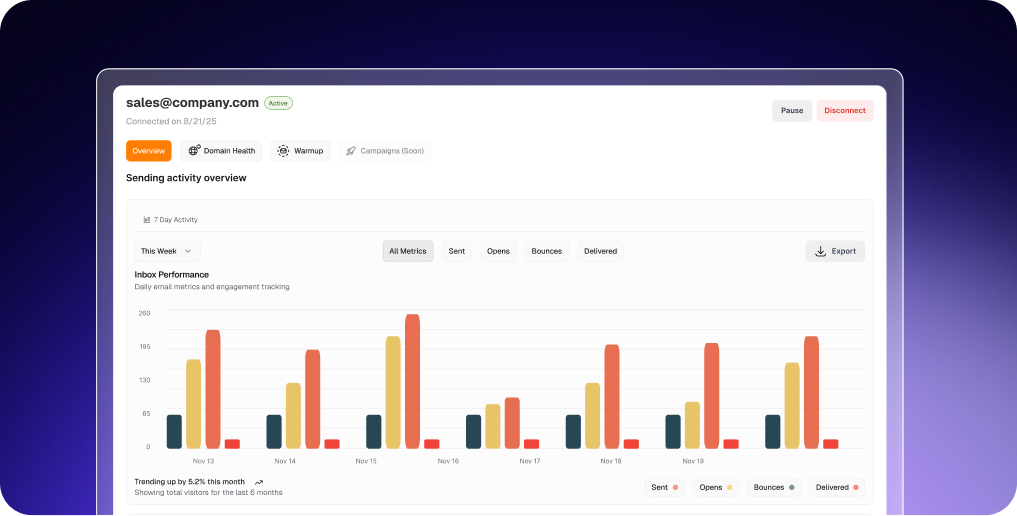


A good open rate for email is generally 20% to 35% for marketing newsletters, 25% to 45%+ for cold outreach, and 50% to 80%+ for transactional and welcome emails. Anything below 15–17% for marketing email or below 20% for cold email usually signals a subject line, list quality, or deliverability problem worth investigating. There's no single universal number — the right benchmark depends entirely on what type of email you're sending.
That said, open rate has gotten noisier since Apple's Mail Privacy Protection (MPP) started auto-opening tracking pixels for a large share of inboxes, which is why the ranges below matter more than any one "magic number."
Open Rate Benchmarks by Email Type
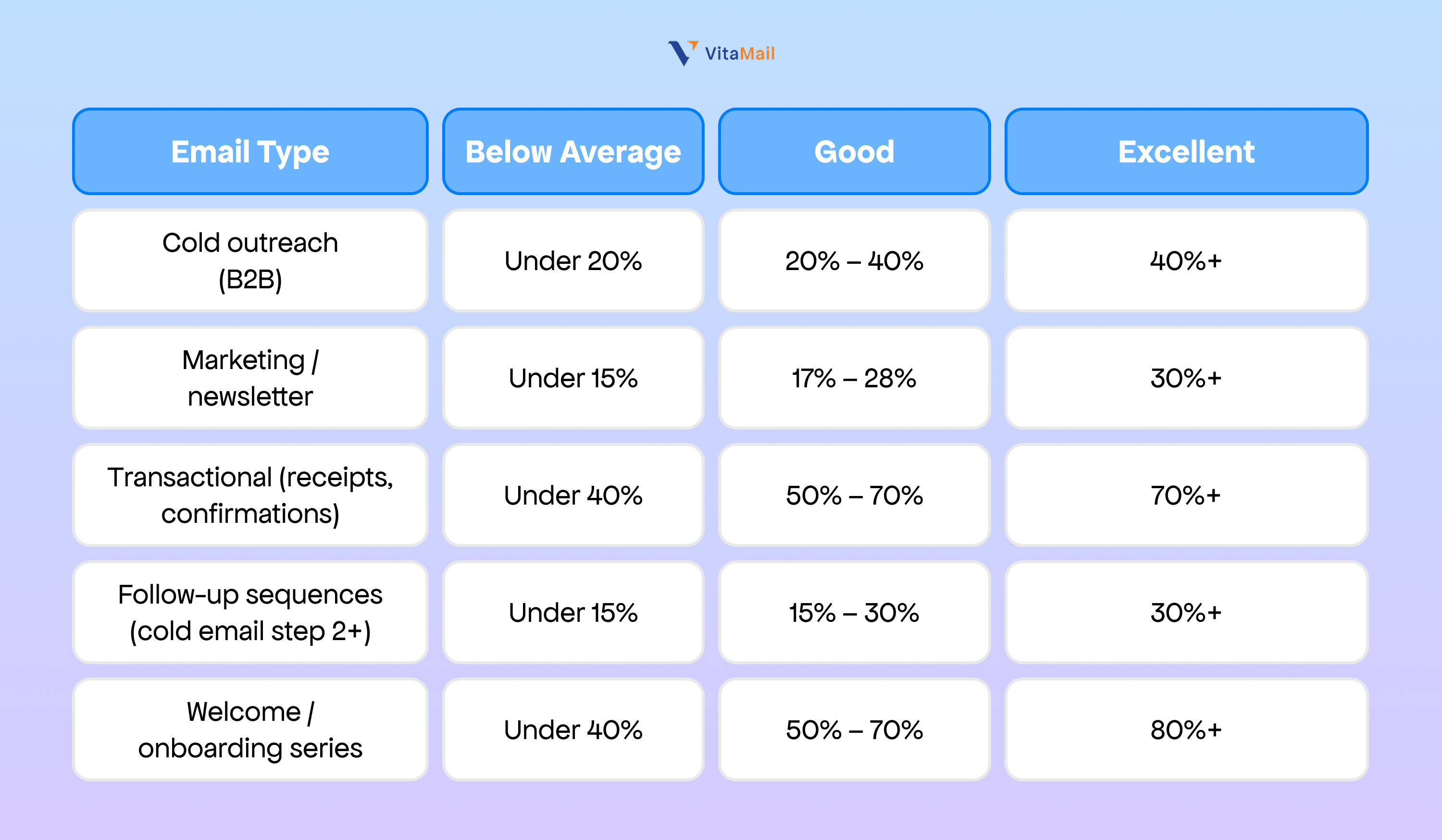
For context on the "average" side of that table: Mailchimp's benchmark data puts the average open rate across all industries at 21.33%, while cold email benchmark data shows the 2026 B2B average open rate sitting at 27.7%, alongside an average reply rate of 3.43%. Welcome emails are the outlier at the top — they typically see open rates above 80% because the recipient is expecting and wants that email.
(Flag for verification before publishing: benchmark percentages shift by 3-5 points across sources and update roughly annually — pull the latest Mailchimp, HubSpot, and Instantly/Amplemarket reports before this goes live to confirm current figures.)
What Affects Your Open Rate?
Does the subject line actually matter that much?
Yes — it's still the single biggest lever you control. Subject lines determine whether an email gets opened before anything else about the message is seen, and personalized or context-specific subject lines meaningfully outperform generic ones. Industry data on cold email specifically shows customized subject lines improving open rates by roughly 50%. Vague, salesy, or clearly templated subject lines get filtered out mentally by the recipient even if the email lands in the primary inbox — the subject line has to earn the open, not just announce the sender.
How much does sender reputation affect open rates?
More than most people realize. If your domain, IP, or account has a poor sending history — high bounce rates, spam complaints, inconsistent volume, or misconfigured authentication records — inbox providers route more of your mail to spam or promotions before the recipient ever sees a subject line. A "great" subject line on a poorly reputed domain will still underperform, because the email isn't reaching the primary inbox in the first place. Bounce rate above roughly 2-3% is typically the threshold where sender reputation starts degrading measurably.
Does list quality and freshness change the numbers?
Substantially. Sending to stale, unverified, or purchased contact lists inflates your bounce rate, which damages domain reputation, which suppresses inbox placement for every subsequent send — a compounding effect. Verified, recently-checked lists consistently outperform older or unverified ones because fewer of the recipients are dead addresses, catch-alls, or spam traps that never would have opened anything regardless of subject line quality.
Does personalization really move the number?
Yes, and increasingly it's less about inserting {first_name} and more about relevance. Behavior-based and context-aware personalization — referencing something specific and true about the recipient's role, company, or situation — outperforms generic broadcast sends by a wide margin. This is a bigger factor in cold outreach than in newsletters, since cold recipients have no existing relationship with the sender to fall back on.
Does send time matter?
It has a modest but real effect. Tuesday and Wednesday sends tend to outperform Monday (inbox triage day) and Friday across most industries and email types. Send-time effects are smaller than subject line or deliverability effects, but they're free to test and worth optimizing once the bigger levers are handled.
Does my industry change what's "good"?
Considerably. Government, nonprofit, and education emails post some of the highest open rates because recipients have an existing institutional relationship with the sender, while retail, e-commerce, and SaaS-to-SaaS cold outreach tend to run lower because inboxes in those categories are more saturated with competing pitches. Compare your numbers to your specific vertical, not the blended "all industries" average — a 22% open rate might be mediocre for a nonprofit newsletter and excellent for SaaS cold outreach.
Why Open Rate Alone Isn't Enough
Open rate used to be a clean signal. It isn't anymore. Apple's Mail Privacy Protection automatically pre-loads tracking pixels for a large share of inboxes regardless of whether a human ever reads the email, which inflates reported open rates across the board and makes them directional at best rather than precise. Several 2026 benchmark reports put cold email open rates anywhere from 27.7% to over 40% depending entirely on how each report accounts for MPP.
For cold email specifically, reply rate — and more usefully, positive reply rate — is the metric that actually tells you whether a campaign is working. Reply rate can't be inflated by a pixel; a reply means a real person read the email and decided to respond. A 2-3% reply rate is roughly average for B2B cold outreach in 2026, with 5-10% considered strong and 10%+ reserved for tightly targeted, well-personalized campaigns.
The gap between a healthy open rate and a weak reply rate is almost always explained by one of two things: the list is full of the wrong people (targeting problem), or the message doesn't feel written for the person reading it (personalization problem). This is where verified, fresh lead data and hyper-personalized messaging matter more than open-rate optimization tricks — they fix the reason someone doesn't reply, not just the reason they don't open.
How to Improve Your Open Rate: A Checklist
- Verify your list before every send. Bounces above 2-3% degrade sender reputation and suppress inbox placement on every future campaign, not just the one that bounced.
- Warm up new sending domains gradually. A cold domain sending high volume immediately looks suspicious to inbox providers and gets throttled or filtered.
- Write subject lines specific to the recipient's situation, not generic value propositions — reference something concretely true about them.
- Clean your list of inactive contacts on a regular cadence rather than letting dead weight drag down your engagement rate and your sender score together.
- Personalize beyond the first name — reference role, company context, or a real trigger event when possible.
- Test send times for your specific list, starting with Tuesday/Wednesday mornings as a baseline.
- Keep a consistent, predictable sending volume rather than erratic bursts, which inbox providers flag as spam-like behavior.
- Use real-time verification at the point of list-building, not just a one-time cleanup — catching bad or risky addresses before they ever enter a sequence keeps bounce rate low and protects the domain reputation that determines whether your subject line ever gets seen at all.
A Note on Fixing the Root Cause, Not Just the Symptom
Most open-rate advice treats the symptom — better subject lines, better send times — without addressing why the underlying number is weak in the first place: a list with too many stale or mismatched contacts, and messaging that isn't specific enough to the recipient. If you're trying to actually improve these numbers rather than just measure them, tools that combine real-time, verified lead data with AI-personalized messaging address the root cause instead of the symptom. VitaMail approaches it this way — verifying contacts before they enter a send to protect deliverability, and generating personalized subject lines and copy so the message earns the open rather than relying on volume. You can see how the two pieces fit together on the VitaMail solutions page.

