



Startups don't have a deliverability team. Most have a founder or a single engineer who needs password resets, OTPs, and receipts to just work, on a small budget, without burning a sprint on infrastructure a bigger company would have a whole role for. We compared four platforms that show up on nearly every serious shortlist in 2026, Mailtrap, Postmark, Twilio SendGrid, and Mailgun, on free tier limits, setup time, deliverability architecture, and what happens to the bill once you outgrow the free plan.
This covers developer-facing transactional email, sent through an API or SMTP relay to trigger OTPs, receipts, and account alerts from inside a product. If you're a small business owner or marketer who wants email list verification and AI-assisted campaign tools instead, VitaMail is built for that audience specifically.
Key Takeaways:
- Choose a transactional email platform based on your product's needs
- Mailtrap's free plan includes 4,000 emails/month, while Postmark offers a 100-email trial before requiring a paid plan.
- Only 14.9% of domains have a DMARC record, making email authentication a common deliverability gap.
- Separate transactional and marketing email streams early to protect critical emails like OTPs and password resets.
- Validate email addresses before sending to reduce bounces and protect your sender reputation
Best Transactional Email Platforms for Startups
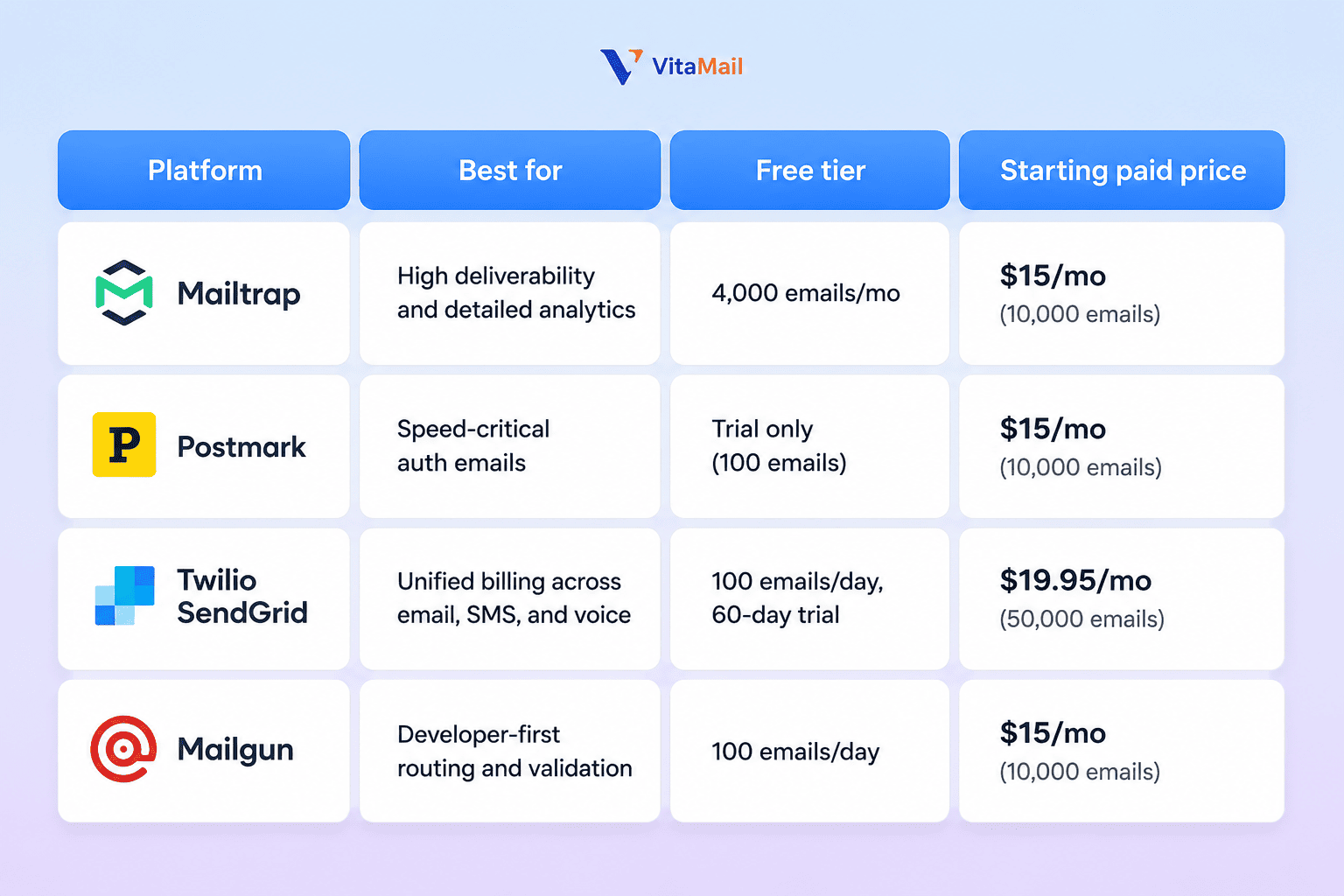
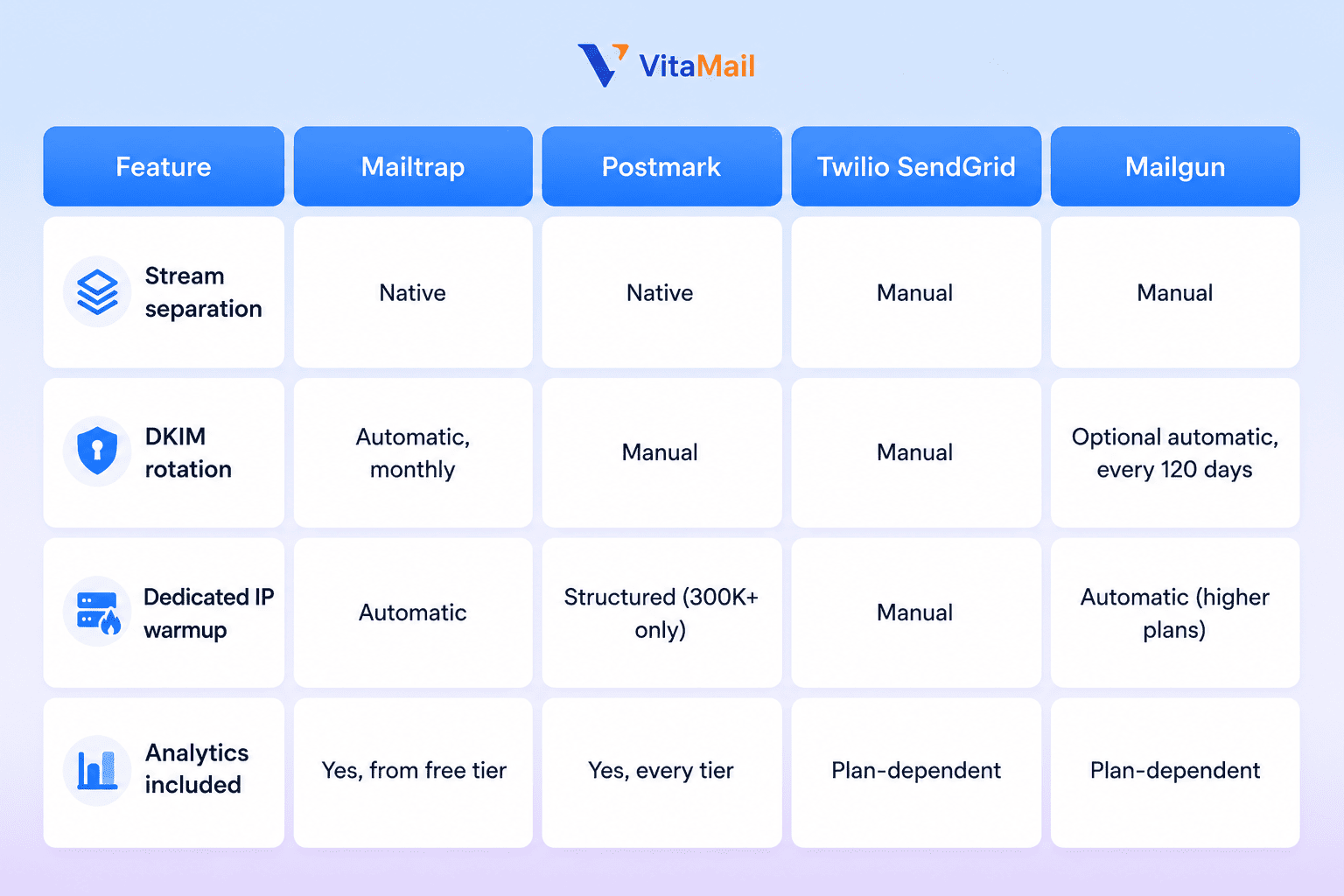
Each of the four fits a different kind of team. Mailtrap includes native stream separation, DKIM keys that rotate automatically every month, and analytics on the free tier without extra configuration. Postmark is built around speed on auth-critical sends, Twilio SendGrid suits teams already billing through Twilio, and Mailgun fits developers who want more control over routing.
How to Choose a Transactional Email Platform
- Mailtrap is for teams that want deliverability infrastructure, stream separation, DKIM rotation, dedicated IP warmup, handled from day one.
- Postmark is for products where auth emails and magic links need to land in seconds.
- Twilio SendGrid is for startups already inside the Twilio ecosystem that want email, SMS, and voice on one bill.
- Mailgun is for developer teams that want granular routing, tagging, and pre-send validation control.
Mailtrap
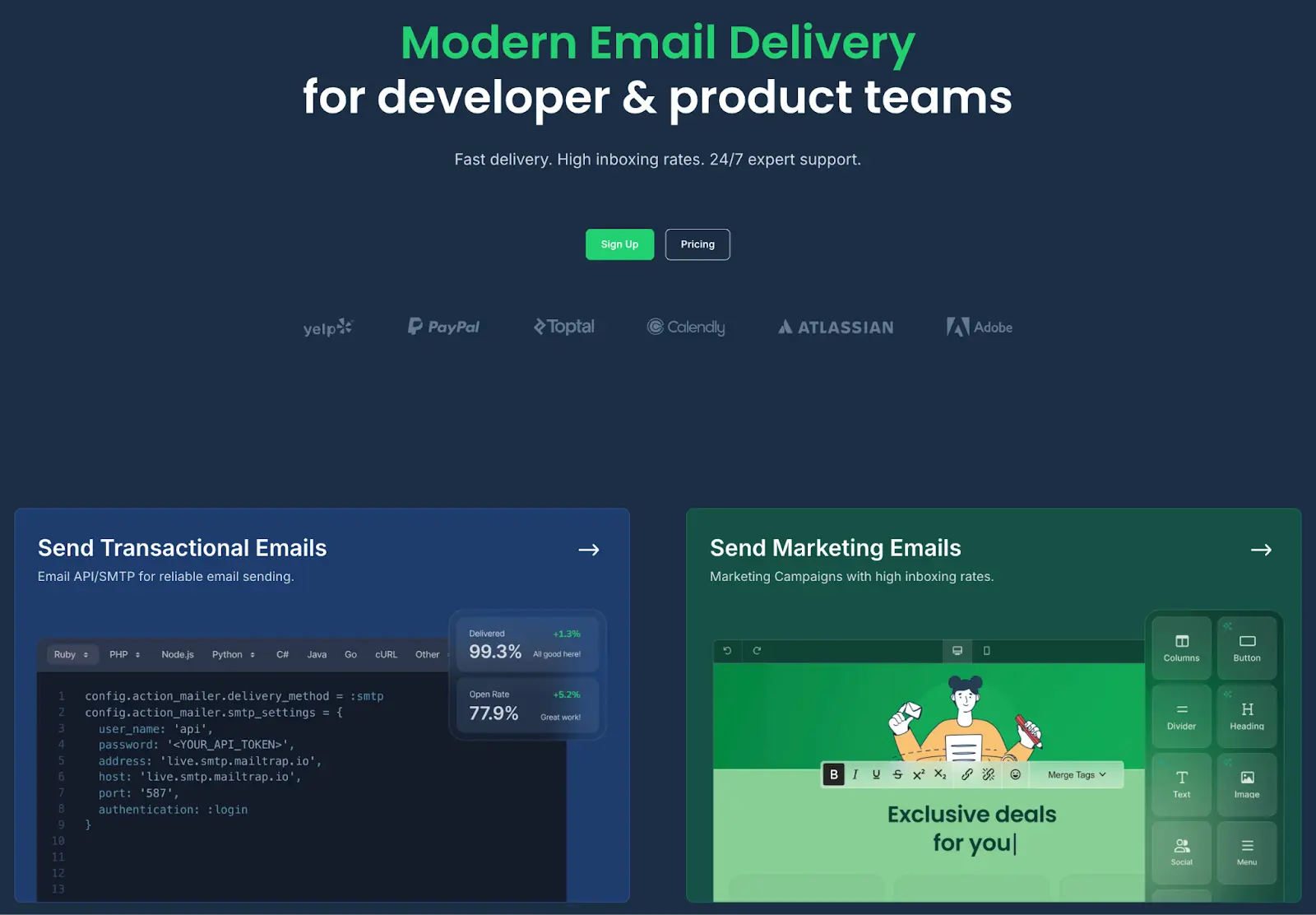
Mailtrap is a transactional email platform for startups, developer and product teams to send emails at scale with high inbox rates and detailed analytics. It ships as a REST API, an SMTP service, and an MCP server, so it drops into whatever a startup's stack already expects without custom glue code, with stream separation built into every account from the start.
- SPF, DKIM, and DMARC configure automatically once you add the DNS records, and DKIM keys rotate on their own every month.
- SDKs cover Node.js, Ruby, PHP, Python, .NET, Elixir, and Java, plus framework snippets for Laravel, Django, and Rails. The MCP server lets tools like Claude Code or Cursor send email directly.
Setup runs about five minutes from account creation to first send. The free plan covers 4,000 emails a month; Basic starts at $15/mo for 10,000 emails, Business at $85/mo for 100,000 (with a dedicated IP and automatic warmup included).
Steal this: build stream separation into your sending setup before you ever add a marketing tool, not after a spam complaint forces the split.
Postmark
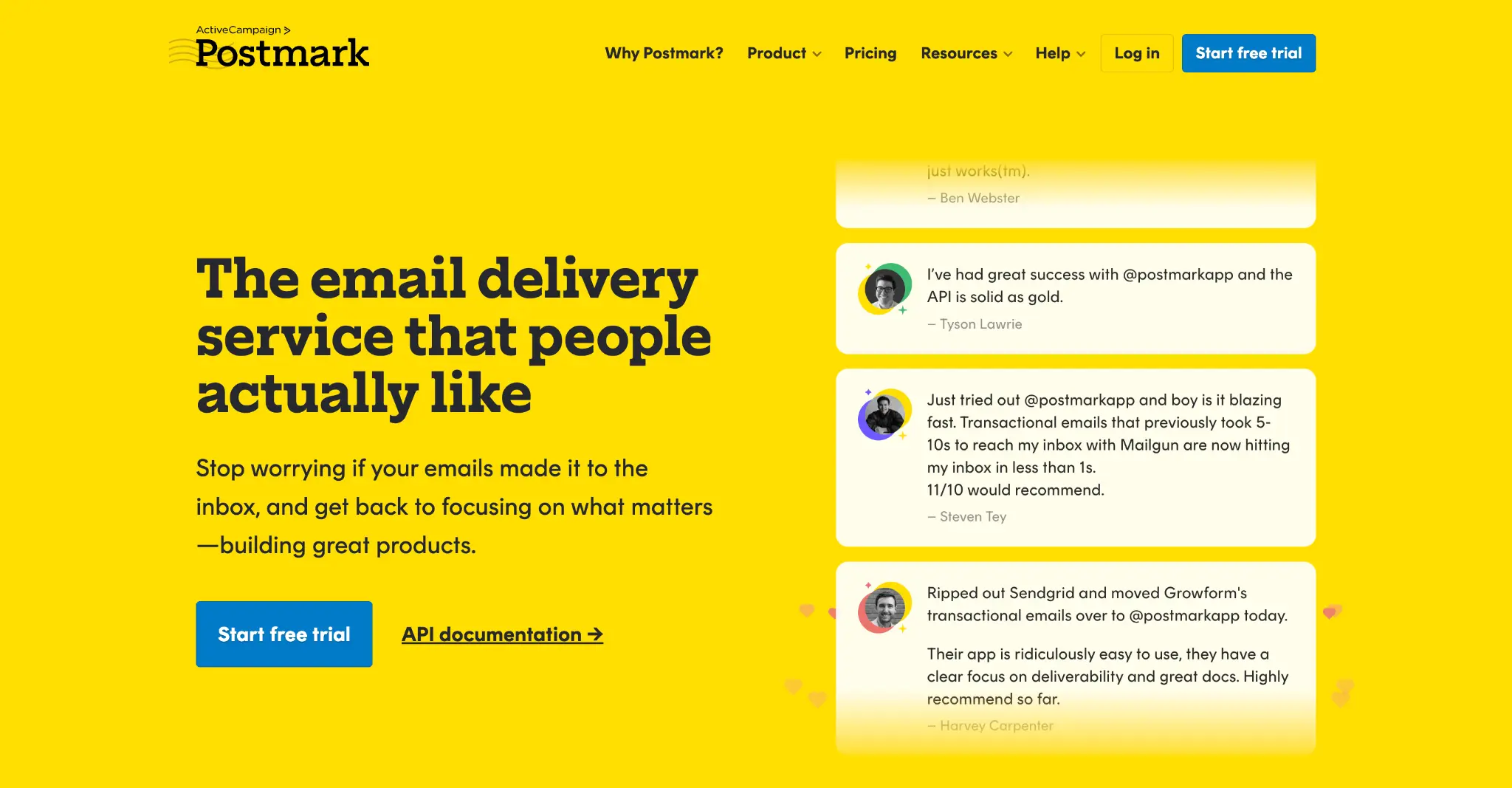
Postmark is a transactional email service for startups to get time-critical auth emails and magic links into the inbox in seconds. Broadcast message streams now handle occasional marketing or release-note sends through the same account, kept on separate infrastructure from your password resets. Every new account still goes through a manual review before live sending turns on, which is part of why its shared IP pools stay clean.
- Message Streams separate transactional, broadcast, and inbound traffic at the infrastructure level, so a bulk send can't slow down a password reset.
- Bounce classification is granular: hard, soft, transient, and spam complaints are tracked and suppressed separately, which matters more than it sounds like until you're debugging a delivery problem at 11pm.
There's no permanent free plan, just a 100-email trial. Paid plans start at $15/mo for 10,000 emails and climb to $115-138/mo at 100,000. Dedicated IPs cost $50/mo but only unlock at 300,000-plus emails a month.
Steal this: budget for speed specifically when an email stands between a user and what they're trying to do right now.
Twilio SendGrid
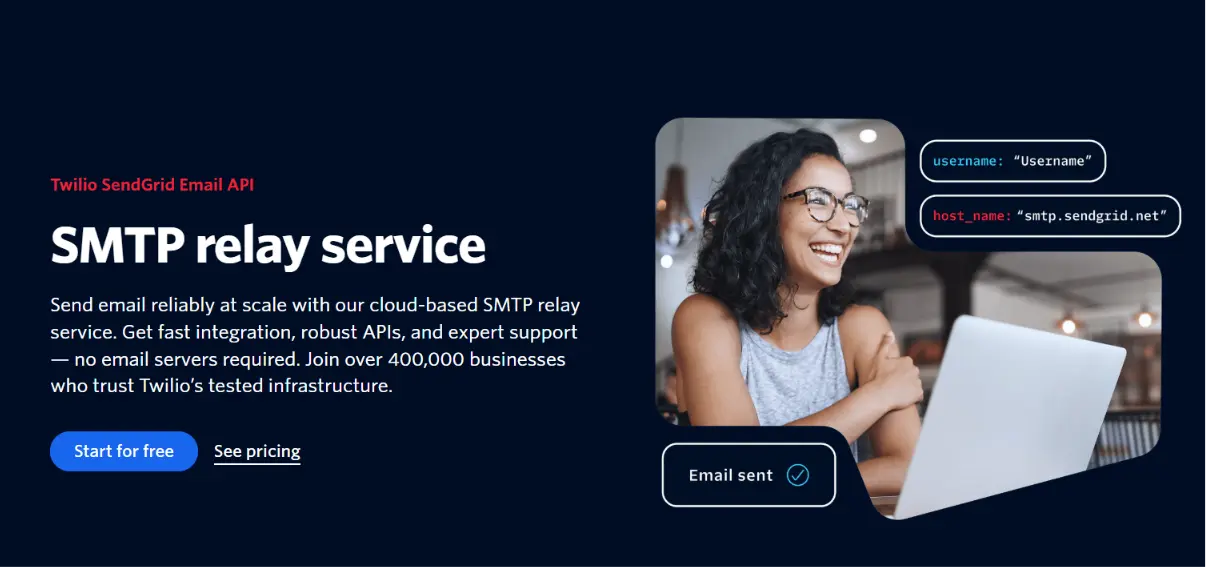
Twilio SendGrid is a transactional email API for startups already spending money with Twilio on SMS or voice, to bring email onto the same account instead of adding a fourth vendor. It launched in 2009, was acquired by Twilio in 2019, and was folded fully into twilio.com in February 2026, and it carries wide SDK adoption.
- SPF, DKIM, and DMARC require manual DNS setup, and key rotation is on you. Stream separation isn't built in either; teams approximate it with IP pools or subuser accounts.
- Because it's Twilio, the same account can trigger SMS, WhatsApp, and voice calls, so an OTP flow with an SMS fallback stays on one bill.
The free plan gives 100 emails a day for a 60-day trial, then it expires. Essentials starts at $19.95/mo for 50,000 emails, Pro at $89.95/mo for 100,000.
Steal this: consolidate email onto whatever channel provider you're already paying for elsewhere before adding a fourth vendor to reconcile.
Mailgun
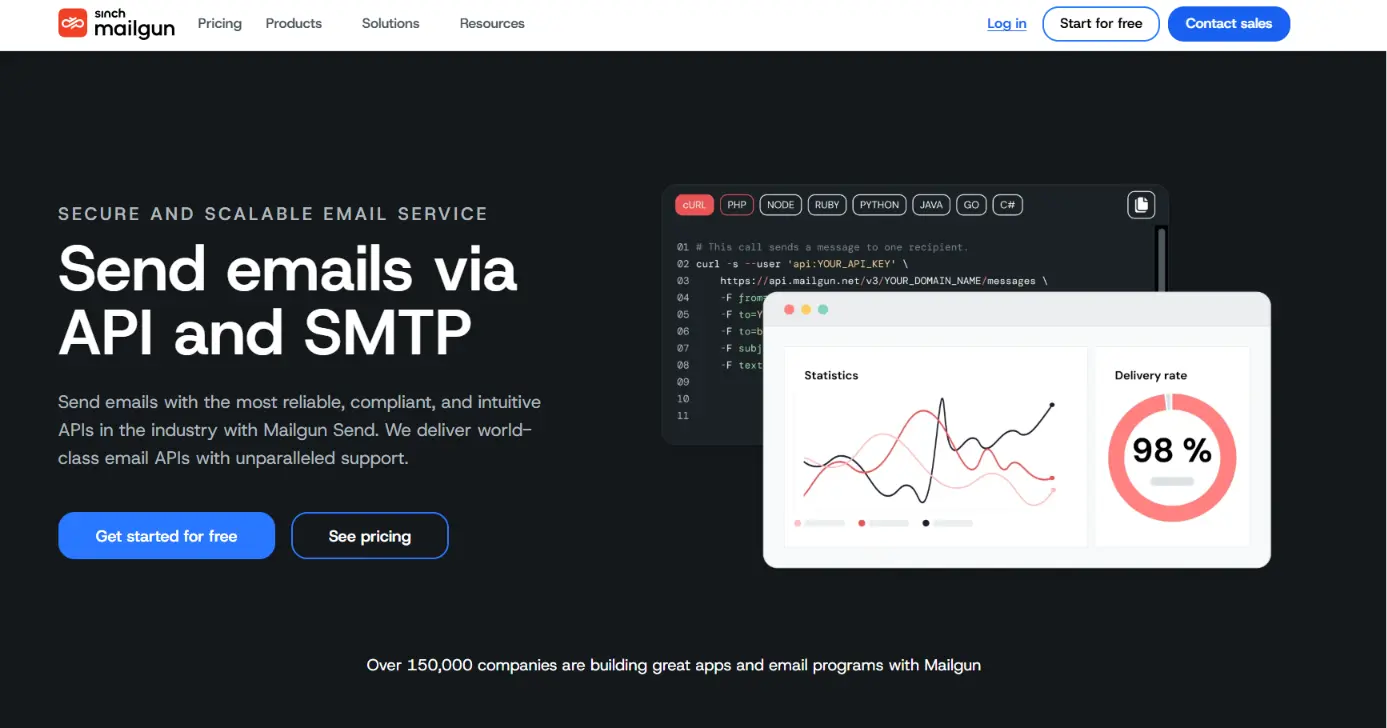
Mailgun is a transactional email API for developer-heavy startups to get granular control over how email actually moves, not just whether it sends. It's built for teams that want to own routing logic and validation rather than lean on a platform to guess at it.
- Both SMTP and a REST API are supported, with solid documentation for custom workflows.
- Lower-tier plans run on shared IP pools; dedicated IPs with automatic warmup show up on higher plans. Email validation is available as a paid add-on, with US and EU data regions for GDPR residency.
The free plan covers 100 emails a day, and paid plans start at $15/mo for 10,000 emails.
Steal this: validate addresses before you send, not after a bounce report tells you the list was bad.
Email Deliverability and Authentication Comparison
DMARC and DKIM are the records that prove an email really came from your domain, and most companies never get around to setting them up. Just 14.9% of domains worldwide have even a basic DMARC record in place, according to Red Sift's December 2025 analysis of 73.3 million domains, and that gap barely closes with company size: 76.2% among fast-growing Inc. 5000 companies versus 93.8% at the Fortune 500 (EasyDMARC 2025 DMARC Adoption Report). Even when it is set up, DKIM works like a signature that needs refreshing. The key ages, and a stale one is a quiet, slow-building cause of emails landing in spam weeks after everything looked fine.
Conclusion
The right transactional email platform for a startup comes down to how much infrastructure a small team is willing to build itself. Mailtrap fits teams that want deliverability handled by default, from stream separation to DKIM rotation. Postmark fits speed-critical auth flows, Twilio SendGrid fits teams already billing through Twilio, and Mailgun fits developers who want more control over routing. Whichever a startup picks, get SPF, DKIM, and DMARC configured before the first production send.