




You hit send on your brilliant email campaign. Five minutes later, your inbox explodes with bounce notifications, whether they’re soft and hard bounces rates, which hurts your sender score. Sound familiar? Here's the truth: your email list is probably rotting. Right now, as you read this, contacts are abandoning old addresses, switching jobs, and letting inboxes go stale. Every month you wait, more addresses turn toxic.
But here's the thing: a simple email check could have prevented this disaster. What exactly does "checking" an email mean? And why should you care before your next campaign goes live? Learning how to check email addresses properly is a survival skill in 2026's competitive inbox landscape.
Key Takeaways:
- Email lists go bad over time (around 2% each month), so checking addresses regularly helps you avoid bounces and protect your sender reputation.
- High bounce rates (above 2–5%) make email providers lose trust in you, which can push your emails into spam.
- Manual checks can catch basic issues, but automated tools are faster and more reliable, especially for large lists.
- Using an email verification tool helps you remove invalid, fake, or risky addresses before sending.
- Cleaning your list before every campaign saves money, improves results, and gives you more accurate performance data.
Why Checking Email Addresses Matters More Than Ever
A healthy email list is key to successful email marketing. It decides if your messages reach inboxes or get flagged as spam. Clean lists lower costs, protect your domain, and improve performance. Here’s why learning how to check email matters in 2026.
Avoid Bounces and Spam Complaints
Every bounced email sends a red flag to email providers. When your bounce rate climbs above 2-5%, Gmail and Outlook start viewing you as a potential spammer.Think of it like this: each bounce is a black mark on your record. Accumulate too many, and email providers assume you're either careless or malicious. Either way, your future emails end up in spam folders.
Protect Your Domain Reputation
Your sender reputation is tied directly to your sending domain and IP address. This reputation determines whether your emails reach inboxes or get filtered as junk. Too many bounces or complaints can permanently taint your domain's reputation, leading ISPs to classify your emails as spam automatically.
Once you're blacklisted, recovering your reputation takes months of careful list management and gradual volume increases. Prevention through email verification saves you from this lengthy rehabilitation process.
Save Money on Email Marketing
Most email marketing platforms charge based on list size. Keeping thousands of invalid addresses means you're literally paying to send emails into the void. By knowing how to check email lists properly, you will reduce wasted costs while improving real reach.
Improve Engagement Metrics
Clean lists produce better results. When you stop sending to dead addresses, your open and click rates naturally increase because your messages are only reaching people who are still active
You'll also get more reliable tracking data. Instead of measuring engagement against a mix of real subscribers and ghost addresses, you'll see accurate metrics that reflect genuine audience interest.
Manual vs. Automated Email Verification: What Works in 2026
When it comes to learning how to check if an email is valid, you've got two main options: do it yourself or use a tool that does it for you. Here's how each one works.
Manual Methods
Check Syntax and Format: Look for obvious errors like missing @ symbols, double @@ signs, or domains without extensions. An address like john.doe@company (missing .com) or jane@@example.com (extra @) won't work.
Verify Domain MX Records: Use DNS lookup tools to check if the domain has MX (Mail Exchange) records. No MX record means no email server, which guarantees bounces. If someone signs up as user@noexist123.com, a quick lookup reveals whether that domain can receive emails.
Google or LinkedIn Search: For business emails, search the address or person's name online. Working corporate emails often appear on LinkedIn profiles or company directories. If neither the person nor the email shows up anywhere, it might be fake.
Send a Test Email (Risky): You could send a message and see if it bounces, but this approach damages your sender reputation. It's like playing email roulette – one wrong move can hurt your ability to reach other recipients.
Automated Methods
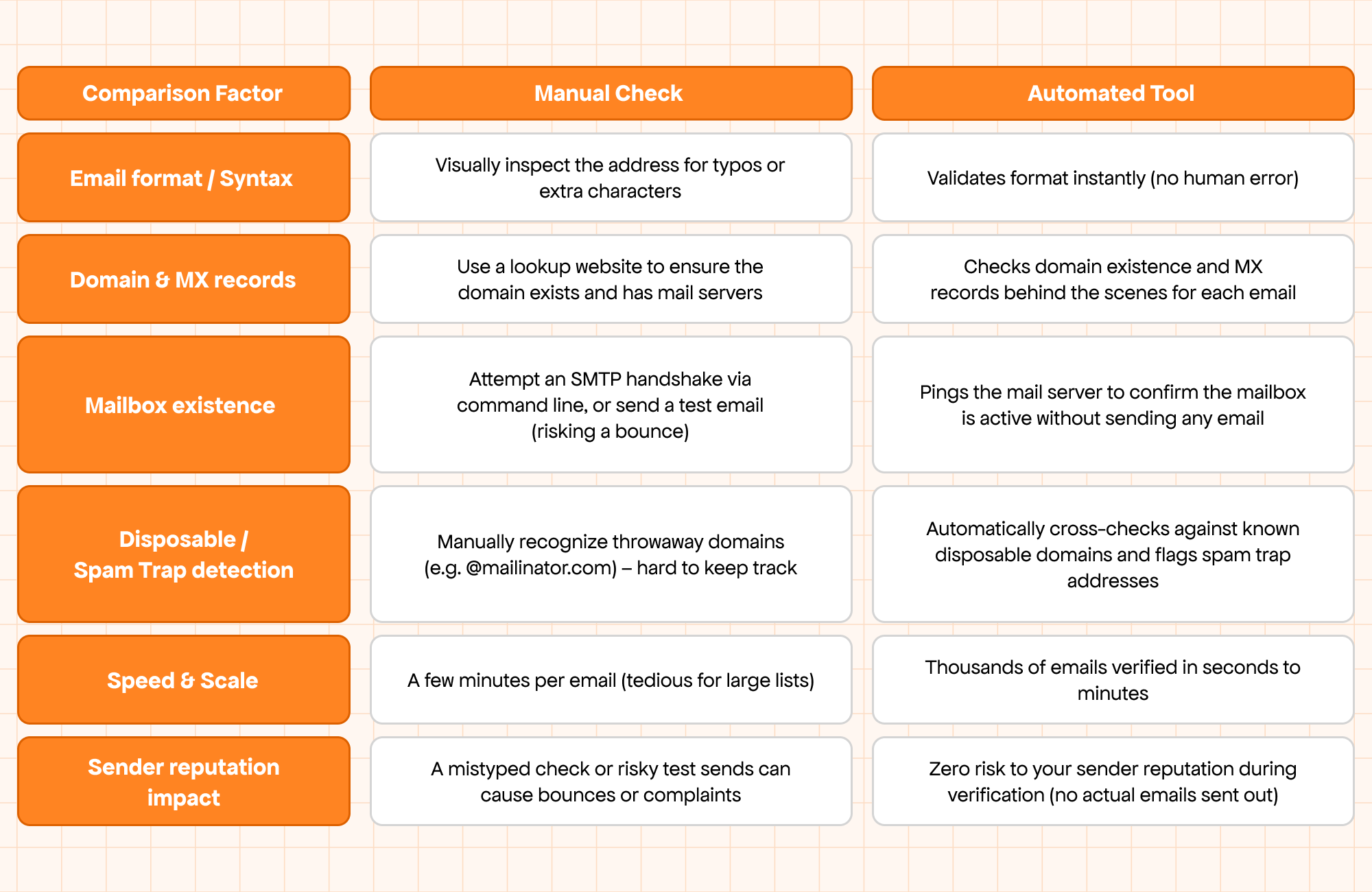
Professional email verification services automate all these checks instantly and safely. They verify syntax, check domains and MX records, ping mail servers to confirm mailbox existence, and filter out disposable domains or spam traps you'd never catch manually.
Here's how manual and automated methods compare:
Modern verifiers catch tricky cases like "catch-all" domains (which accept all emails) and role-based addresses like support@ or info@ that might not be ideal for marketing campaigns.
Ready to see what's actually in your email list? Most marketers are surprised by what they find when they run their first verification. Some discover their list is cleaner than expected. Others find out why their campaigns have been underperforming.

Why Email Validation Services Beat Manual Checking
Manual list checks may work for small lists, but they don’t scale. As lists grow, mistakes become easier to miss and harder to fix. Email validation services are designed to handle volume and catch issues. The points below explain why automated validation works better.
Speed and Efficiency
Email verifiers process massive lists in minutes. VitaMail's system handles over 100,000 emails per hour for bulk verification. What might take you days to check manually, automated services complete before your first coffee break.
Higher Accuracy
Quality services achieve 97-99% accuracy using multiple verification steps and real-time database checks. They catch nuances humans miss, like emails with valid formats hosted on domains without mail servers. Many services guarantee your bounce rate will stay below specific thresholds.
Hidden Risk Detection
Beyond basic validity, these tools flag spam traps, bots, and disposable emails that could harm your reputation. They maintain databases of temporary email domains (like 10-minute email services) and identify abuse addresses known for marking emails as spam.
They also spot role addresses (admin@, info@) that might not belong to individual people, helping you segment your approach accordingly.
Resource Savings
Every hour your team spends scrubbing email lists is time not spent on strategy or content creation. Automated services work 24/7, with many offering API integrations for real-time verification at signup.
Better Performance
Marketers who switch to verification services experience immediate improvements in their campaigns. Delivery rates and inbox placement improve, resulting in increased opens and clicks. Better sender scores from fewer bounces translate to higher ROI on email campaigns.
Best Free Email Verification Tools for 2026
Several excellent tools let you check email validity for free, and they're much faster than manual methods:
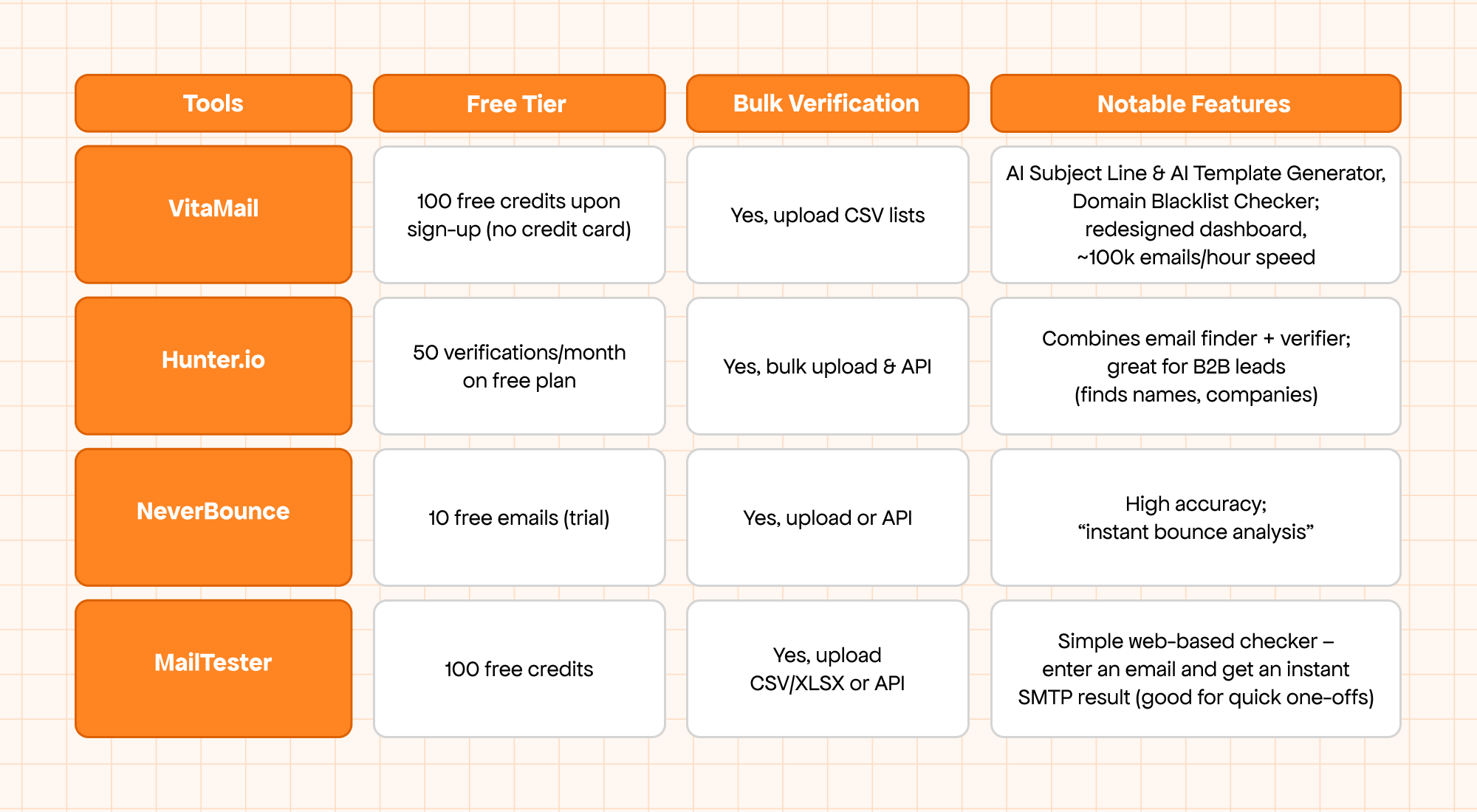
VitaMail gives new users 1,000 free credits, making it easy to verify email lists before launching campaigns. While email verification remains a core capability, VitaMail has evolved into an AI-powered email campaign and outreach platform. Alongside bulk email verification, it includes Domain Health monitoring, Domain Doctor guidance, inbox warm-up, and contact management tools that help businesses prepare campaigns from one place. Flexible Free, Pay-Per-Use, Subscription, and Enterprise plans make it suitable for both occasional and ongoing email outreach.
Hunter.io offers 50 free monthly checks and doubles as an email-finding service for B2B prospecting. It integrates with Salesforce and HubSpot, making it perfect for sales teams.
NeverBounce provides a small free trial but excels in accuracy. Their unique list analysis feature estimates bounce rates before you pay, helping you decide if cleaning is necessary.
MailTester requires no login and provides instant SMTP checks for single addresses. It's perfect for quick verification but lacks bulk capabilities and advanced features.
If you’re just starting and want to know how to check email addresses in bulk, VitaMail offers one of the most generous free tiers.
VitaMail gives new users 1,000 free credits, making it easy to verify email lists before sending campaigns. Beyond email verification, the platform also includes Domain Health monitoring, inbox warm-up, contact management, and campaign tools, giving businesses a practical way to prepare and manage email outreach from one place.
How to Verify Email Lists in Bulk
Uploading unverified lists to your CRM or email platform is risky. If a large portion is invalid, your first campaign could trigger massive bounces and get your account flagged. Many email service providers will suspend accounts with excessively high bounce rates.
One marketer learned this the hard way when emailing a 2,300-address list unused for two years. The campaign bounced so badly that their email service provider temporarily blocked their account.
Use Bulk Verification Tools
Services like VitaMail support bulk CSV and XLSX uploads, allowing businesses to verify thousands of email addresses before launching campaigns. Results are processed quickly, making it easy to identify invalid addresses, reduce bounce rates, and prepare cleaner contact lists for outreach.
Get Detailed Reports
After processing, you receive comprehensive reports tagging each email as "Valid," "Invalid," "Catch-all," "Disposable," or "Role-based." You can export clean lists containing only valid emails or segment different categories for tailored approaches.
VitaMail provides downloadable reports along with an online dashboard that summarizes verification results, contact quality, and overall list health. Users can review verified contacts, organize them into Lists, and move directly into campaign preparation without exporting data between multiple tools.
Automation and Integration
For regular list management, look for services with API integrations connecting to your email marketing software or signup forms. This makes bulk checking a seamless workflow part, automatically verifying new imports before any emails go out.
Bulk verification is especially crucial for purchased lists, older lists unused for months, or large event/trade show collections where typos and fake entries are common. Running these through verification services identifies risky addresses before they damage campaigns.
Don't let a dirty list sabotage your next campaign. Every day you wait, more addresses go bad, and your sender reputation becomes more vulnerable. The good news? You can clean your entire list in minutes, not hours.

Essential Tips for Long-term Email List Health
Keeping an email list healthy takes ongoing effort. Addresses change, people switch jobs, and engagement drops over time. These tips will help you maintain list quality and avoid deliverability issues in the long run.
Set Regular Cleanup Cycles
Email verification isn't a one-time task. Lists naturally decay about 2% monthly as addresses go bad continuously. Schedule quarterly or bi-annual verifications to prevent bounce buildup. Think of it like regular car maintenance – preventive care beats emergency repairs.
Segment by Verification Status
Don't treat all emails equally after verification. Send to "Valid" addresses for most campaigns, but handle "Catch-all" or "Unknown" addresses differently. You might put them in separate segments for smaller test sends or different messaging approaches.
Remove definitively invalid addresses immediately. Continuing to email addresses that will always bounce is asking for trouble.
Warm Up New or Cold Lists
Don't blast thousands of emails on day one with new domains or long-dormant lists. ISPs get suspicious of sudden high-volume sends from cold senders. Instead, warm up gradually by starting with small batches of your most engaged contacts, then incrementally increasing volume over days or weeks.
Consider re-engagement campaigns for cold subscribers, asking if they still want to hear from you before removal. Even verified addresses can generate bounces and low engagement if people have moved on.
Conclusion
Your email list is constantly changing. People switch jobs, abandon old inboxes, and make typos when signing up. The only way to stay ahead is to verify your email lists regularly.
You can keep hoping your contacts are still valid, or you can spend a few minutes checking them before your next campaign. A quick verification today can help reduce bounce rates, protect your sender reputation, and improve the chances of reaching real people.
Pick any tool from the list above, upload your contacts, and review the results. Whether your list needs a few fixes or a complete cleanup, knowing the quality of your contacts is always better than guessing.
VitaMail gives new users 1,000 free credits to verify email lists before sending campaigns. Beyond email verification, it also helps businesses create email campaigns, monitor domain health, prepare inboxes with warm-up, organize contacts and workspaces, and manage outreach from one platform. That means you can move from list verification to campaign launch without switching between multiple tools.