


Send too many emails and people unsubscribe. Send too few and they forget you exist.
Email frequency is one of the most debated topics in email marketing — and for good reason. Get it wrong in either direction and you're either burning your list or leaving revenue on the table. Most marketers either default to "once a week because that sounds right" or blast their list whenever they have something to say, with no real strategy behind either approach.
How Often Should You Send Emails by Industry?
While the right frequency depends on your audience, industry benchmarks can give you a useful starting point:
E-commerce and retail: 2–4 times per week is common, especially during promotional periods. Subscribers expect frequent updates on deals and new products. Outside of peak seasons, 1–2 times per week maintains engagement without fatigue.
B2B and SaaS: 2–4 times per month tends to work best. B2B buyers are busy professionals who value quality over volume. A well-timed, high-value email every couple of weeks outperforms a daily drip campaign in most cases.
Newsletters and media: Daily or weekly, depending on the format. Daily newsletters work when the content is genuinely time-sensitive or habitual (news, markets, deals). Weekly roundups work for most other topics.
Cold outreach: 3–5 touches per sequence, spaced 3–5 days apart. More than that and you're in spam territory. Less and you're leaving replies on the table.
Nonprofits and community organizations: Once or twice a month is typically the sweet spot. Enough to stay connected, not so much that it feels transactional.
These are starting points, not rules. The only benchmark that really matters is how your audience responds.
5 Tips to Find Your Ideal Email Frequency
Tip 1: Start With a Baseline and Test
If you're just getting started or rethinking your approach, pick a reasonable baseline and measure from there. For most businesses, that starting point is once per week or twice per month. It's frequent enough to build a habit, and infrequent enough that you're not overwhelming anyone before you have data to work with.
Once you've established your baseline, run a simple frequency test. Split your list into two segments — one receiving your current cadence and one receiving emails slightly more or less often. Track open rates, click rates, and unsubscribes over 4–6 weeks. Let the data tell you which group responds better.
This isn't a one-time test. Email list behavior changes as your audience grows and evolves. What worked six months ago might not be the optimal email marketing frequency today. Build frequency testing into your regular routine, even if it's just a quarterly review.
Tip 2: Segment Your List by Engagement Level
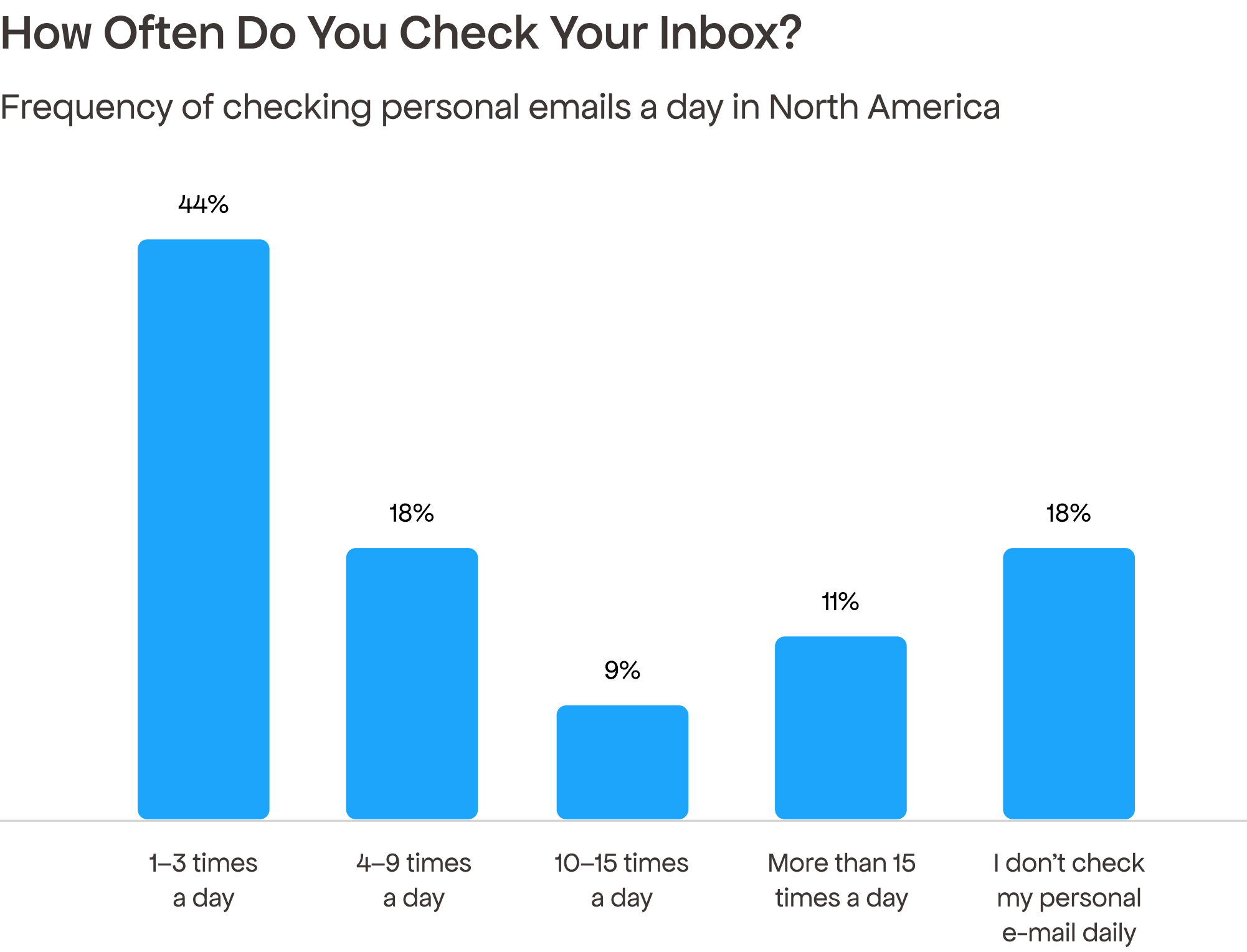
One of the biggest mistakes in email frequency strategy is treating your entire list the same way. A subscriber who opens every email and clicks regularly is a completely different audience than someone who hasn't opened anything in three months. Statista reports on how often people check their inbox.
Sending the same frequency to both groups is a missed opportunity at best and list damage at worst.
Instead, segment your list by engagement level and adjust frequency accordingly. Your most active subscribers — those who open consistently and click through — can handle higher frequency. They're interested, they're paying attention, and more sends means more touchpoints for conversion.
Your less engaged subscribers need a lighter touch. Sending them emails at the same rate as your active segment is more likely to trigger unsubscribes or spam reports. Consider dropping them to a lower frequency cadence or running a re-engagement campaign before you write them off completely.
Most email platforms make this segmentation straightforward. Look at open rate over the last 60–90 days as your primary signal and build your segments from there.
Tip 3: Let Subscribers Choose Their Own Frequency
This is one of the most underused tactics in email marketing, and it works remarkably well. Instead of guessing what frequency your subscribers want, just ask them.
You can do this at the point of signup — offer a simple preference center where new subscribers choose how often they want to hear from you. Options like "weekly," "twice a month," or "monthly highlights" give people a sense of control and set clear expectations from the start.
You can also offer this choice to your existing list. A simple email that says "we want to make sure we're showing up in your inbox at the right frequency — here's how to adjust your preferences" will get clicks, reduce unsubscribes, and signal to your audience that you respect their time.
The data is clear: when subscribers choose their own email frequency, engagement goes up and unsubscribe rates go down. People are far less likely to opt out of something they explicitly signed up for.
Tip 4: Watch Your Unsubscribe and Open Rates Closely
Your metrics are the most honest feedback you'll ever get on your email frequency. Most marketers look at open rates and click rates, which is a good start. But when it comes to frequency, there are two numbers you need to watch even more closely: unsubscribe rate and list growth rate.
An unsubscribe rate above 0.5% per send is a warning sign. It doesn't always mean your content is bad — it often means you're sending too often, or your cadence doesn't match what your subscribers expected when they signed up.
Look at trends, not just snapshots. If your unsubscribe rate has been creeping up over the last 6–8 weeks, that's a signal to pull back. If your open rate is declining steadily — especially if it's dropping while your list size stays flat or grows — that points to engagement fatigue from over-sending.
On the flip side, if your open rates are strong and unsubscribes are low, you may have room to increase frequency and test a higher cadence without hurting list health.
One important note: don't just look at aggregate numbers. Break down your metrics by segment and by campaign type. A promotional email and a value-first newsletter will perform very differently even at the same frequency.
Tip 5: Match Frequency to Your Content Value
This is the principle that underlies everything else. The right email frequency is directly tied to how much genuine value you're delivering per send.
If every email you send contains something your subscribers would miss if they didn't see it — a useful insight, an exclusive offer, a relevant update — you can send more often without burning out your list. The inbox is not a place people avoid when they trust the sender.
If your emails are promotional-heavy, repetitive, or don't offer anything new, then even a modest frequency will feel like too much. The solution isn't always to send less — sometimes it's to raise the quality of what you're sending.
Ask yourself before every send: "Would my subscriber be genuinely glad they received this?" If the answer is consistently yes, frequency becomes less of a constraint. If you're hesitating, that's a signal to either improve the content or pull back on the cadence.
Final Thoughts
There's no magic number for ideal email frequency. But there is a method: start with a reasonable baseline, test consistently, segment by engagement, give subscribers control where possible, and always let content quality lead.
You can refine your email strategy with advanced features offered by this AI email platform for marketers.
Frequency is a lever. Pull it thoughtfully.
Want to send smarter outreach at exactly the right frequency — without the guesswork? Try VitaMail →