



AI for email marketing has closed a gap that used to take years and headcount to bridge. Small teams that understand this are quietly out-executing competitors twice their size — not by working harder, but by removing the friction that slows everyone else down: drafting copy, testing subject lines, cleaning lists, checking deliverability.
This guide is a practical breakdown of how small teams can use email marketing AI tools — from the first draft to the last follow-up — and everything that affects whether your emails actually reach the inbox.
What AI for Email Marketing Actually Does (and What It Doesn’t)
The U.S. Chamber of Commerce reports that 98% of small businesses now use AI tools—more than double the 40% in 2023—showing that AI-driven operations have become the standard for businesses of all sizes.
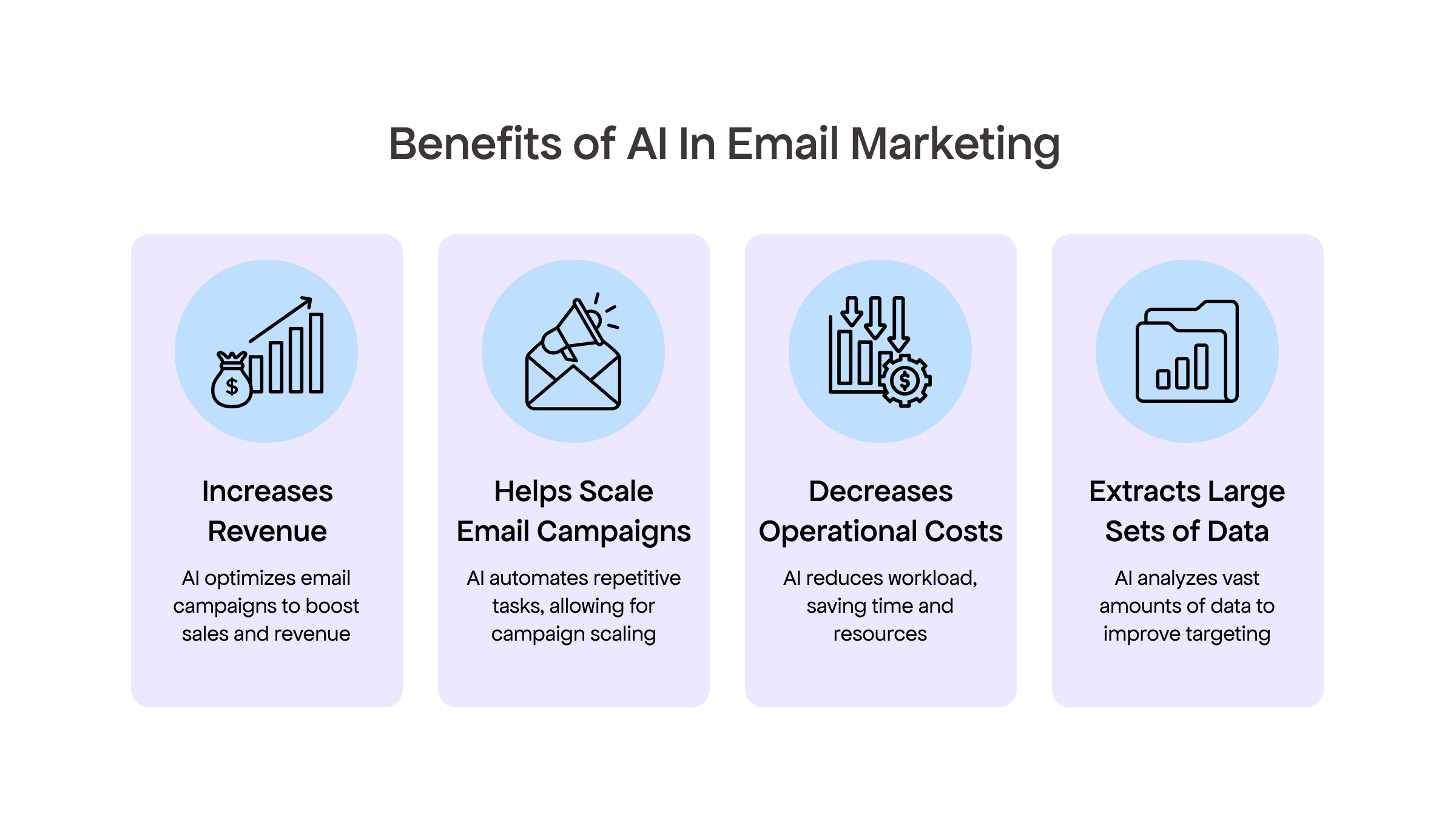
AI for email marketing doesn’t write perfect emails on its own or replace judgment about who to target. What it does is eliminate the mechanical work between your strategy and your results: the blank page, the tenth subject line variation, the manual list scrub, the guesswork about send time.
Automation vs. AI: The Real Difference
Standard automation runs on rules — if someone clicks, they move to the next step. Useful, but static. AI tools for email marketing go deeper: they analyze which openers get replies from CTOs versus founders, which subject line structures perform in your industry, what time your specific list is most responsive — and feed those signals back into your next campaign. The system gets better the more you use it.
Why AI Tools for Email Marketing Now Work for Small Teams
Predictive send time, behavioral segmentation, dynamic personalization — these used to live inside enterprise platforms with five-figure contracts. Platforms like VitaMail have rebuilt them for lean teams: no implementation consultants, no seat minimums, no six-month onboarding. A team of two can now run campaigns that would have required a dedicated marketing ops hire three years ago.
How Small Teams Can Use AI to Write Cold Emails That Get Replies
Subject Lines: The Highest-Leverage Sentence You Write
For cold email marketing, the subject line does all the trust-building work before the recipient knows anything about you. A 5% lift in open rate across 1,000 sends is 50 more conversations — and that compounds across every campaign.

AI subject line tools know that questions outperform statements in cold B2B outreach, that specificity (“3 ideas for [Company]’s onboarding flow”) beats vagueness, and that promotional phrasing triggers spam filters before it triggers a human. VitaMail’s AI Subject Line Generator produces ranked variations based on predicted performance for your audience. Generate 5, A/B test the top 2, keep the winner as a template. Most teams see open rates climb from the 18–22% range into the 30s within a few weeks of doing this consistently.
AI Email Generator: From Blank Page to Strong Draft in 60 Seconds
VitaMail’s AI Email Generator is built around the structure that cold emails with high reply rates share: an opener showing 30 seconds of research, a one-sentence value prop tied to a specific problem, a proof point (a result, a client name, a number), and a single low-friction CTA — not “Would love to connect!” but “Are you open to a 15-minute call Thursday?”
You provide the inputs. The generator builds the draft. You personalize the opener and sharpen the CTA. Total time: under 10 minutes per variant, down from 45.

Personalization at Scale
Personalized cold emails get 2–3x the reply rates of generic blasts. AI handles this by pulling dynamic fields from your CRM — industry, job title, company size, recent activity — and weaving them into copy automatically. A VP of Sales gets a different opening line than a Head of Growth, even in the same sequence. The sender spent 2 minutes setting up variables, not 2 hours writing each one.
Automating Your Cold Email Workflow With AI Tools
Sequences That Convert: A Simple Structure That Works
Most replies in cold email marketing come from follow-ups, not first touches — follow-ups 2 and 3 generate a disproportionate share of responses. Most small teams stop after one email because tracking manually is painful. AI-powered sequences solve this: they run on schedule, pause when a prospect replies, and resume if they don’t.
• Day 1 — Personalized opener: problem-specific, single CTA, under 100 words
• Day 4 — Follow-up: add one new piece of value — a stat, a case study, a relevant observation
• Day 9 — Short nudge: 2 sentences, low pressure, easy to say no
• Day 16 — Breakup email: “I’ll leave it here” — these get surprisingly high reply rates
Teams running this structure consistently report 40–60% of total replies coming from emails 2 through 4.
Segmentation and Send Time Optimization
Treating a list of 500 contacts as one audience is one of the most common mistakes in cold email marketing. A CFO and an SDR manager have different problems and different reasons to reply. AI tools for email marketing segment automatically based on job title, industry, or behavioral signals, and route each segment into the right sequence with the right copy variant.
Email Timing matters too. Tuesday–Thursday, 8–10am local time, consistently outperforms other windows for B2B. AI handles timezone-aware delivery for each recipient automatically — typically a 4–8 point open rate improvement across a campaign of 1,000 sends. Not dramatic in isolation, but compounded with cleaner lists and better subject lines, it’s the difference between a campaign that breaks even and one that generates pipeline.
Cold Email Deliverability: The Part Most Small Teams Skip
The best subject line and the most personalized copy produce zero results if your emails land in spam. Deliverability is the foundation everything else depends on — and the area small teams most consistently overlook.
Validate Your List Before Every Send
A bounce rate above 2% gets your domain flagged by Gmail and Outlook. Once flagged, even emails to valid contacts go to spam. List decay runs at 20–30% annually — a list built 18 months ago has 200–300 invalid addresses per thousand contacts.

VitaMail’s Email Validator removes hard bounces, flags role-based addresses like info@ and support@ (low conversion, high complaint risk), and identifies catch-all domains before you send. It takes minutes. It protects months of sender reputation work.
SPF Records: Working Silently or Killing Deliverability Quietly
Without a valid SPF record, inbox providers can’t verify your email is legitimate and will route it to spam without bouncing it — so you won’t know it’s happening. Misconfigured SPF records are common on domains using multiple sending tools (a CRM, an outreach platform, a transactional service). Each needs to be listed, and the 10-lookup DNS limit is easy to exceed.
VitaMail’s SPF Checker runs a live check, shows your current record, and tells you exactly what to fix. Check it before every cold email campaign.
Spam Trigger Check Before Launch

Modern spam filters don’t just scan for trigger words. They analyze HTML structure, link density, image-to-text ratios, authentication gaps, and behavioral signals from previous sends. VitaMail’s Spam Checker flags broken unsubscribe links, promotional subject lines, missing plain-text versions, and authentication issues — all before your campaign goes out. For small teams using AI for email marketing at volume, this should be non-negotiable before every launch.
Measuring What’s Actually Working
The Four Metrics That Matter
• Open rate: 25–35% is healthy for cold B2B. Below 20% is a subject line or deliverability issue, not a content one.
• Reply rate: 5–10% is strong. Below 3% on a validated list means your offer or targeting needs work.
• Bounce rate: keep under 2%. Every point above that erodes sender reputation.
• Spam complaint rate: stay below 0.1%. Above it, inbox providers throttle delivery or suspend your domain.
Track per campaign, not as rolling averages. Rolling averages hide problems. Per-campaign data shows exactly which subject line, segment, and send time is driving results.
How AI Compounds Over Time
The compounding advantage of AI for email marketing isn’t just this campaign — it’s that every campaign makes the next one smarter. AI tools surface which opener structures get the most replies from your audience, which follow-up timing converts best, which proof points land by industry. Over six months, a small team running AI-assisted cold email marketing builds a playbook from their own real data, not generic benchmarks.
Scale Your Cold Email Marketing With AI — Even With a Small Team

The small teams winning at cold email marketing aren’t outspending anyone. They’re out-systematizing them — replacing manual, repetitive work with AI tools for email marketing that handle the mechanics while they focus on strategy, relationships, and offers.
Start small: run your next subject lines through an AI generator, validate your list, check for spam triggers. Those three steps will improve your next campaign without touching anything else. VitaMail’s free tools — AI Subject Line Generator, AI Email Generator, Email Validator, SPF Checker, Spam Checker — are built for exactly this. No credit card. No setup time.