



Here's a frustrating truth about email marketing: you could have the perfect subject line, compelling copy, and an irresistible call-to-action and still get ignored if you send your email at the wrong time.
The statistics are sobering. Email send time can impact open rates by 20-30%, and in some cases, the difference between a campaign sent at 9 AM versus 2 PM amounts to hundreds of additional opens and clicks. Yet most marketers guess. They send campaigns based on convention, habit, or what feels right rather than what actually works.
The good news? You don't have to guess anymore.
This guide breaks down exactly when to send emails based on real data across industries, audience segments, and sending patterns.
What Is the Best Time to Send a Marketing Email?
Before we dive deep, here's what the data consistently shows:
Best Days to Send Emails: Tuesday through Thursday consistently outperform other days. Tuesday is often the strongest performer overall, with open rates typically 10-15% higher than other days. Friday shows moderate performance, while Monday and weekend sends underperform by 15-25%.
Best Hours to Send Emails: Two distinct peaks emerge in email engagement:
- Morning Peak: 9 AM - 12 PM (highest engagement, peak productivity hours)
- Evening Peak: 8 PM - 10 PM (secondary engagement window, evening leisure time)
The afternoon slump (1-4 PM) sees a marked drop in engagement, and anything sent after 10 PM or before 6 AM typically underperforms.
Open Rate Impact: Send time accounts for approximately 20-30% variance in open rates. A well-timed campaign can achieve 35-40% open rates, while poor timing can result in 15-20% opens for identical content.
Critical Context: These are general patterns. Your specific optimal send time depends heavily on your industry, audience demographics, time zone distribution, and the type of content you're sending. B2B audiences have different patterns than B2C. Healthcare professionals check email differently than e-commerce shoppers.
Best Time to Send Emails by Day
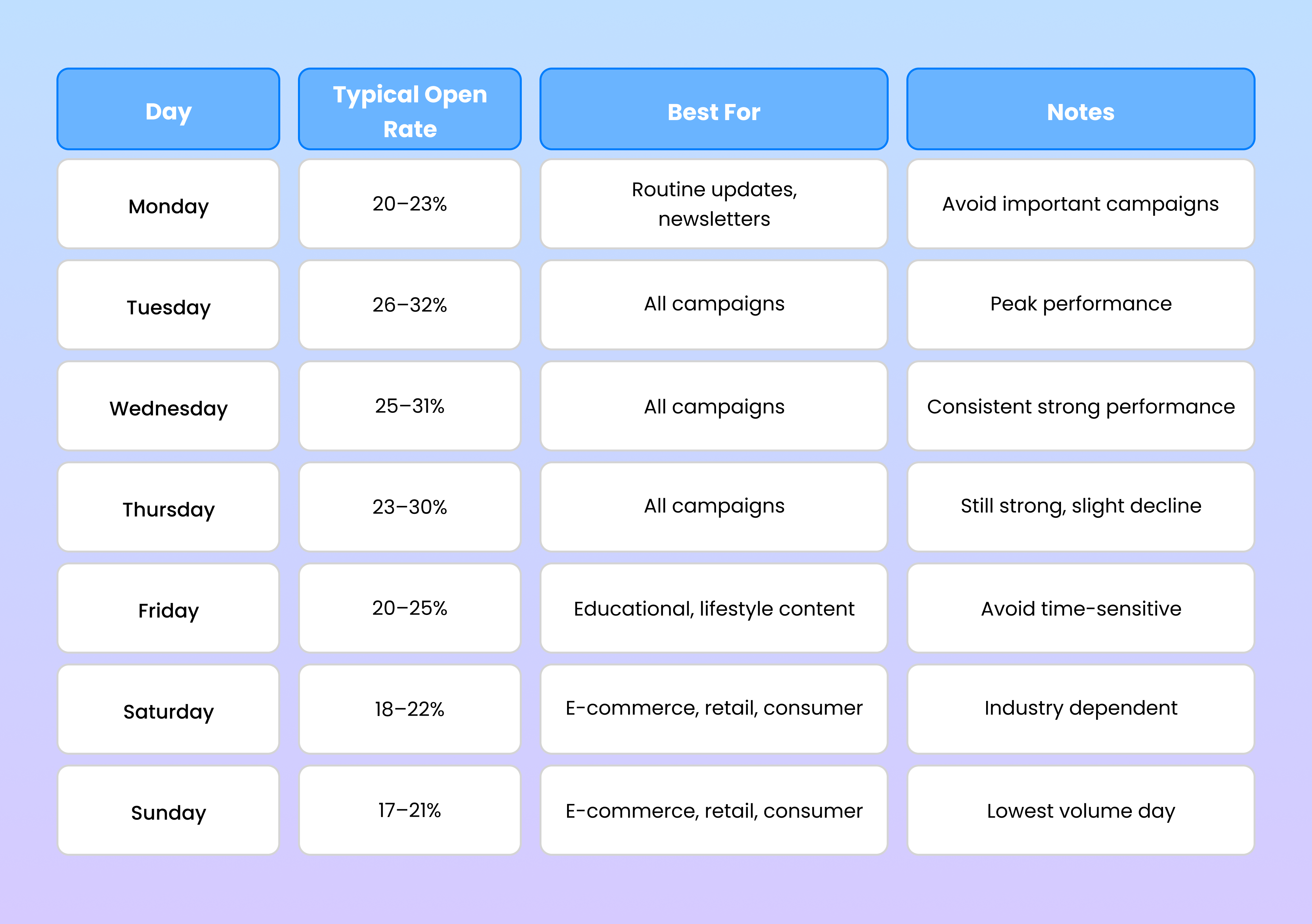
When is the best time to send emails? The answer depends heavily on the day of the week. Email engagement varies dramatically by day of week. Understanding why helps you predict performance and plan your sends strategically. Research shows that choosing the right day is one of the most important email marketing best practices you can implement.
Monday
Monday mornings are chaos for most professionals. Inboxes explode with weekend backlog, urgent messages, and the Monday morning rush. This creates a paradox: while Monday sees high email volume, engagement rates typically fall 15-20% below the week average.
Why? Attention is fragmented. Users are overwhelmed, scanning rapidly, and often deleting emails in batches without reading. If you must send on Monday, aim for late afternoon (4-5 PM) when people have worked through their inbox priority items.
Monday Performance: 70-75% of baseline engagement rates
Best Use: Not ideal for important campaigns, but acceptable for routine updates, newsletters, or content designed to be consumed quickly
Tuesday-Thursday
This is where campaigns perform. Tuesday-Thursday sees the highest engagement rates across virtually all industries. Here's why:
- Tuesday: People have adjusted to the week, inboxes are manageable but not overwhelming. Work momentum is building. Decision-making happens mid-week. Typical open rates: 25-32%
- Wednesday: Consistent with Tuesday. Mid-week psychology still dominates. People are focused and engaged with work. Typical open rates: 24-31%
- Thursday: Still strong, though engagement begins a slight decline as weekend approaches. Friday anticipation starts to creep in. Typical open rates: 23-30%
The Tuesday-Thursday advantage compounds when you consider click-through rates. Not only do more people open emails during this window, but they're also more likely to take action. Decision velocity increases mid-week.
Optimal Window: Send Monday evening through Thursday morning for maximum reach and engagement.
Friday
Friday's performance tells a story about work-life boundaries. Open rates drop 15-20% compared to mid-week. Here's what's happening:
- People are mentally checking out of work mode
- Decision-making slows (fewer people want to commit to action on Friday)
- Mobile email checking increases (people are distracted with weekend plans)
- Email gets batched and deferred to "later"
That said, Friday isn't completely off-limits. For certain content types—weekend reads, entertainment, lifestyle content—Friday can actually perform well because people have more relaxed attention. But for time-sensitive promotions or content requiring immediate action, avoid Friday.
Friday Performance: 80-85% of peak mid-week rates
Best Use: Long-form educational content, weekend planning content, lifestyle/entertainment
Weekend (Saturday-Sunday)
Saturday and Sunday see engagement rates 30-40% below mid-week peaks. Most professionals aren't actively working, and emails get buried under weekend personal content.
That said, context matters. Weekend sends work well for:
- Retail/e-commerce (shopping happens on weekends)
- Travel/hospitality (weekend planning)
- Consumer lifestyle (entertainment, dining)
- Educational content (people read on weekends)
But for B2B campaigns, time-sensitive promotions, or anything requiring prompt action? Skip the weekends.
Weekend Performance: 60-70% of peak engagement rates
Best Time to Send Emails by Hour
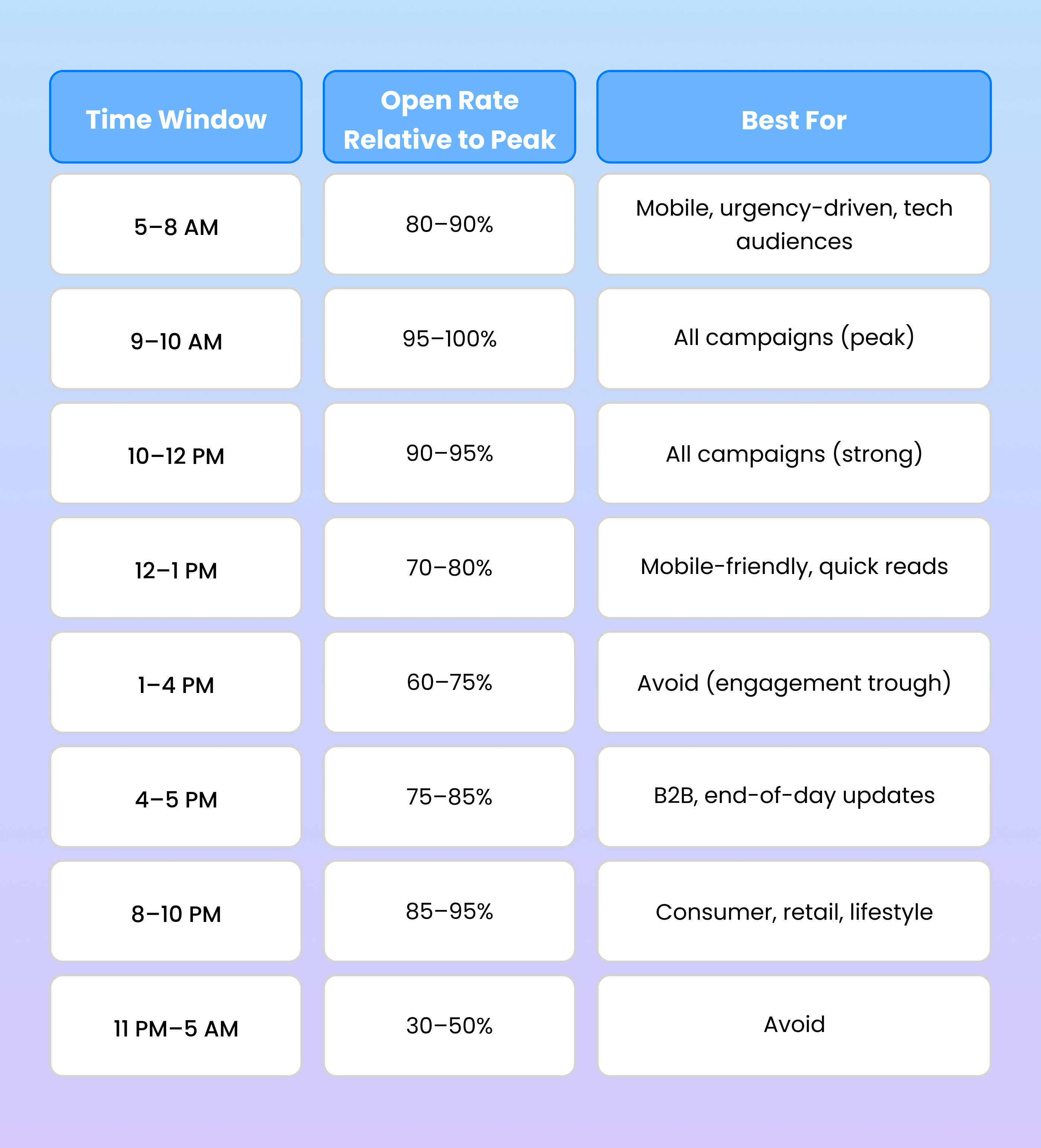
Knowing the best time to send email campaigns means understanding that while day-of-week matters, hour-of-day often matters even more. The same email sent at 9 AM versus 2 PM can see a 20%+ difference in opens.
Early Morning (5-8 AM)
Early morning represents a growing engagement window, driven primarily by mobile device usage. People check email while:
- Commuting
- Having breakfast
- Before work officially starts
- During the morning routine
The 6-8 AM window sees strong openings, particularly for mobile users. However, this varies by location and industry. Tech workers and West Coast audiences see earlier peaks than other segments.
Performance: 80-90% of peak mid-day rates
Best For: Urgency-driven campaigns, time-sensitive offers, tech-savvy audiences, mobile-first content
Mid-Morning (9 AM-12 PM)
This is the single best sending window for most campaigns. Here's why:
- People have settled into their workday
- They've processed immediate morning priorities
- Cognitive focus is high
- Email is a legitimate work activity (not a distraction)
- Desktop and mobile usage is balanced
- Decision-making and action-taking peak
9-10 AM sees particularly strong performance as people start their workday. 10-11 AM maintains momentum. 11 AM-12 PM begins a slight decline as people approach lunch, but still strong.
Within this window, 9:30 AM-10:30 AM emerges as the single best sending time across most industries and segments.
Performance: 100% (baseline peak)
Best For: All campaign types-promotions, announcements, newsletters, educational content, anything requiring engagement
Midday (12-1 PM)
Email engagement drops noticeably during lunch (12-1 PM). People are stepping away from desks, taking breaks, or eating while being distracted. However, mobile checking increases during this window as people scroll on phones during lunch.
Performance: 70-80% of peak rates
Best For: Light, entertaining content that works well on mobile; content designed for quick consumption
Afternoon (1-4 PM)
This is the worst time to send for most campaigns. Open rates consistently fall 20-30% compared to morning peaks. What's happening:
- Post-lunch energy dip (the 2-3 PM "slump")
- Afternoon meetings and work activities dominate
- Email checking becomes a background activity
- People are distracted and decision-fatigued
The afternoon is when emails get filed away for "later" and often forgotten.
Performance: 60-75% of peak rates
Best For: Almost nothing—this is the time to avoid if possible
Exception: Some B2B audiences (particularly sales and account management roles) check email regularly in the afternoon. If your audience is actively working through afternoon client communication, 3-4 PM can work. But for most segments, this is dead time.
Late Afternoon (4-5 PM)
As people wrap up their workday, email engagement ticks back up slightly. The end-of-day email check happens around 4-5 PM as people catch up before leaving the office.
Performance: 75-85% of peak rates
Best For: B2B campaigns, end-of-day notifications, workflow/summary emails
Evening (8-10 PM)
Evening sends see a surprisingly strong secondary peak. This window captures:
- People checking email at home
- Leisure time, more relaxed browsing
- Mobile usage at peak
- Decision time for next-day actions
8-9 PM sees the strongest evening engagement. 9-10 PM remains solid. After 10 PM, engagement drops sharply.
For consumer-focused campaigns, evening sends can sometimes outperform mid-morning sends, especially for lifestyle, retail, and entertainment content.
Performance: 85-95% of peak mid-day rates (sometimes equals or exceeds)
Best For: Consumer campaigns, retail, lifestyle, entertainment, long-form content (people have time to read)
Late Night/Early Morning (11 PM-5 AM)
Sending during this window is almost universally a mistake. Engagement drops 40-50% compared to peak times. The rare exceptions are automated transactional emails or time-zone specific sends aimed at specific regions.
Performance: 30-50% of peak rates
Best For: Nothing—avoid this window
How to Test Your Optimal Send Time: Methodology That Works
Knowing the best time to send emails in general is one thing. Knowing YOUR optimal send time is another. Here's how to actually test and identify what works for your audience-this is critical to mastering email marketing best practices.
The A/B Testing Framework
Important: Before running A/B tests, make sure your email list is clean, poor data quality can skew your results from the start.
Set Up a Proper Test: Divide your email list into two equal groups (minimum 1,000 each). Send to Group A at 10 AM Tuesday and Group B at 2 PM Tuesday-keep everything else identical (subject, content, design, day).
Wait 48-72 Hours: Most opens happen within 1-4 hours for promotional emails, but wait 72 hours to capture the full picture before analyzing.
Measure: Compare open rates (primary) and click-through rates (secondary). With 1,000 users per group, a 3% difference in opens is statistically meaningful.
Analyze Your Historical Data
Before testing, pull data from your email platform for the past 12 months. The group sends by day-of-week and hour, then compares average open and click rates. Look for: Do Tuesday-Thursday consistently outperform? Is there a clear hourly pattern? Most email platforms provide this in embedded analytics dashboards historical analysis often reveals your audience's true pattern without needing to test. Send-time insights are most valuable when combined with a well-structured campaign strategy.
Common Mistakes to Avoid
Even when you know the best time to send emails, many marketers still make critical mistakes implementing these best practices. These errors can undo all the benefits of picking the perfect send time.
Mistake 1: Ignoring Time Zones
Sending to a US audience at "10 AM" without accounting for time zones is a trap. You're sending during business hours for some subscribers and early morning for others.
Mistake 2: Assuming Your Industry Follows General Patterns
Your healthcare practice, financial advisory firm, or nonprofit might have patterns that diverge from industry averages.
Mistake 3: Testing with Insufficient Sample Size
Testing send times with 200 subscribers per group introduces noise. Results appear significant when they're actually random variations.
Mistake 4: Not Accounting for Seasonality
Send time performance varies by season. Holiday periods, summer months, and back-to-school all show different engagement patterns.
Mistake 5: Forgetting About Frequency Fatigue
If you send daily, optimal send time becomes secondary to not overwhelming subscribers. Frequency impacts engagement more than send time.
Mistake 6: Neglecting Your Specific Audience Persona
You might think your audience is "professionals aged 35-50" but you actually have 40% early-career (25-35) and 30% near-retirement (55+). These groups have different send-time preferences.
Mistake 7: One-Time Testing
You tested send times once in March and decided "2 PM is best." Six months of data later, you never retested.
Conclusion: From Data to Action
Here's what the data tells us clearly: when you send matters, but it matters in the context of who you're sending to.
Ready to test and optimize your send times?