



Email marketing campaigns remain one of the most powerful tools in the digital marketer's toolkit. With an average ROI of $42 for every dollar spent, email marketing campaigns consistently outperform other digital channels. Whether you're a solopreneur launching your first campaign or an established business looking to refine your strategy, learning how to create an effective email marketing campaign is essential for driving conversions and building lasting customer relationships.
This comprehensive guide walks you through the entire process of creating an effective email marketing campaign from defining your goals to analyzing your results. You'll discover proven email best practices, actionable strategies, and practical tips that will help you craft campaigns that actually get results.
Why Email Marketing Campaigns Matter
Before diving into the how-to steps, it's important to understand why email marketing campaigns deserve a prominent place in your overall marketing strategy.
Email remains one of the most direct and personal ways to communicate with your audience. Unlike social media algorithms that constantly change, email marketing campaigns deliver your message directly to your subscribers' inboxes. This direct access creates an opportunity for deeper engagement and stronger customer loyalty.
The numbers speak for themselves: consumers check their email an average of 15 times per day, making it one of the most frequently accessed channels. Direct email marketing generates three times more conversions than social media and search marketing combined.
Step 1: Define Your Campaign Goals and Audience
The foundation of any effective email marketing campaign starts with crystal-clear objectives. Before you write a single email, you need to answer a fundamental question: "What do I want this campaign to achieve?"
Set Specific, Measurable Goals
Vague goals like "increase sales" or "build engagement" won't guide your campaign effectively. Instead, define SMART goals:
- Specific: "Increase product purchases from existing subscribers by 15% over 90 days"
- Measurable: Use metrics like conversion rate, click-through rate (CTR), or revenue generated
- Achievable: Set realistic targets based on your historical performance
- Relevant: Align goals with your broader business objectives
- Time-bound: Establish clear deadlines (e.g., "by Q2" or "within 60 days")
Examples of specific campaign goals include:
- Generate 150 qualified leads for your sales team
- Achieve a 25% click-through rate on promotional emails
- Drive $5,000 in direct revenue from email sales
- Increase webinar registrations by 40%
- Re-engage inactive subscribers with a 10% reactivation goal
Define Your Target Audience
The most powerful way to create an effective email marketing campaign strategy is useless if you're sending it to the wrong people. Spend time clearly defining who you're trying to reach.
Consider these dimensions:
- Demographics: Age, location, job title, company size, industry
- Psychographics: Interests, values, pain points, goals
- Behavior: Purchase history, engagement level, content preferences
- Stage in buyer journey: Awareness, consideration, decision
Create audience segments rather than treating all subscribers as one homogeneous group. A new subscriber who just joined your list has different needs than a long-term customer. Someone who abandoned a shopping cart needs a different message than someone browsing your pricing page.
The better you understand your audience, the more targeted and relevant your email marketing best practices become. This segmentation is crucial, studies show that segmented campaigns achieve 14% higher open rates and 100% higher click-through rates compared to non-segmented campaigns.
Step 2: Build Your Email List
You can't run an effective email marketing campaign without a quality email list. Yet many businesses make the mistake of prioritizing list size over list quality. A smaller list of engaged, interested subscribers will outperform a large list of disinterested contacts every single time.
Quality Over Quantity
Your email list is one of your most valuable business assets. It represents real people who have given you permission to communicate with them. This permission is sacred, treat it accordingly.
Focus on organically building an engaged list of subscribers who actively want to hear from you. This approach ensures higher engagement and better campaign performance.
Implement Double Opt-In
Double opt-in requires subscribers to confirm their email address by clicking a link in a confirmation email. While this additional step reduces initial sign-up numbers by 20-30%, it significantly improves list quality. Double opt-in ensures that:
- Subscribers are genuinely interested in your content
- Email addresses are valid and typo-free
- Your sender reputation stays strong
- Engagement metrics improve across the board
Clean Your List Regularly
Even the best-maintained email lists deteriorate over time. People change email addresses, lose interest, or check their email less frequently. Regularly remove invalid, inactive, or problematic addresses.
Key email best practices for list maintenance:
- Remove hard bounces (emails that permanently failed delivery) immediately
- Monitor bounce rates and maintain them below 2%
- Suppress unsubscribes and complained addresses
- Re-engagement campaigns: Win back inactive subscribers before removing them
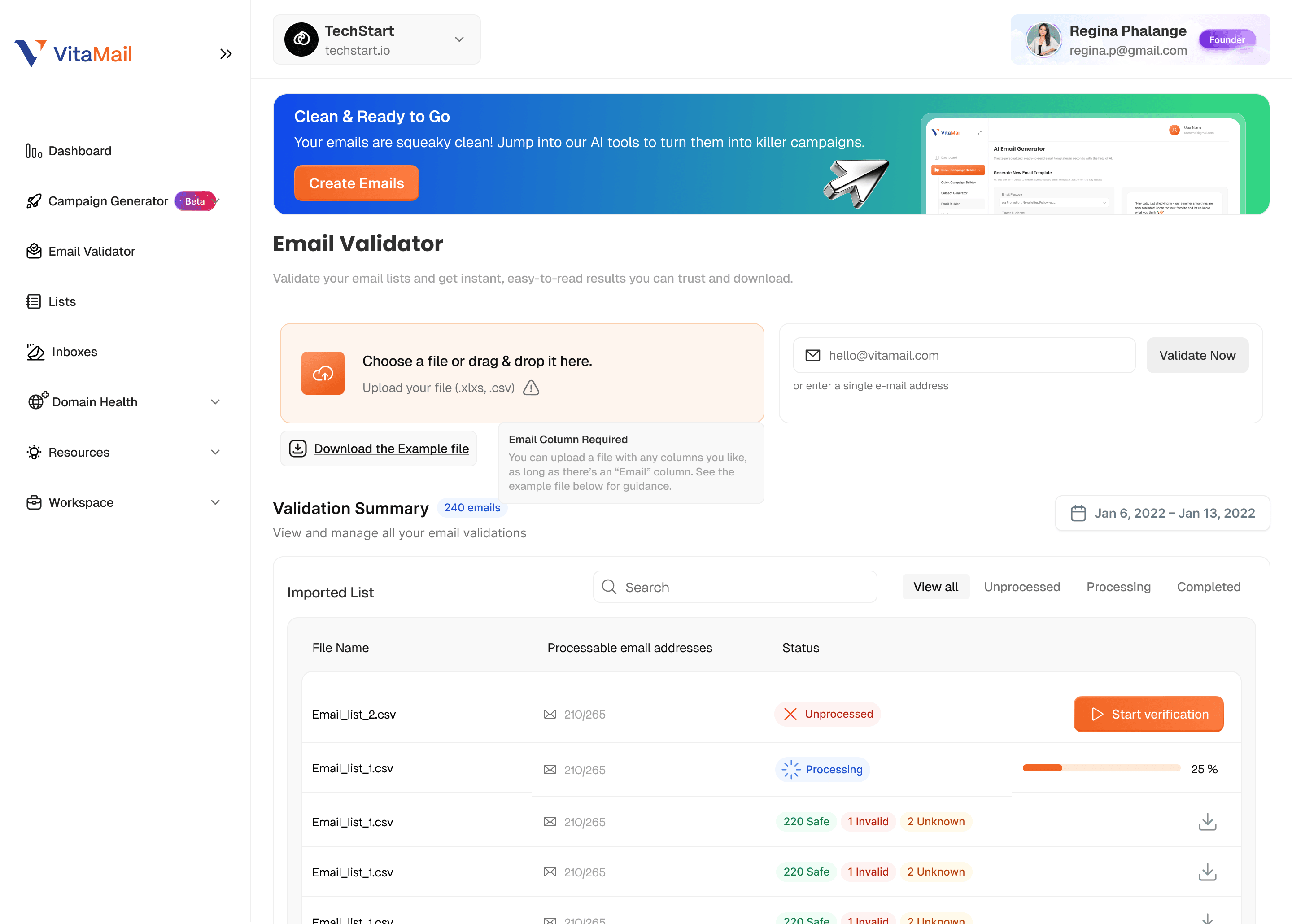
- Validate email addresses: Ensure the addresses you're mailing to actually exist
This is where tools like email validation services become invaluable. Before launching any email marketing campaign, verify that your list contains accurate, deliverable email addresses. Invalid addresses inflate your bounce rate, damage your sender reputation, and waste your campaign budget on unreachable contacts.
Implementing email validation ensures that every email address on your list is correct, active, and ready to receive your messages. This seemingly simple step dramatically improves your campaign performance and sender reputation.
Step 3: Craft Your Email Content
This is where your email marketing campaign truly comes to life. The content you create will determine whether subscribers open your emails, click your links, and take action.
Understand the Subject Line's Critical Importance
Your subject line is the gatekeeper to your email marketing campaign. If your subject line doesn't compel subscribers to open, the most brilliant email content won't matter.
Direct email marketing success starts here. Research shows that 47% of people decide whether to open an email based solely on the subject line. Even worse, 69% of email recipients report spam solely based on the subject line.
Crafting subject lines that get opened:
- Create curiosity: "The one email marketing mistake costing you 40% of revenue"
- Be specific: "3 proven tactics to increase email click rates by 28%"
- Use personalization: "[First name], your personalized product recommendations are ready"
- Avoid spam triggers: Stay away from excessive caps, multiple exclamation points, or spammy words like "FREE," "URGENT," or "ACT NOW"
- Keep it concise: Aim for 40-50 characters so it displays fully on mobile devices
- Test variations: A/B test subject lines to discover what resonates with your audience
How to create an email marketing campaign
Email Marketing Campaign Generator Tool
Knowing what makes great email content is one thing; actually creating it consistently is another. While these best practices are invaluable, implementing them on every campaign takes time, especially as you scale to multiple emails per week.
This is where an email campaign generator tool becomes your secret weapon. Rather than staring at a blank screen wondering how to structure your email or craft a compelling subject line, a smart generator can help you:
- Generate multiple subject line variations optimized for higher open rates based on your industry and goals
- Draft compelling email copy that naturally incorporates the best practices covered in this guide
- Structure your content for maximum scannability and engagement
- Ensure compliance with email regulations automatically
VitaMail's email campaign generator combines proven email marketing principles with AI-powered suggestions to help you create high-performing campaigns in minutes instead of hours. Simply input your goal, audience segment, and key message and the generator handles the copywriting, formatting, and best practices implementation.
This means you can focus on what matters most: strategy, personalization, and measuring results. Instead of spending 30 minutes crafting the perfect subject line, you can generate 5 variations, test them, and move forward.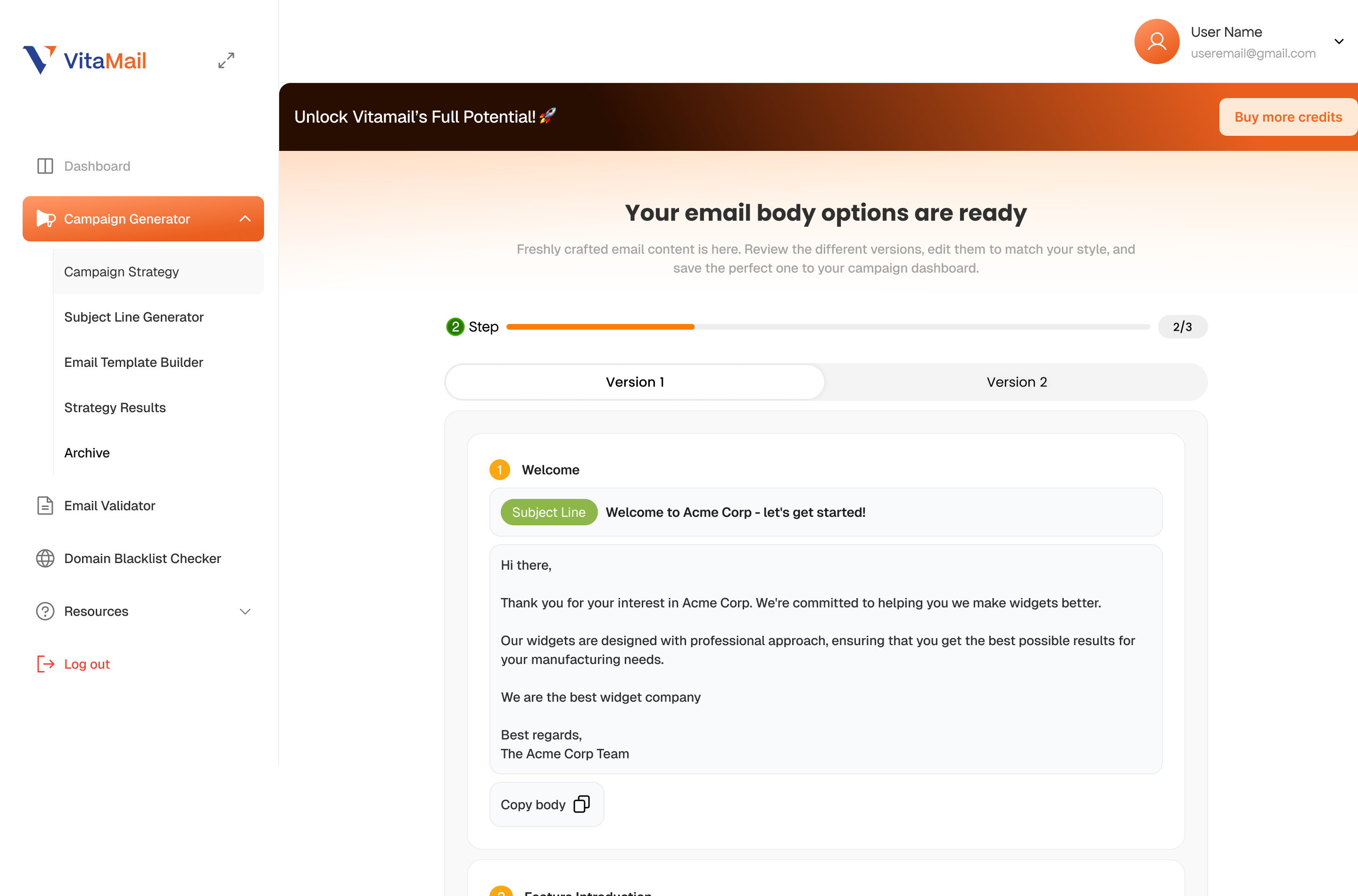
Try VitaMail's Free Email Campaign Generator and see how much faster you can create effective campaigns.
Step 4: Design for Maximum Engagement
Email design is far more than just making things look pretty. Strategic design directly impacts your open rates, click-through rates, and ultimately, conversions. An email marketing campaign's visual presentation can make or break your message.
Mobile-First Design is Non-Negotiable
Over 55% of emails are opened on mobile devices first. If your email doesn't render beautifully on a smartphone, you're immediately losing more than half your audience.
Mobile-first design principles:
- Single-column layout: Multi-column designs don't stack properly on mobile
- Large buttons: Make CTAs at least 44x44 pixels for easy tapping
- Readable font size: Minimum 14px for body text on mobile
- Responsive images: Images should scale proportionally on all screen sizes
- Short lines: Limit text to 50-60 characters per line for mobile readability
Test your emails across multiple devices and email clients (Gmail, Outlook, Apple Mail, etc.) before sending. Every email client renders slightly differently what looks perfect in one might look broken in another.
Use Visual Hierarchy to Guide Action
Your email design should guide subscribers naturally toward your desired action. Use these design elements strategically:
- Size: Make important elements (headlines, CTAs) larger
- Color: Use contrasting colors to draw attention to buttons and CTAs
- Whitespace: Generous spacing makes emails less overwhelming and easier to scan
- Typography: Use bold and italics sparingly to emphasize key points
- Images: Include 1-3 relevant images, but don't rely on images alone (some recipients have images disabled)
Color Psychology in Email Marketing Campaigns
Colors influence behavior and emotion. When designing your email marketing campaign, choose colors strategically:
- Red/Orange: Creates urgency; effective for limited-time offers
- Green: Associated with action and growth; great for CTAs
- Blue: Conveys trust and professionalism; effective for B2B campaigns
- Yellow: Draws attention; use sparingly to highlight important elements
Your CTA button color is particularly critical. Studies show that green and orange CTAs outperform red ones by 21% in email marketing campaigns. Test different colors to see what resonates with your specific audience.
Images and Alt Text Best Practices
Every image in your email should serve a purpose. Decorative images reduce email file size and load time without adding value. When you do use images:
- Compress files: Keep images under 1MB total for fast loading
- Add descriptive alt text: "Email validation dashboard showing 95% deliverability rate" instead of just "dashboard"
- Include text overlays: Don't rely solely on images to convey your message
- Create branded visuals: Use AI image prompts to match your campaign style
Alt text serves two purposes: it displays when images don't load (improving user experience) and it helps email clients understand your content (improving filtering and deliverability).
Branding Consistency Across Campaigns
Your email marketing campaign should feel like a natural extension of your brand. Consistent branding builds recognition and trust.
- Use brand colors: Stay within your brand color palette
- Logo placement: Include your logo in the header for instant recognition
- Font consistency: Stick to 1-2 fonts maximum
- Voice and tone: Match your brand's communication style
- Footer design: Include consistent footer elements across all campaigns
Step 5: Set Up Automation and Scheduling
Creating individual campaigns is one thing, but scaling your email marketing campaigns efficiently requires automation. This is where email marketing campaigns become truly powerful; you can nurture relationships at scale while maintaining personalization.
Build Your Automation Workflows
Email automation allows you to send timely, relevant messages based on subscriber behavior without manual intervention. Common automation workflows include:
Welcome Series Send a sequence of 3-5 emails automatically to new subscribers within the first week. A well-executed welcome series achieves 50% open rates and drives early engagement. Use this to set expectations, deliver promised value, and prime subscribers for future campaigns.
Abandoned Cart Recovery Ecommerce email marketing campaigns often include abandoned cart sequences. Send the first reminder 1-2 hours after abandonment, a second 24 hours later, and a third 48 hours later. Include the abandoned products, customer reviews, and a compelling incentive to complete the purchase.
Re-engagement Email marketing campaigns targeting inactive subscribers help you win them back or gracefully remove them from your list. Segment inactive subscribers (no opens or clicks in 90 days) and send a special re-engagement offer. If they don't engage, remove them to protect your sender reputation.
Post-Purchase Sequence After someone makes a purchase, send a sequence that:
- Confirms their order and provides details
- Delivers helpful content related to their purchase
- Requests a product review
- Suggests complementary products
- Nurtures them toward repeat purchase
Educational Drip Campaign Build a multi-email series that educates subscribers about your product or industry. Deliver one email every 2-3 days, each teaching a specific concept. This positions you as an authority and gradually moves subscribers toward a purchase decision.
Timing: When to Send Your Campaigns
Timing dramatically impacts open rates and engagement. While the "perfect send time" varies by audience, research provides useful guidance:
General best practices for email marketing campaigns:
- Day of week: Tuesday through Thursday generally outperform Monday and Friday
- Time of day: 8-10 AM and 2-4 PM typically see highest open rates
- Avoid weekends: Unless your audience specifically checks email on weekends
- Consider time zones: If you have a geographically dispersed audience, send during their local morning hours when possible
- Test and learn: Your audience is unique test different send times and use data to optimize
Most advanced ESPs allow you to optimize send times per subscriber based on their historical engagement patterns. This "send time optimization" can increase opens by 20-30%.
Conclusion: Putting It All Together
Learning how to create an effective email marketing campaign requires attention to multiple elements working in harmony. You must understand your audience, craft compelling content, design for every device, and execute strategically.
The good news? Email marketing campaigns are one of the most measurable marketing channels available. Every element can be tested, optimized, and improved. The campaign you send today will perform better than the one you sent three months ago if you apply these email marketing best practices and learn from your data.
VitaMail's email validation service removes invalid addresses, catches typos, and identifies spam traps before you send. This simple step has helped businesses improve their email marketing campaign performance by 20-40% through better deliverability and lower bounce rates.
Ready to launch your first effective email marketing campaign?