




"Just following up on my last email" is the most common sentence in cold outreach and one of the least likely to get a reply. It tells the prospect nothing new, adds no value, and signals you have nothing more to say. This post is about what to say instead.
A cold email follow-up that works is one that gives the prospect a new reason to engage: a new piece of information, a relevant trigger, social proof, or a direct question about a pain they are experiencing. It does not reference the previous email. It does not apologise for following up. It stands alone as a reason to reply.
The data makes the stakes clear. 70% of SDRs give up after one follow-up (Yesware, 2024). Most replies in a cold email sequence happen on touches 3 through 5 (Lemlist, 2024). The gap between those two facts is where most pipeline is lost. Below are seven follow-up frameworks, each with an annotated template built around a specific prospect, a bad example you will probably recognise, and the psychology that makes each framework work at its point in the sequence.
Why "just following up" fails, and what to do instead
It adds no new information. The prospect already processed your first email and chose not to reply. Sending the same message with different words does not change the calculus. You are asking them to make the same decision again with no new inputs. Reply rates on a repeat-of-email-1 follow-up approach zero because you are offering zero new reasons to engage.
It signals you have nothing more to say. When you ask whether they "had a chance to look," you are telling the prospect that your value proposition did not land the first time and you have no additional arguments. That is the opposite of building credibility over the course of a sequence. Each email should make your case stronger, not repeat it at a lower volume.
It creates social pressure without reciprocity. An unanswered email creates a mild social debt. The easiest way to resolve that debt is to keep ignoring it. A follow-up that offers something new (a stat, a case study, a resource) changes the dynamic. Replying feels like receiving something, not giving something. The prospect can respond without feeling like they are doing you a favour.
The rule: every follow-up must justify its own existence with something that was not in the previous email. If you cannot articulate what is new, do not send it.
Do not write this: Hi Marcus, Just following up on my last email to see if you had a chance to take a look. Would love to connect. Let me know if you have 15 minutes. [Signature]
Write this instead: Hi Marcus, Chartline just posted three SDR roles on your careers page. That ramp period is usually when teams realise they need better lead infrastructure before the headcount arrives. Worth a quick call before the hiring starts? [Signature]
The first version could have been sent by anyone to anyone. The second version could only have been written by someone who looked at Chartline's careers page this week. That is the difference.
How many follow-ups to send and when
How many: Send 4 to 5 follow-ups after the initial email. Research consistently shows it takes 5 to 8 touches to get a B2B reply (Salesforce State of Sales, 2024). But sending more than 5 follow-ups with no new content damages your sender reputation more than it generates replies. Each touch needs to earn its place with genuinely new information. If you cannot write five distinct angles, send fewer.
When: Space your follow-ups 3 to 5 days apart. The cadence loosens as the sequence progresses because each additional touch carries slightly more social weight. Here is how the seven frameworks map to a standard sequence:
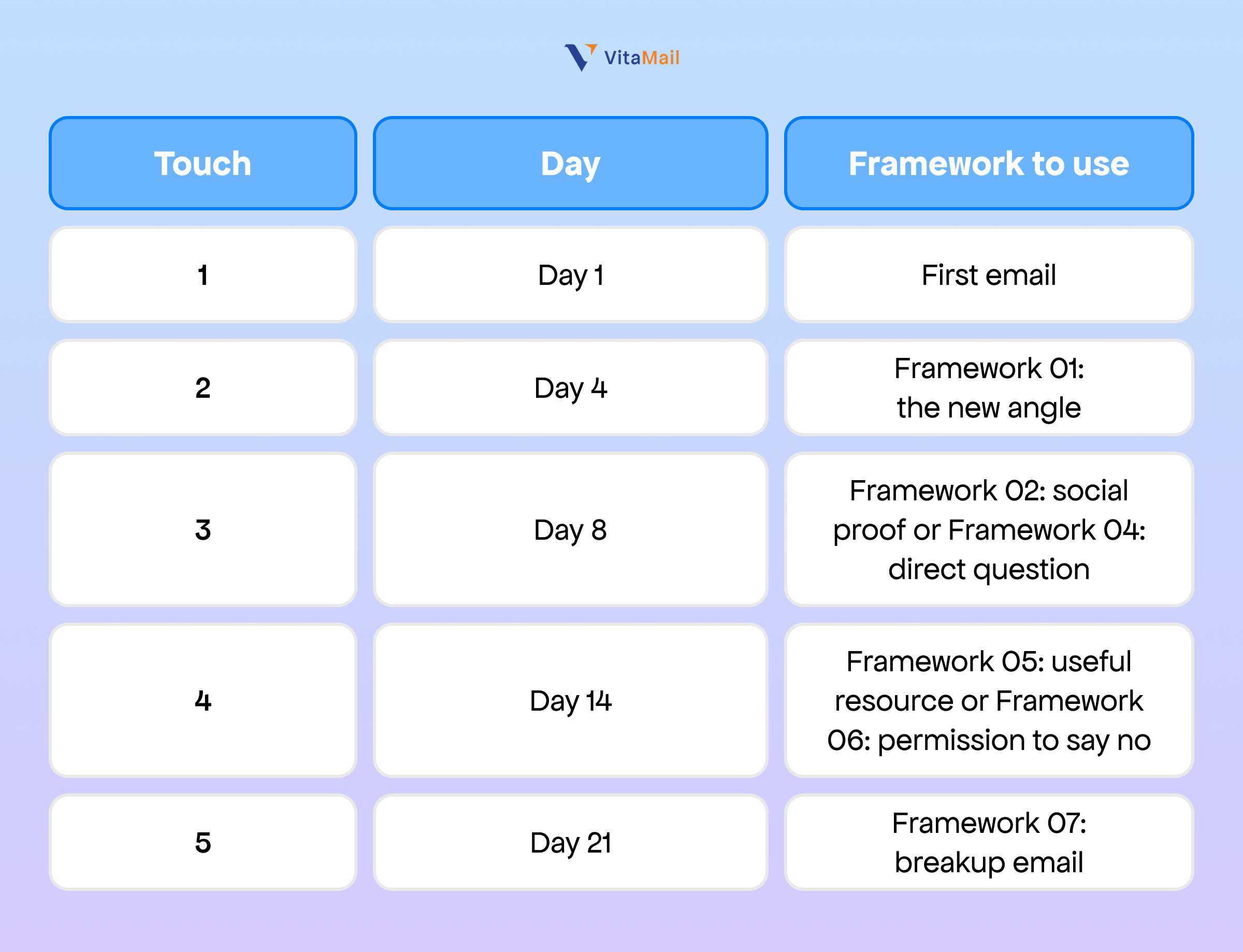
Note on triggers: If a new signal appears at any point (a funding round, a new job posting, a LinkedIn post), use Framework 03 (the new trigger) regardless of which touch number you are on. A trigger-based email always outperforms a scheduled one because it is genuinely responsive to something that just happened at the prospect's company.

7 cold email follow-up frameworks with annotated templates
Framework 01: The new angle
The prospect already processed your first email and decided not to reply. The only way to get a different outcome is to introduce genuinely new information: a stat, a case study, or an industry insight that connects to their likely pain. This email does not reference email 1 at all. It stands on its own as a completely independent reason to reply.
What not to write: Hi Marcus, I wanted to check back on my previous email. I know you're busy, but I think this could really help your team. Do you have 15 minutes this week?
Subject: The average Series A SDR takes 4.2 months to ramp
Hi Marcus,
A recent Bridge Group study found that the average SDR at a Series A company takes 4.2 months to reach full quota. For a 60-person team like Chartline scaling its outbound motion, that ramp cost adds up fast if the lead infrastructure is not already in place when new hires start.
We helped three analytics companies cut that ramp window to under 8 weeks by building validated lead lists before day one. Happy to share what we did.
Worth 15 minutes?
[Signature]
Annotation Subject line formula: Stat reference, no mention of previous email Psychology: The prospect chose not to reply to email 1. Repeating the same pitch with softer language does not change that decision. A new data point reframes the conversation entirely and gives them a reason to engage that did not exist before. Structure: New stat hook → Pain bridge specific to prospect's situation → Brief proof → Single CTA Word count: 89 words
When to use this: Touch 2, three to four days after the initial email. Best when you have a relevant stat or insight the prospect has not seen.
Framework 02: The social proof
By touch 3, the prospect is aware of you and running a low-level risk assessment. The question in their mind is not "what does this product do?" but "will this actually work for a company like mine?" One specific, concrete result from a peer company answers that question better than any value proposition.
What not to write: Hi Priya, Just wanted to check in and see if you got my last message. We've helped a lot of companies like Fidelio improve their outbound. Let me know if you'd like to chat!
Subject: How a Series B SaaS team went from 6 to 28 demos/month
Hi Priya,
Loopline is a Series B project management platform, similar size and stage to Fidelio. Before switching to automated outbound, their SDR team was booking 6 demos per month manually.
Ten weeks later, they hit 28 demos per month. The biggest shift was moving from generic list pulls to AI-validated prospect lists matched to their actual ICP.
I can walk you through exactly what changed. Would Thursday or Friday work for a 15-minute call?
[Signature]
Annotation Subject line formula: Peer result reference with specific metrics
Psychology: At this stage, the prospect is evaluating risk, not features. A specific result from a company they can see themselves in ("similar size and stage") reduces perceived risk more effectively than any feature list. The numbers do the selling.
Structure: Peer identification → Before metric → After metric → Key driver → Time-bound CTA
Word count: 88 words
When to use this: Touch 3, around day 8. Most effective when the proof company matches the prospect's industry, stage, or team size closely.
Framework 03: The new trigger
A new event at the prospect's company gives you a legitimate reason to reach out that is completely independent of your previous emails. It reframes the message as a new conversation rather than a follow-up. The prospect cannot dismiss it as persistence because it is genuinely responsive to something that just happened.
What not to write: Hi Selin, I'm reaching out again because I think we could really add value to your marketing stack. Would love to reconnect whenever you have a moment.
Subject: Your HubSpot integration and what it means for outbound
Hi Selin,
I saw Portlio just announced the HubSpot integration on your blog. Congratulations. That integration usually opens up a new outbound channel because your CRM data can now feed directly into prospecting workflows.
Most e-commerce SaaS teams we work with use that moment to build targeted outbound sequences for the HubSpot-adjacent buyer. It tends to be a high-converting segment.
Worth a 10-minute call to explore whether that applies to Portlio?
[Signature]
Annotation Subject line formula: Trigger reference + implication for their business
Psychology: A trigger-based email cannot be dismissed as generic persistence. It proves you are paying attention to the prospect's company in real time. The email feels like a new conversation, not a nudge, because it genuinely is one.
Structure: Trigger acknowledgment → Implication for their business → Peer pattern → Low-commitment CTA
Word count: 90 words
When to use this: Any touch, whenever a new signal appears. A trigger email always takes priority over the next scheduled framework in the sequence.
Framework 04: The direct question
A specific yes-or-no question about a pain the prospect is likely experiencing is the easiest possible email to reply to. It requires no commitment, no meeting request, no decision. Just an honest answer. The more accurate the question, the more likely the reply.
What not to write: Hi James, Following up on my earlier note. Would love to learn more about your current outbound process and see if we can help. Let me know when works.
Subject: Is manual research the bottleneck?
Hi James,
Quick question. With 200 people at Stackr and a growing SDR team, is manual lead research the main thing slowing down your reps? Or is the bottleneck somewhere else in the sequence (deliverability, reply rates, something else entirely)?
Not pitching anything here. I am genuinely curious because the answer changes what I would recommend.
[Signature]
Annotation Subject line formula: Short question, under 8 words, directly naming the suspected pain
Psychology: A yes-or-no question is the lowest-effort reply format available. The prospect does not need to evaluate a pitch, schedule a meeting, or make a decision. They just need to answer honestly. The question also flatters their expertise by positioning them as the authority on their own problem.
Structure: Direct question → Expanded options → No-pitch disclaimer → Curiosity framing
Word count: 68 words
When to use this: Touch 3 or 4, especially when you are uncertain about the prospect's primary pain point. The reply tells you how to pitch them next.
Framework 05: The useful resource
Reciprocity is one of the most reliable psychological triggers in outreach. When you give something valuable with no strings attached, replying feels natural rather than transactional. A resource follow-up is the lowest-pressure email in the sequence and often the one that breaks the silence from prospects who were interested but too busy to engage with a pitch.
What not to write: Hi Nadia, I wanted to follow up one more time. I really think our platform could help Outbound Lab scale. Can we find time to chat?
Subject: 2025 cold email deliverability benchmarks by industry
Hi Nadia,
SalesIntel just published their 2025 cold email deliverability benchmarks broken down by industry. The agency numbers are particularly interesting. Average deliverability for sales agencies dropped 11% year over year, mostly driven by tighter spam filters at Google and Microsoft.
Thought this might be useful for Outbound Lab's client campaigns. Here is the report: [link]
Let me know if useful.
[Signature]
Annotation Subject line formula: The resource itself, named directly, not framed as a question
Psychology: Reciprocity. Giving something useful without asking for anything in return creates a natural inclination to respond. This email also demonstrates competence by showing you understand what data matters to the prospect's business. No CTA beyond "let me know if useful" keeps the pressure near zero.
Structure: Resource identification → Key finding relevant to prospect → Personal relevance → Passive CTA
Word count: 72 words
When to use this: Touch 4, around day 14. Best for prospects who opened previous emails but did not reply. The absence of a pitch is the point.
Framework 06: The permission to say no
Social pressure from an unanswered email sequence is real. Most prospects are not ignoring you out of disinterest. They are deferring because they have not had time to evaluate whether your offer is relevant. Removing the pressure by giving them explicit permission to say "not right now" often triggers the yes they were holding back.
What not to write: Hi Tom, I've sent a few emails and haven't heard back. I totally understand you're busy, but I really believe we could help Birchvault. Any chance we could connect?
Subject: Bad time?
Hi Tom,
I have sent a couple of notes about outbound for Birchvault and have not heard back, which is completely fine. Pre-Series A is a sprint and outbound may not be the priority right now.
If the timing is off, a one-word "not now" reply works perfectly. I will check back in a few months. If it is the right time, I can have something specific for an 18-person team ready for a quick call.
Either way, no pressure.
[Signature]
Annotation Subject line formula: "Bad time?" or similar low-pressure open, under 4 words
Psychology: Giving the prospect an easy exit paradoxically increases the likelihood of a positive reply. When the pressure to say yes is removed, the prospect can evaluate the offer on its merits instead of avoiding the social cost of engagement. The "not now" option also preserves the relationship for future outreach.
Structure: Acknowledgment → Easy exit offered → Alternative path → No-pressure close
Word count: 85 words
When to use this: Touch 4 or 5, especially for prospects at early-stage companies where timing uncertainty is high.
Framework 07: The breakup email
This is the most important framework to understand clearly. When you state that you will stop reaching out, you create scarcity and force a decision. The prospect can no longer passively defer. They must actively choose to let the conversation end. This is why the breakup email consistently produces the highest reply rate of any touch in the sequence. It must not be melodramatic, passive-aggressive, or guilt-inducing. It must be calm, brief, specific about a future trigger, and final.
What not to write: Hi Priya, This will be my last attempt to reach you. I've tried several times and it seems like this isn't a priority. If you ever change your mind, my door is always open.
Subject: Should I close your file, Priya?
Hi Priya,
I will stop reaching out after this note. If outbound becomes a priority during your Series B build, here is a 3-minute walkthrough of how VitaMail V5 works for project management SaaS teams like Fidelio: [link]
Wishing you a strong quarter.
[Signature]
Annotation Subject line formula: "Should I close your file, [First Name]?" creates urgency through finality
Psychology: Scarcity and loss aversion. The prospect has been passively deferring a decision. Announcing you will stop reaching out forces an active choice: let the conversation end permanently, or reply now. This is why breakup emails consistently have the highest reply rate in the sequence. The calm, no-pressure tone is essential. Any hint of guilt or passive aggression destroys the effect.
Structure: Final notice → Passive future-trigger link → Warm close, no pitch
Word count: 52 words
When to use this: Touch 5, the final email in the sequence. Always the last touch. Never bluff a breakup; if you say you will stop, stop.
Follow-up subject lines: what works and what gets ignored
The fresh start
A subject line that makes no reference to your previous email performs best at touches 2 through 4. The prospect does not need to remember your last message to understand why this email matters. "Three SDR roles on your careers page" works because it is specific and stands alone. "Re: my last email" fails because it puts the burden of context on the prospect.
The direct question
Questions under eight words create curiosity and lower the effort required to engage. "Is outbound the gap this quarter?" is specific enough to feel relevant but open enough to invite a reply. Avoid vague questions like "Quick question for you" that promise nothing.
The pattern interrupt
Brevity and directness create a pattern interrupt in an inbox full of subject lines competing for attention. "Should I close your file?" and "Bad time?" work because they are short, unexpected, and low-pressure. They stand out precisely because they are not trying to sell anything.
The genuine thread reply
Using "Re: [original subject]" is appropriate when you are genuinely threading on the same conversation and adding new information. It works at touches 2 and 3 when the prospect opened email 1 and you want to build on it. Do not fake a thread. If the prospect never opened email 1, a fake "Re:" will feel dishonest and damage trust.
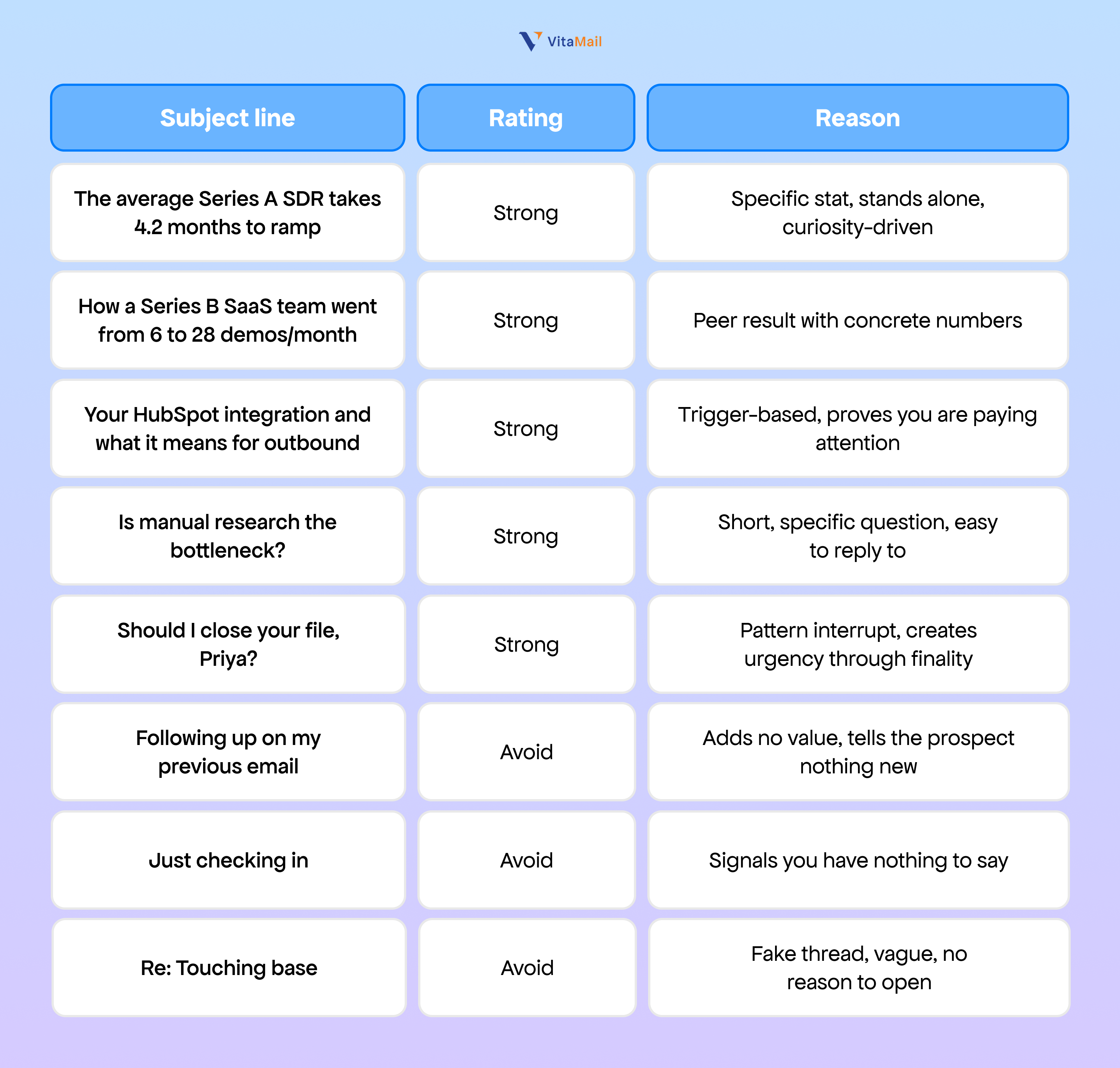
The rule: follow-up subject lines should be shorter than your touch 1 subject lines. Under 50 characters. By touch 3, the prospect may already recognise your name. Brevity is the advantage.
How to automate follow-ups without losing the personal touch
Running a 5-touch sequence for 200 prospects means writing, timing, and tracking 1,000 individual emails. Even with these frameworks, the personalisation required for each follow-up takes real time. The math breaks down quickly for any team running outbound at scale.
VitaMail V5 automates the full sequence, applying the right framework at each touch for each prospect. When the prospect reaches touch 3, V5 selects the appropriate framework (social proof, direct question, or whichever fits the prospect's profile) and generates the personalised copy. When a new trigger event appears (a funding round, a new job posting, a LinkedIn post), V5 identifies it and applies Framework 03 to that prospect's sequence instead of the scheduled touch.
The result is a sequence that adapts in real time while maintaining the specificity that makes each email feel individually written. Every follow-up references the prospect's company, stage, team size, and recent activity, without requiring you to research and write each one manually.
To understand how this fits into a complete cold outreach system start with V5's end-to-end workflow: website analysis, ICP definition, validated lead list, domain warmup, and AI-personalised campaigns.
The difference is in what happens after email 1
The gap between a 2% reply rate and a 15% reply rate is almost entirely explained by what happens after the first email. Most replies live in touches 3 through 5. Most teams never get there because they either stop too early or send follow-ups that add nothing new.
The one rule: every follow-up must give the prospect a new reason to engage. If you cannot say what is new, do not send it.
VitaMail runs the full sequence automatically, applying the right framework to each follow-up based on where the prospect is in the sequence and what new signals have appeared at their company. Every email references the prospect's actual situation. Every trigger is identified and acted on in real time.

