



Cold email has a reputation problem. Most people have received a bad one. The irony is that the principles behind an effective cold email are not complicated: they are just consistently ignored.
Cold email outreach best practices are the specific, repeatable behaviours that separate a 1% reply rate from a 15–25% reply rate: precise targeting, validated lead lists, personalised copy, multi-touch sequencing, and strict deliverability hygiene. This guide covers all twelve.
The 12 practices are grouped into five categories: foundation, deliverability, copywriting, sequencing, and compliance. Each one includes a specific stat, a concrete example, and the exact mistake it prevents. At the end, you will find a pre-send checklist you can use before every campaign.
Foundation: Get Targeting and Data Right Before Anything Else
If your foundation is wrong, no amount of good copy or timing will save the campaign. Targeting and data quality are the prerequisite layer. Get these right first, or everything built on top of them will underperform.
Practice 1: Define Your ICP Before You Write a Single Word
Targeting the wrong audience destroys both reply rates and domain reputation simultaneously. Every email sent to someone who was never going to buy risks a spam complaint, an unsubscribe, or silence that drags your sender score down.
An ICP for cold outreach includes firmographics (industry, employee count, revenue range), tech stack (tools they use that signal fit), buying triggers (recent funding, a key hire, a product launch), and the specific buyer role (title, seniority, department).
Compare the difference:
- Loose ICP: Any B2B company with over 10 employees.
- Tight ICP: Series A SaaS companies, 20–100 employees, using HubSpot Free, recently hired a VP Sales. Buyer is VP Sales or Head of RevOps.
The tight ICP means every contact has a reason to care. The loose ICP means most contacts will ignore you.
VitaMail generates an ICP definition automatically from your website URL, so you start with a tight profile instead of a blank page.
The mistake this replaces: writing a great email and sending it to the wrong 500 people.
Practice 2: Validate Every Email Address Before It Enters a Sequence
Bounce rates above 3% trigger spam filters and damage your sender reputation with major inbox providers (Postmark, "Monitoring Your Bounce Rate," 2024). Once your domain is flagged, even your valid emails start landing in spam.
Real validation covers three layers: SMTP verification (confirming the mailbox exists on the receiving server), catch-all detection (identifying domains that accept all addresses, making individual verification impossible), and disposable email detection (flagging temporary inboxes). This is different from syntax checking, which only confirms the format is correct (name@domain.com) without verifying whether anyone receives mail there.
The contrast is stark. A syntax-checked list might look clean on the surface but bounce at 15–20% on the first send. An SMTP-verified list with catch-all filtering will bounce under 2%, keeping your sender reputation intact.
VitaMail V5 delivers pre-validated lead lists, so every address has passed SMTP verification, catch-all detection, and disposable email filtering before it enters your sequence. Learn more about email validation explained.
The mistake this replaces: buying a list and discovering a 20% bounce rate after the first send.
Practice 3: Warm Up Your Sending Domain
A new or cold domain has no sender reputation. Sending at volume before warmup means landing in spam before any prospect reads your subject line. ISPs assign reputation scores to sending domains, and a domain with no history is treated as untrustworthy by default.
The warmup process has three stages. First, set up a dedicated subdomain (e.g., outreach.yourcompany.com) to protect your primary domain. Second, configure SPF, DKIM, and DMARC authentication records. Third, ramp sending volume gradually over 3–4 weeks using an automated warmup tool that builds positive engagement signals.
Compare the outcomes:
- No warmup: You launch a 500-contact campaign from a new domain. Gmail sees an unknown sender blasting hundreds of emails. Result: 80%+ lands in spam.
- Proper warmup: You spend three weeks gradually building engagement signals. When you launch the same campaign, Gmail recognises the domain. Result: 90%+ hits the primary inbox.
Read the complete domain warmup guide for a step-by-step walkthrough.
The mistake this replaces: launching a 500-contact campaign from a brand-new domain on day one and watching every email land in spam.
Copywriting: Writing Emails That Earn a Reply
Deliverability gets the email to the inbox. Copywriting gets it opened, read, and replied to. These are separate skills and both are required. You can have perfect deliverability and still get zero replies if your copy does not earn attention.
Practice 4: Write a Subject Line That Earns the Open
47% of email recipients decide whether to open an email based on the subject line alone (Convince & Convert, "Email Statistics," 2024). Your subject line is not a summary of your email. It is a gate. If it fails, nothing else matters.
Four subject line formulas work consistently for cold outreach:
- The specific question: References their company or situation directly. Example: "{{Company}}'s onboarding flow: a quick thought?"
- The trigger event reference: Ties to something that just happened. Example: "Congrats on the Series A, {{FirstName}}"
- The social proof hook: Mentions a relevant peer. Example: "How {{Similar Company}} cut churn by 30%"
- The pattern interrupt: Ultra-short, curiosity-driven. Example: "15 mins?" or just "{{FirstName}}"
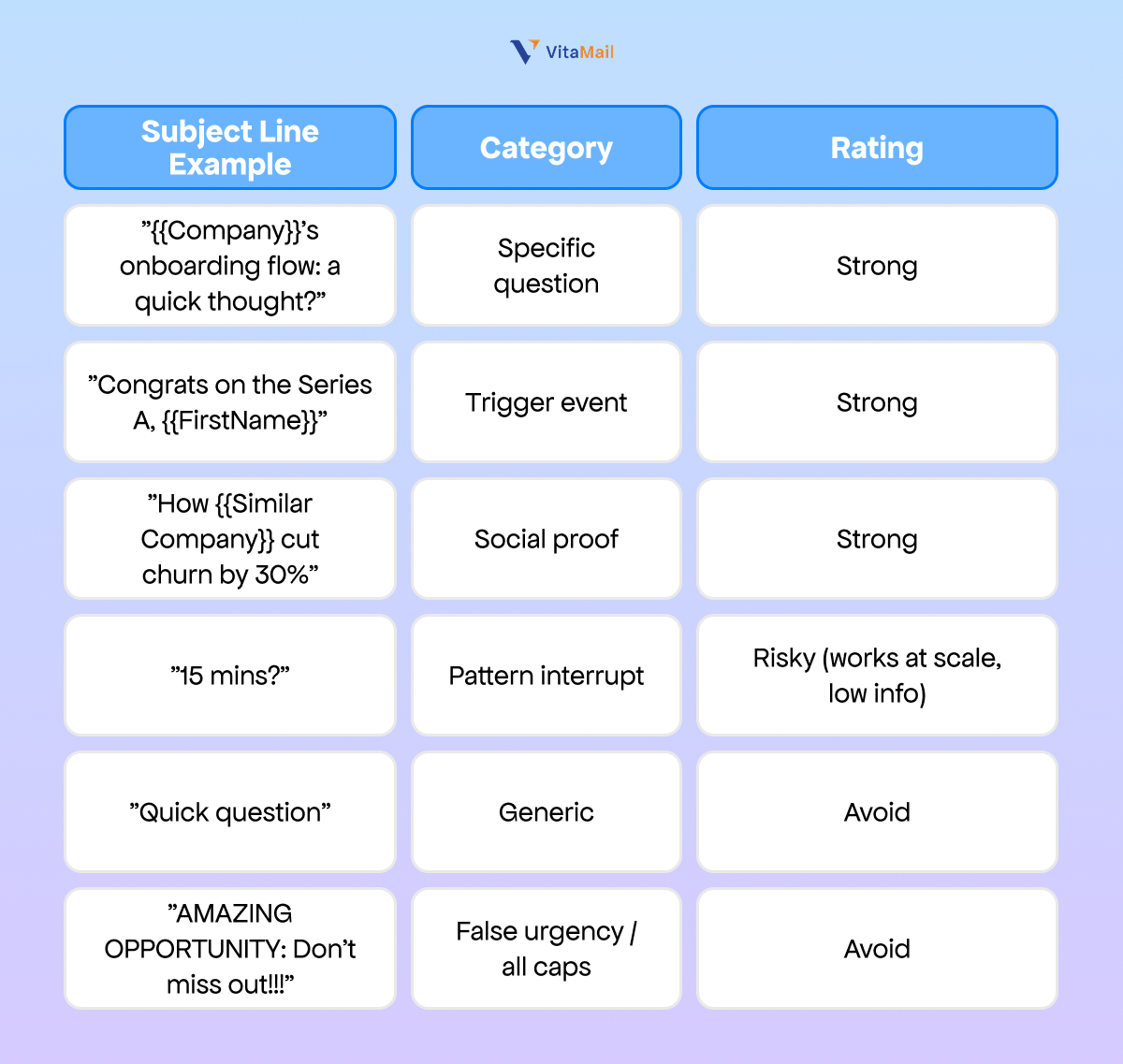
What not to write: "Quick question" with no personalisation, subject lines over 60 characters (truncated on mobile), and anything with false urgency or all caps.
The mistake this replaces: spending 30 minutes on the email body and 10 seconds on the subject line.
Practice 5: Open With a Personalised, Specific First Line
The first sentence of the email body is what converts an open into a read. If your opener is about you, your company, or your product, the prospect stops reading. If it is about them, they keep going.
- Generic opener: "My name is Alex and I work at Outbound Co. We help sales teams book more meetings through AI-powered outreach. I wanted to reach out because I think we could be a great fit for your team."
- Personalised opener: "Saw you just promoted your SDR lead to Head of Sales. That is usually when teams start thinking about scaling outbound more seriously."
The difference is immediate. The generic opener asks the prospect to care about a stranger's product. The personalised opener demonstrates research and references something specific to their world.
Three reliable sources for openers: a recent company news item (funding round, product launch, expansion), a LinkedIn post the prospect wrote, and a trigger event visible from public data (a new hire, a job posting, a technology change). Some teams also use partner overlap data to personalise AI outbound messages and make cold outreach feel more relevant from the first interaction
The mistake this replaces: opening with your name, your company, and your product in the first three sentences.
Practice 6: Keep the Email Under 150 Words
Analysis by Boomerang found that emails between 50 and 125 words had the highest response rates. Lavender's 2024 data confirmed the pattern: cold emails under 100 words outperform longer versions (Lavender, "Cold Email Benchmarks," 2024). Shorter emails get more replies.
If you cannot say it in 150 words, you are trying to do too much in one email. Cut the company background. Cut the feature list. Keep the personalised opener, one sentence of relevance, and the CTA.
- Before (250 words): "Hi Sarah, my name is Alex and I'm the co-founder of Outbound Co. We're an AI-powered sales platform that helps B2B teams automate outbound. We've worked with Acme Corp, TechStart, and GrowthLabs to increase pipeline by 3x in under 90 days. Our platform includes email sequencing, LinkedIn automation, a built-in CRM, and AI personalisation. I noticed your company recently raised a Series A and is hiring sales roles, which usually means you're scaling outbound. I'd love to show you how we've helped similar companies. Would you be open to a 30-minute call this week?"
- After (95 words): "Hi Sarah, saw you just closed your Series A and are hiring three SDRs. That usually means outbound is about to become a priority. We helped TechStart (also Series A, similar team size) go from zero to 40 booked meetings per month within their first quarter of outbound. Worth a 15-minute call to see if a similar playbook could work for {{Company}}?"
The shorter version is sharper, not thinner. It says everything the prospect needs to decide whether to reply.
The mistake this replaces: treating email one as a product brochure.
Practice 7: Use One Clear Call to Action
Multiple CTAs create decision paralysis. When you ask the prospect to do three things, the most likely outcome is they do none of them.
The CTA in a cold email should always be low-friction: a yes/no question, a request for a 15-minute call, or a single Calendly link. Never a purchase, a demo signup, and a referral request in the same email.
Ask for a reply before you ask for a meeting. The first email asks a question that can be answered in one sentence ("Is this something your team is thinking about?"). The meeting request comes in the reply thread, where friction is lower.
- Overloaded CTA: "Let me know if you'd like a demo, a free trial, or to be connected with a case study."
- Single CTA: "Worth a 15-minute call next week to see if this fits?"
The single CTA gives the prospect one decision. The overloaded version gives them three, plus the implicit fourth: ignore everything.
The mistake this replaces: ending an email with "let me know if you'd like a demo, a free trial, or to be connected with a case study."
Sequencing: Why One Email Is Never Enough
Research from Salesforce's State of Sales report (2024) shows that it takes an average of 5–8 touches to generate a meaningful response in B2B outreach. Teams that stop after one or two touches leave the majority of bookable conversations on the table.
Practice 8: Send a Multi-Touch Sequence, Not a Single Email
A single email gives you one chance to land at the right moment with the right message. A multi-touch sequence gives you five.
The anatomy of a 5-touch sequence looks like this: touch 1 is the relevance hook (your strongest personalised message), touches 2–4 introduce new angles (a different value proposition, a case study, a relevant question), and touch 5 is the breakup email (a short, direct message that signals you will not follow up again, which often generates a final wave of replies).
Recommended timing: Day 1, Day 4, Day 8, Day 14, Day 21. Too fast (daily emails) feels like harassment and triggers spam complaints. Too slow (two weeks between touches) loses context.
Read the cold email follow-up sequence guide for templates and timing variations by industry.
The mistake this replaces: sending one email, waiting two weeks, and concluding that cold email doesn't work.
Practice 9: Every Follow-Up Must Add New Value
"Just following up on my last email" is not a follow-up. It is noise. It tells the prospect nothing new and gives them no reason to respond that they did not already have.
Three types of new hooks that work: a new stat or insight relevant to their industry, a case study from a similar company, and a direct question about a specific pain they are likely experiencing.
- Lazy follow-up: "Hi Sarah, just circling back on my last email. Did you get a chance to look at it? Would love to connect."
- Value-adding follow-up: "Hi Sarah, we just published a breakdown of how TechStart went from 0 to 40 booked meetings in 90 days with a 3-person SDR team. Given your hiring push, thought it might be relevant. Worth a quick chat?"
The lazy version asks the prospect to go re-read an email they already chose not to reply to. The value-adding version gives them a new reason to engage.
The mistake this replaces: copying and pasting the original email with "just circling back" added to the top.
Practice 10: Send at the Right Time
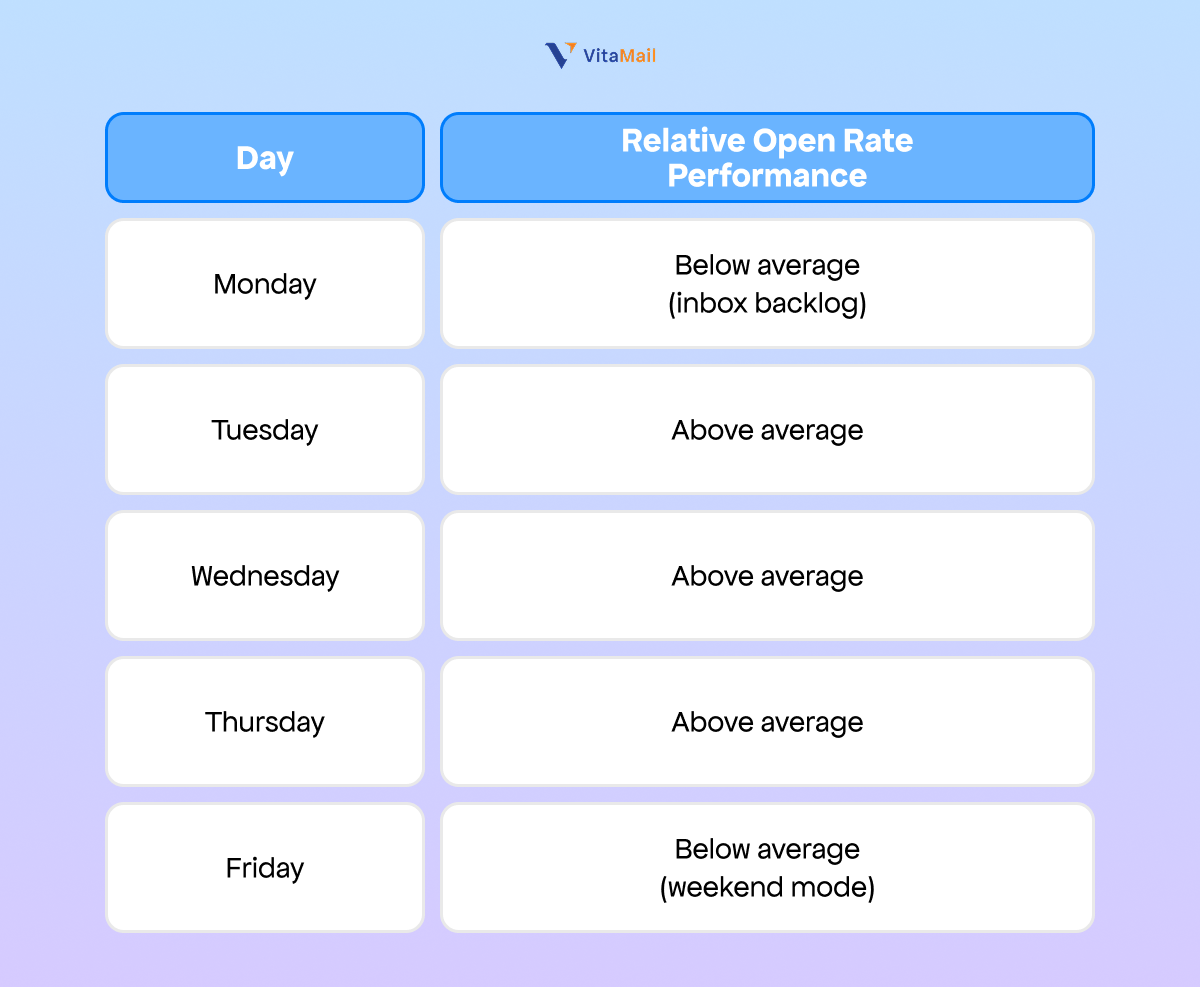
Data from HubSpot's email marketing research (2024) shows that Tuesday through Thursday, between 8–10am or 3–5pm in the recipient's timezone, consistently outperforms other send windows for open and reply rates.
Monday mornings underperform because recipients are catching up on the weekend backlog. Friday afternoons underperform because recipients are mentally shifting into the weekend.
Timezone accuracy requires knowing where the prospect is located. This is a data quality issue, not just a scheduling one.
The mistake this replaces: sending every email at 9am your own timezone regardless of where the prospect is.
Analytics: Measuring What Matters and Fixing What Doesn't
Practice 11: Monitor Your Four Core Metrics and Know What Each One Diagnoses
Cold email campaigns generate four metrics that matter. Each one diagnoses a different problem.
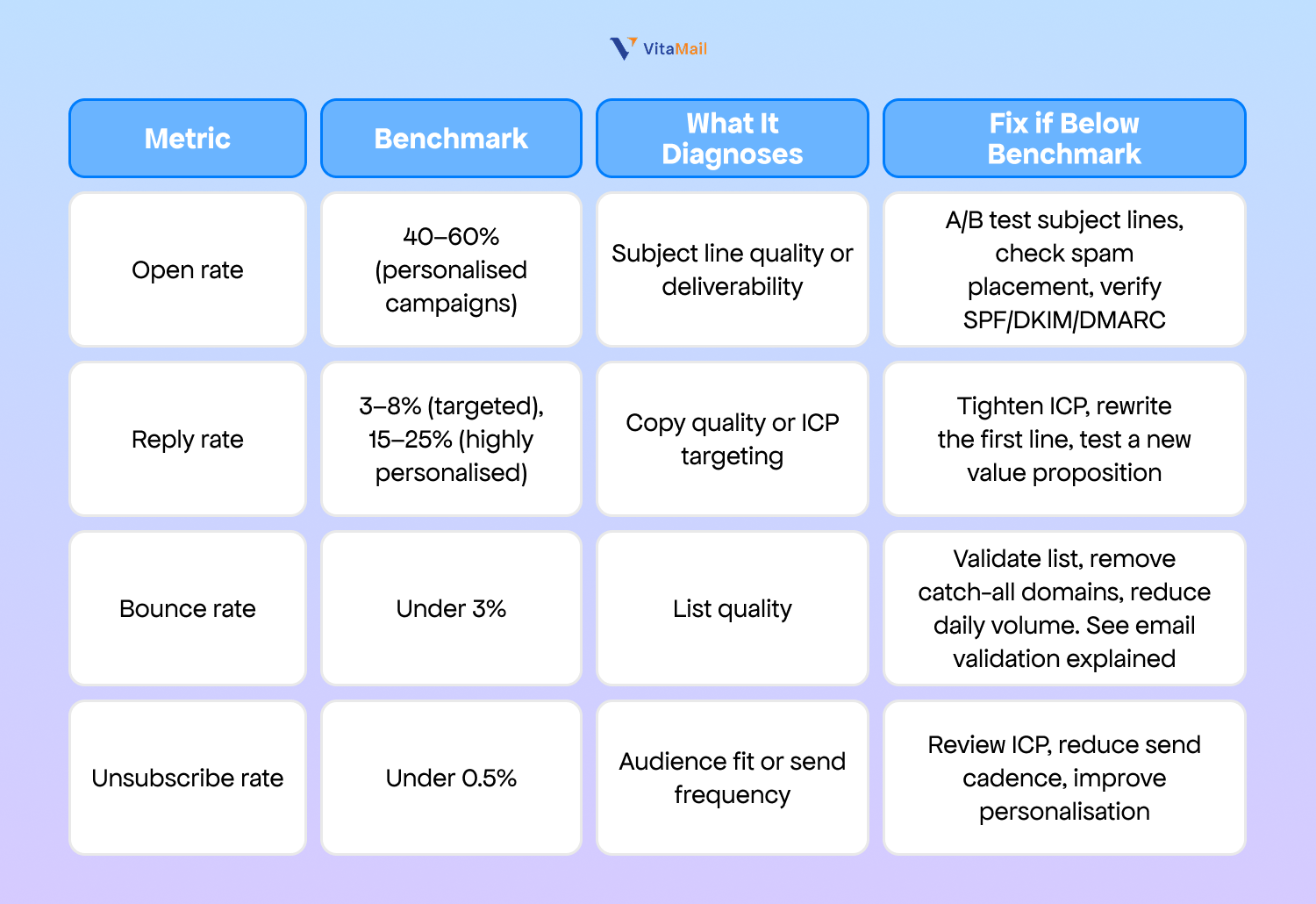
The iteration principle: change one variable at a time. If you rewrite the subject line, the opener, and the CTA simultaneously, you will never know which change drove the result. Test one variable per week. Measure. Then move to the next.
Compliance: Staying Legal While Scaling
Practice 12: Understand the Law in Every Market You Are Sending To
Compliance is not a legal technicality. It is a deliverability and reputation concern. ISPs treat non-compliant senders as spammers regardless of intent. Recipients who cannot find an unsubscribe link are more likely to hit the spam button, damaging your domain reputation directly.
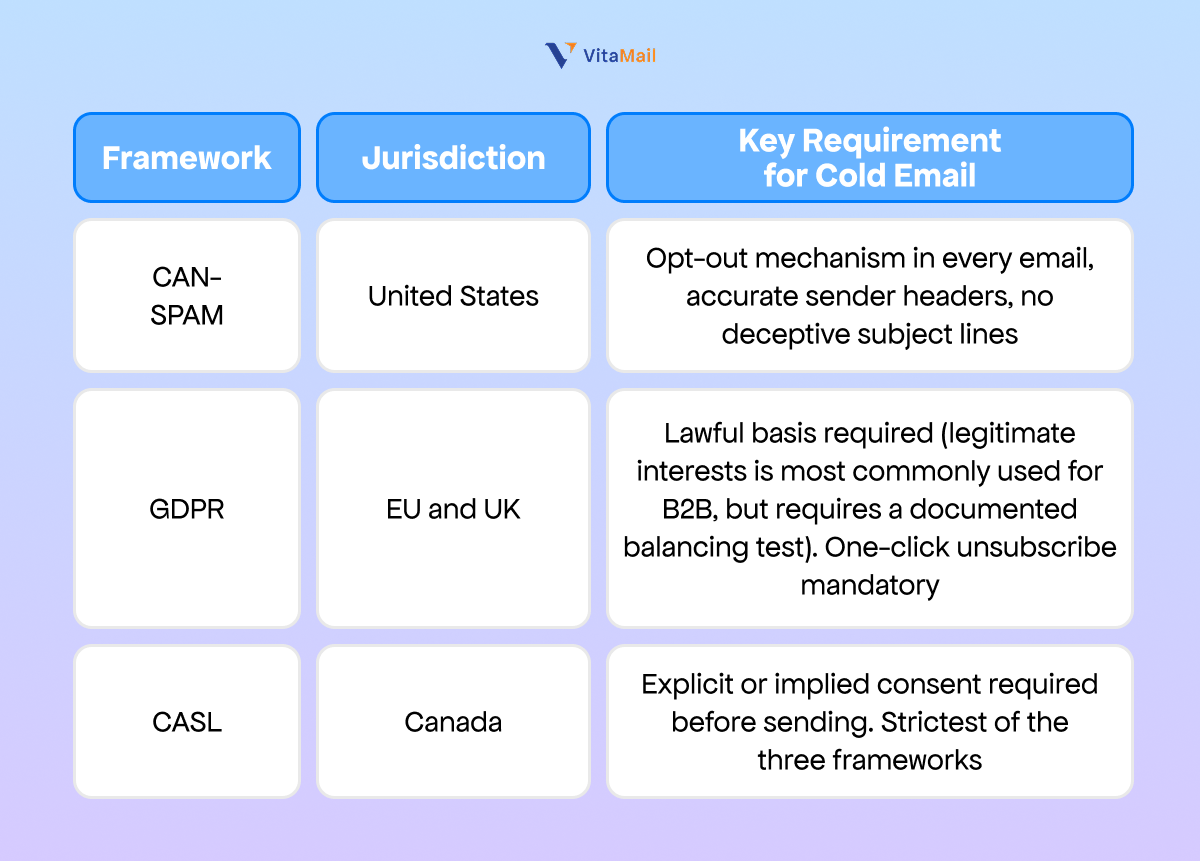
Explicit or implied consent required before sending. Strictest of the three frameworks
Four actions cover the minimum requirement across all three frameworks:
- Include a one-click unsubscribe link in every email.
- Honour opt-outs within 10 business days (CAN-SPAM requires this as a maximum; best practice is immediate).
- Do not use misleading subject lines.
- Maintain a suppression list and check it before every send.
Learn more about email marketing laws by country for a detailed breakdown by jurisdiction.
The mistake this replaces: assuming that because you are not a spammer, the law does not apply to you.
The Cold Email Outreach Checklist: 12 Things to Verify Before You Send
Use this checklist before every campaign. If any item is unchecked, fix it before sending.
- ICP defined in writing before the lead list was built
- Lead list validated for SMTP, catch-all, and disposable addresses
- Sending domain warmed for at least 3 weeks
- SPF, DKIM, and DMARC records verified and passing
- Subject line under 60 characters with no deceptive language
- Opening line is personalised and specific to this recipient
- Email body is under 150 words
- One CTA only per email
- Multi-touch sequence scheduled with a minimum of 3 touches
- Each follow-up has a new hook (not "just following up")
- Unsubscribe link or opt-out mechanism included in every email
- Send time scheduled for Tuesday to Thursday, 8–10am or 3–5pm in the recipient's timezone
How VitaMail V5 Applies All 12 Practices Automatically
Every practice in this guide maps to a specific feature in VitaMail V5:
Foundation: V5 generates your ICP automatically from your website URL, then builds a targeted lead list. Every address passes SMTP verification, catch-all detection, and disposable email filtering before entering a sequence.
Deliverability: Built-in domain warmup ramps send volume over three weeks with automated engagement signals. SPF, DKIM, and DMARC configuration is guided through the setup wizard.
Copywriting: V5's AI generates personalised subject lines and opening lines for each prospect using company data, recent news, and detected trigger events.
Sequencing: Automated multi-touch sequences with configurable timing and send-time optimisation based on the prospect's detected timezone.
Analytics: The campaign dashboard tracks open rate, reply rate, bounce rate, and unsubscribe rate with diagnostic recommendations when metrics fall below benchmark.
Compliance: VitaMail V5 includes automatic unsubscribe handling and suppression list management across all campaigns.
Conclusion
Cold email outreach is not complicated. It is specific. The gap between a 1% and a 20% reply rate is not luck or writing talent. It is the consistent application of the 12 practices in this guide: precise targeting, validated data, deliverability hygiene, sharp copy, disciplined sequencing, and legal compliance.
VitaMail V5 was built to apply all twelve automatically, so your team can focus on replies, not setup.