



Email marketing delivers the highest ROI of any marketing channel, but that return is built on a fragile foundation: deliverability. You can have the best copy, the sharpest design, and an unbeatable offer, but if your message lands in the spam folder, or worse, doesn't get delivered at all, it’s all for nothing.
The single most important factor you control is the health of your list.
This is where email list hygiene becomes your most powerful lever for growth. In 2026, it’s no longer a "nice-to-have" biannual task. It’s a critical, automated process that separates high-performing brands from those wondering why their open rates are tanking.
This guide provides a tactical, step-by-step plan to optimize your email list hygiene, automate the process, and protect your sender reputation for good.
What is Email List Hygiene?
Email list hygiene is the ongoing process of identifying and removing invalid, unengaged, and risky email addresses from your subscriber list.
Think of it as preventative healthcare for your email program. Instead of just letting your list grow, you actively curate it to ensure it only contains high-quality contacts who are actively interested in your brand.
A clean list isn't just about removing "bad" emails. It's about maintaining a database of engaged subscribers, which signals to inbox providers like Gmail, Outlook, and Apple Mail that you are a high-quality sender worth placing in the primary inbox.
Why Email List Hygiene Matters
Ignoring list hygiene is like trying to fill a leaky bucket. You spend all your time and money acquiring new leads (water), only to lose them through bounces and unsubscribes (the leaks).
A clean list, on the other hand, plugs those leaks and ensures every drop of your marketing effort counts.
Impact on Deliverability and Sender Reputation
Your sender reputation is a score that Internet Service Providers (ISPs) assign to your sending domain. This score is the primary factor in determining if your emails land in the inbox or the spam folder.
Poor hygiene directly damages this reputation. High bounce rates, low engagement, and spam complaints are all red flags. A clean list does the opposite:
- Low Bounces: Shows ISPs your list is up-to-date.
- High Engagement (Opens/Clicks): Shows ISPs that recipients want your email.
- Low Complaints: Shows ISPs you aren't sending unsolicited mail.
This positive feedback loop improves your sender score, which in turn boosts your deliverability, creating a cycle of success.
Compliance & Legal Risk (GDPR, CAN-SPAM, CASL)
This isn't just a best practice; it's a legal requirement. Maintaining a clean list is your first line of defense against costly violations.
Compliance Callout:
- CAN-SPAM (USA): Requires you to honor opt-out requests promptly. Failing to remove unsubscribed users is a direct violation. Penalties can reach up to $53,088 per email.
- GDPR (EU): Mandates that you have explicit, provable consent (Art. 7) and that data is accurate (Art. 5). Sending to unengaged users who haven't confirmed consent or old, inaccurate addresses is a compliance risk. Fines can be up to €20 million or 4% of global revenue.
- CASL (Canada): Requires explicit consent. A key part of CASL is that consent can expire. Regularly cleaning your list ensures you are only mailing those with active, implied, or explicit consent.
Cleaning vs. Scrubbing: Key Differences
While often used interchangeably, "cleaning" and "scrubbing" (or "validation") refer to two different parts of the hygiene process.
- Email List Cleaning: This is the strategic process of segmenting and removing subscribers based on their engagement data. You do this inside your Email Service Provider (ESP).
- Example: Removing subscribers who haven't opened an email in 120 days.
- Email List Scrubbing (Validation): This is the technical process of verifying whether an email address is valid, deliverable, and safe. This is done using a third-party tool (like Vitamail's Email Validator).
- Example: Uploading a list to identify hard bounces, typos (gmial.com), disposable domains, and spam traps before you ever send an email.
You need both. Strategic cleaning manages engagement, while technical scrubbing protects your reputation from toxic addresses.
Risks of Poor Email Hygiene
What happens if you let your list decay? The consequences are fast, compounding, and costly. Even a healthy list decays by 22.5% to 30% every year as people change jobs, abandon old addresses, or lose interest.
Bounce Rates & Spam Traps
- Hard Bounces: These are permanent delivery failures (invalid address, fake domain). ISPs see anything above a 0.5% hard bounce rate as a major red flag.
- Soft Bounces: Temporary issues (inbox full, server down). If an address soft-bounces repeatedly, ESPs will treat it as a hard bounce.
- Spam Traps: These are "honeypot" email addresses used by ISPs and anti-spam services to catch malicious senders. They look real but have no human owner. Sending to even one can get your domain or IP address blacklisted. They are the single biggest threat posed by un-scrubbed, purchased, or scraped lists.
Blacklisting and Sender Penalties
If your bounce rates and spam complaints (aim for below 0.1%) are too high, you’ll end up on a blacklist.
A blacklist is a public database of senders known for spammy behavior. Once you're on one (like those run by Spamhaus or Barracuda), major ISPs will automatically block or filter your emails. Getting off a blacklist is a slow, painful, and manual process that can halt your email marketing for weeks.
Step-by-Step Guide to Cleaning Your List
Here is the tactical, 7-step playbook for a full-scale list cleaning and optimization.
1. Segment Subscribers by Engagement
First, stop viewing your list as one giant entity. Create segments based on the last time a subscriber engaged (opened or, more importantly, clicked).
- Engaged (0–90 days): Your active, healthy audience. Keep sending.
- Cooling (91–180 days): Still valuable, but at risk. Target them with your best content.
- Lapsing (181–365 days): High risk. These subscribers need a re-engagement campaign.
- Dormant (365+ days): These users are actively harming your sender reputation. Stop mailing them in your regular flow and prepare to sunset them.
2. Run a Re-Engagement Campaign
Before you delete your "Lapsing" segment, try to win them back. Create an automated 2-3 email "win-back" campaign.
- Email 1: The "We Miss You" (with a hook):
- Subject: "Is this goodbye?" or "A special offer, just for you."
- Body: Acknowledge their absence and present your best-performing content, a new feature, or a compelling discount. The goal is a single click.
- Email 2: The Final Call (with urgency):
- Subject: "We're removing you from our list"
- Body: Be transparent. "To make sure we're only sending emails people want, we're cleaning our list. If you want to stay, just click the link below!"
- Email 3: The Unsubscribe (if no action):
- Body: "You've been unsubscribed. No hard feelings! If you change your mind, you can always re-subscribe at [link]."
Anyone who clicks a link in this flow is re-tagged as "Engaged." Anyone who doesn't is moved to your suppression list.
3. Implement a Sunset Policy
A sunset policy is an automated rule that stops you from emailing unengaged subscribers. This is your most important automated workflow.
How to set it up (Example Workflow):
- Trigger: Subscriber has not opened or clicked an email in 120 days.
- Action: Add subscriber to the "Re-Engagement" automated workflow (see Step 2).
- Condition: Did the subscriber click a link in the workflow?
- If YES: Remove "Lapsing" tag. Add "Re-Engaged" tag. Return to main list.
- If NO: Add subscriber to a suppression list.
This one automation will solve 80% of your deliverability problems.
4. Remove Bounces, Invalid, and Role Accounts
This is the technical scrubbing part. Before you run a big campaign or onboard a new list, you must validate it.
Use a service like Vitamail's Email Validator to scrub your list and identify:
- Invalid / Hard Bounces: userdoesntexist@domain.com
- Syntax Errors: user@gmial.com (typos)
- Disposable Emails: 10minutemail@...
- Role Accounts: info@, support@, admin@ (These have low engagement and high complaint rates)
- Spam Traps: (The tool identifies domains and patterns known to be traps)
Immediately remove all of these from your list. Do not email them. Ever.
5. Confirm Subscriptions (Double Opt-in)
The best way to keep your list clean is to start clean. A double opt-in process is the 2026 standard.
- Single Opt-in: User fills out a form. They are added to the list. (Fast, but risky. Prone to typos and bots).
- Double Opt-in: User fills out a form. They receive an automated email asking them to "Confirm your subscription." Only after they click that link are they added to your list.
This process guarantees the email is valid, the user is engaged, and you have explicit, provable consent (hello, GDPR).
6. Automate Your List Hygiene Workflows
You cannot do this manually. Set up "if-then" automations in your ESP or platform.
7. Monitor & A/B Test Your Hygiene Schedule
Don't "set it and forget it." Your "90-day" window might be too long. Or too short.
- A/B Test Your Win-back: Try sending your win-back campaign at 90 days for Group A and 120 days for Group B. Does one group re-engage at a higher rate?
- A/B Test Your Offer: Does a 20% discount (Group A) re-engage more users than a "free guide" (Group B)?
Use data to refine your hygiene schedule until it's optimized for your specific audience.
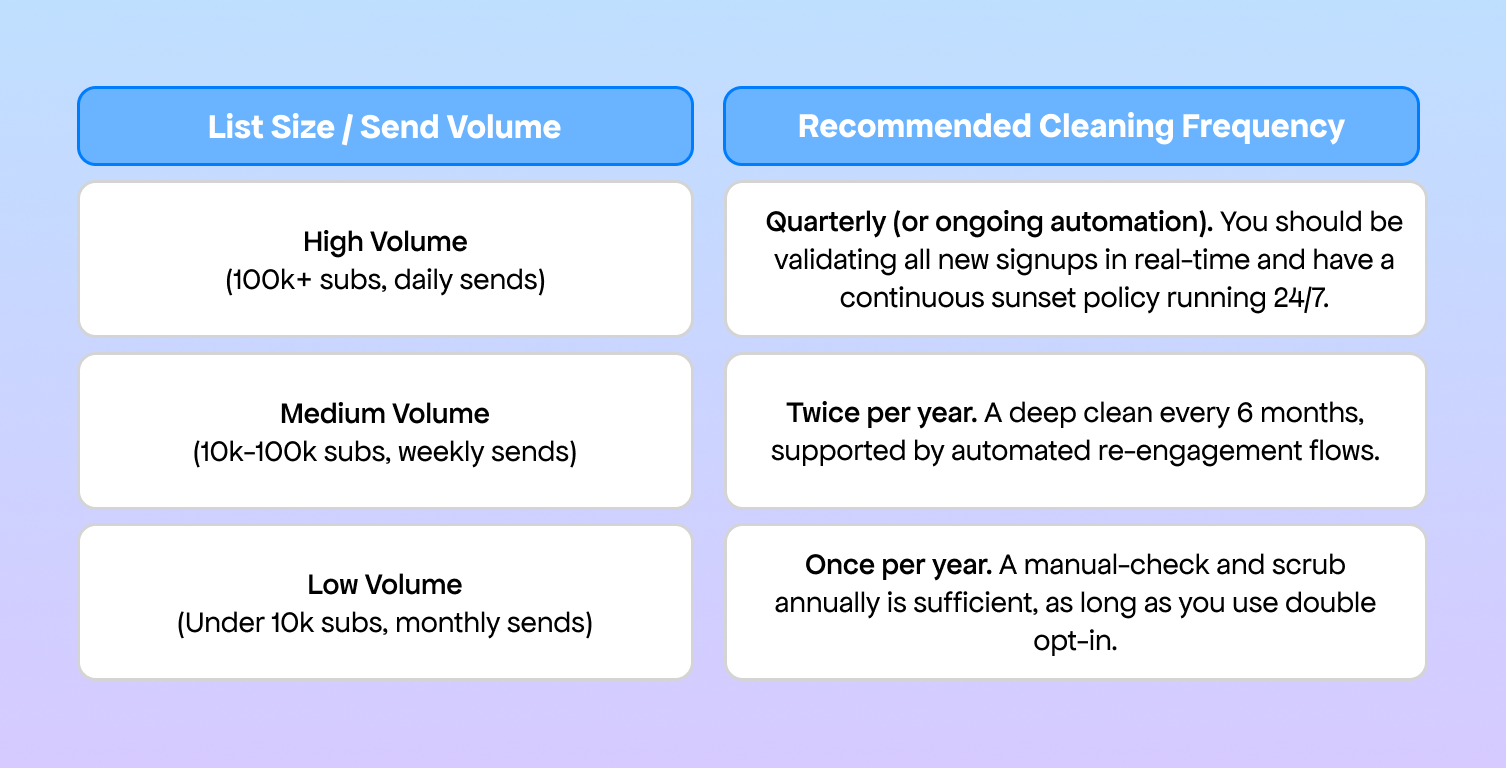
🗓 How Often Should You Clean Your Email List?
This depends on your list size and send volume.
Tools & Services for Email List Cleaning
No single platform does it all. You'll need a combination of your ESP and a dedicated validation tool.
- Email Service Providers (ESPs): (Mailchimp, Klaviyo, ActiveCampaign) These are where you build your strategic automations, like re-engagement campaigns and sunset policies.
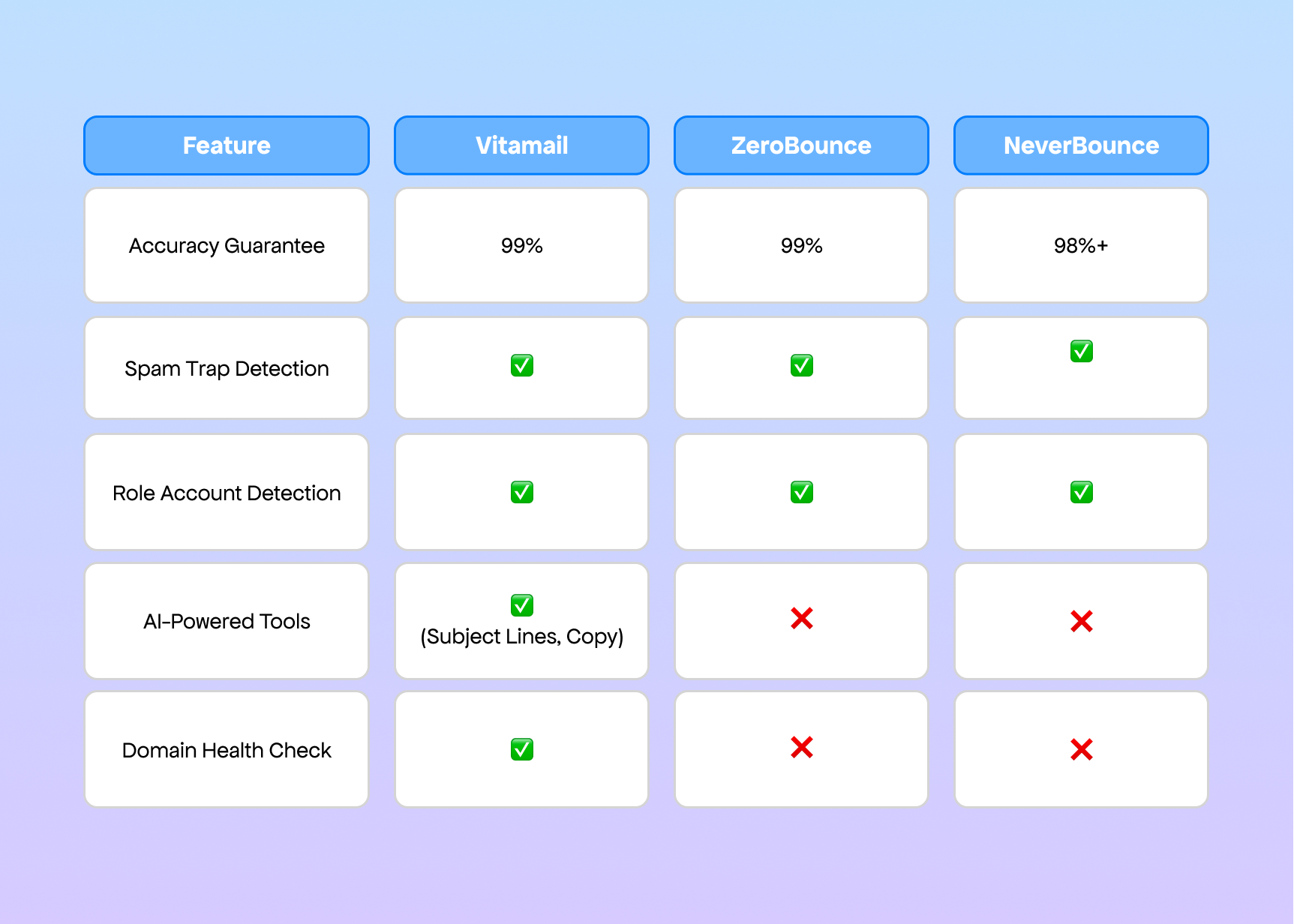
- Email Validation Tools: (Vitamail, ZeroBounce, NeverBounce, Bouncer) These are for the technical scrubbing. You use them to check for bounces, traps, and typos.
Feature Comparison (What to Look For):
Key Metrics to Track
You can't manage what you don't measure. Create a simple "List Hygiene Dashboard" and track these KPIs monthly:
- Bounce Rate: (Hard Bounces / Total Emails Sent). Goal: < 0.5%
- Spam Complaint Rate: (Complaints / Total Emails Delivered). Goal: < 0.1%
- Unsubscribe Rate: (Unsubscribes / Total Emails Delivered). Goal: < 0.5%
- List Growth Rate: (New Subs - Unsubs) / Total List Size.
- Engagement Rate: (% of list that has opened or clicked in 90 days).