



In the world of email marketing, the size of your list can often feel like a badge of honor. But ask any deliverability expert, and they’ll tell you that a bloated list full of dormant contacts is not only expensive, it’s actively harmful to your sender reputation and bottom line.
Maintaining a clean, engaged email list, often called list hygiene, is one of the most crucial tasks for any successful digital marketer. Here is your essential guide on identifying when to keep a subscriber and when it’s time to let them go.
Why List Hygiene Is Not Optional
Before we get into the specifics, understand this: Internet Service Providers (ISPs) like Google, Microsoft, and Yahoo prioritize user experience. When they see your emails going out to thousands of people who never open, click, or even scroll, they flag your content as low-quality.
The consequences of neglecting list cleaning are significant:
- Lower Deliverability: Your emails are more likely to land in the Spam folder—even for your most engaged subscribers.
- Higher Costs: Most Email Service Providers (ESPs) charge based on subscriber volume. You're paying to mail people who will never convert.
- Inaccurate Metrics: Low open and click rates distort your true engagement metrics, making it impossible to accurately measure the success of your campaigns.
Part 1: When to Let Go (The Essential Cuts)
For certain segments of your list, the decision is easy. These contacts are actively hurting your performance and should be removed immediately.
1. Hard Bounces
A hard bounce means the email address is permanently invalid or nonexistent. Continuing to send to these addresses tells ISPs that your list acquisition methods are poor.
- Action: Immediately remove any contact that results in a hard bounce. Your ESP should automate this process, but it is wise to confirm.
2. Spam Complains
These are subscribers who clicked the "Report Spam" button. While it's impossible to please everyone, a high rate of spam complaints is a major red flag for ISPs.
- Action: Remove these subscribers immediately. Continuing to email them is a guaranteed way to tank your sender reputation.
3. The Unengaged and Dormant (12+ Months)
This is the largest segment of potential dead weight. If a subscriber hasn't opened or clicked any of your emails in 12 to 18 months, they are likely never going to. They may have abandoned the email address or simply lost interest.
- Action: Do not immediately delete these users. Instead, place them in a special segment for a final, crucial step: The Re-Engagement Campaign.
Part 2: The Last Chance: The Re-Engagement Campaign
You shouldn't remove a non-engaging subscriber without giving them one final opportunity to raise their hand. A re-engagement campaign is a sequence of 2-3 emails designed to elicit a simple "Yes" or "No" regarding continued subscription.
Example Campaign Structure:
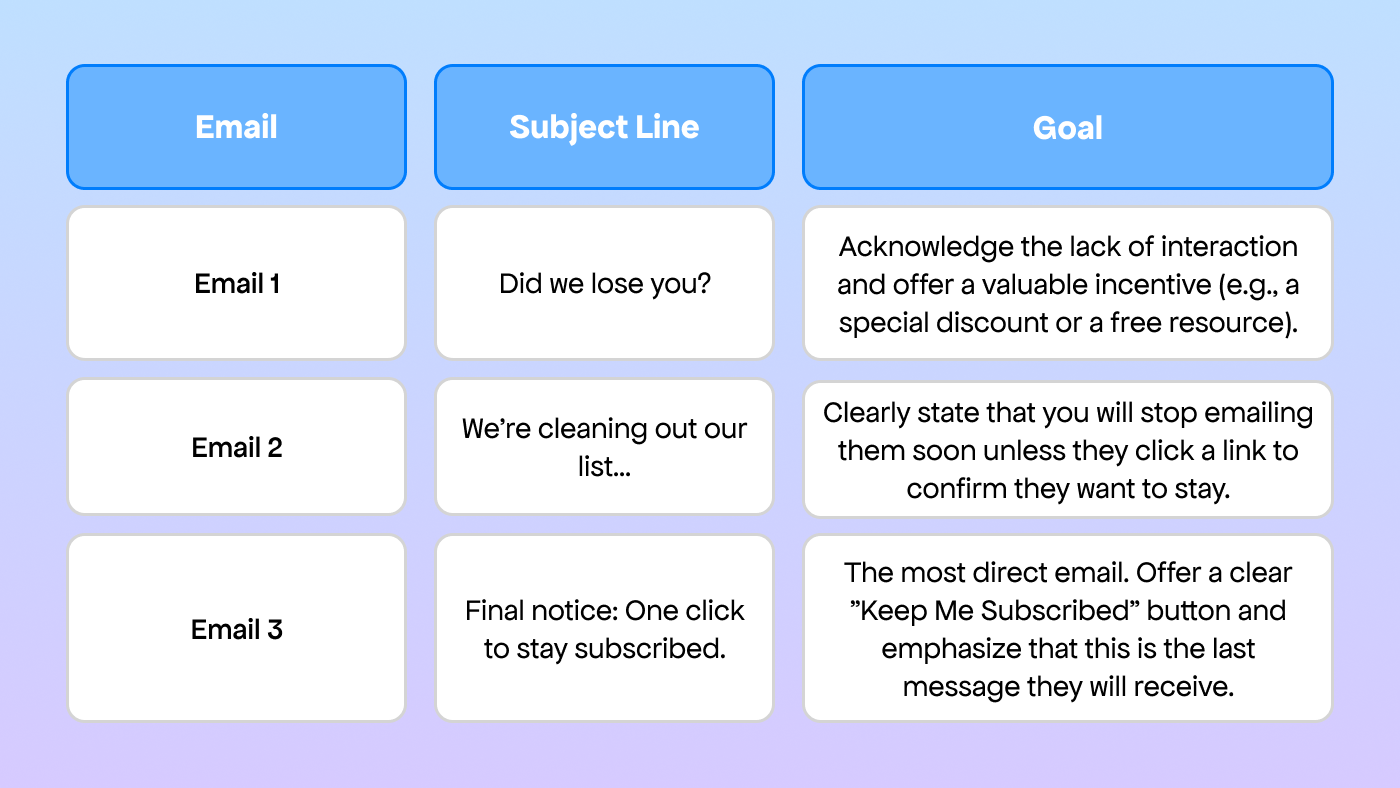
The Decision Point:
- Keep: Any subscriber who opens, clicks, or interacts with the re-engagement campaign. Move them back to your general active list.
- Let Go: Any subscriber who fails to open or click on any of the emails in the re-engagement sequence. Remove these contacts from your database completely.
Part 3: When to Keep (Value Over Volume)
While engagement is the primary metric, there are scenarios where you should hesitate before deleting a contact, even if their open rate is low.
1. Recent Purchasers
If a subscriber made a purchase in the last 6-12 months, they are still a customer. While they may not be opening every marketing email, they may open transactional or highly specific promotional emails.
- Strategy: Segment these users. Reduce their email frequency, focusing only on high-value communications like product updates, exclusive offers, or loyalty programs.
2. New Subscribers (0-6 Months)
A new lead may simply be in the research phase. Deleting them too soon is akin to cutting off a conversation before it starts.
- Strategy: Give new sign-ups ample time to move through your welcome series and nurture sequence. If they haven't engaged after six months, then consider moving them to the re-engagement process.
3. The "Silent Clickers"
Sometimes, a subscriber has low or zero open rates but does click on specific emails, possibly using an email client that pre-loads images (falsely inflating an open) or simply skimming subject lines without triggering the open pixel.
- Strategy: If your ESP data shows a click history, even with a poor open rate, they are still valuable. Clicks are a much stronger signal of intent than opens.
🚀 Accelerate Your Cleaning Process: Verify First!
Manually dealing with hard bounces and invalid addresses can be a time sink that puts your sender reputation at risk. Before you launch your next re-engagement campaign or send your next major newsletter, eliminate the worst offenders instantly.
Using a Bulk Email Verifier ensures that every address you send to is valid, protecting your sender reputation and maximizing your deliverability from day one.
Ready to instantly scrub your list of invalid addresses and secure your deliverability? ➡️ Verify Your Bulk List Now with Vitanur's BulkVerifier
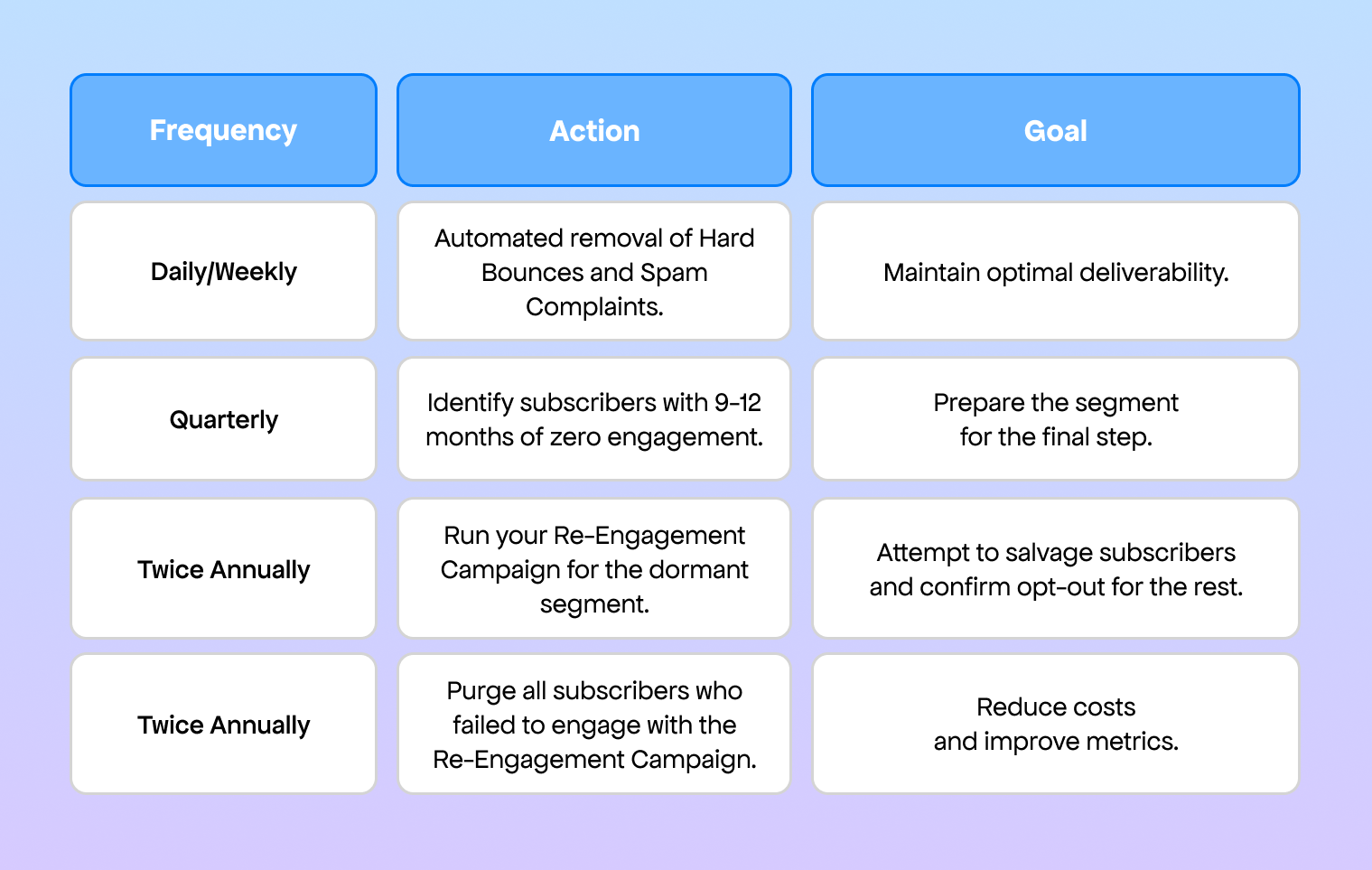
Summary: A Simple List Cleaning Timeline
List cleaning is not a one-time event; it should be an ongoing part of your marketing calendar.
Remember: Quality always trumps quantity. A smaller list of highly engaged subscribers will generate better results, boost your ROI, and keep your emails out of the spam folder, ensuring your message gets to those who want to hear it most. Start cleaning today.