




Apollo.io is the default starter platform for outbound teams, and that is exactly why so many teams hit a ceiling with it. It does three jobs adequately: contact data, cold email sending, and basic sequencing. The problem starts when one of those three becomes the bottleneck and Apollo's depth in that area runs out.
The strongest Apollo.io alternatives fall into four categories: B2B contact databases (ZoomInfo, Cognism, Lusha), cold email platforms (Lemlist, Instantly, Smartlead), sales engagement suites (Salesloft, Outreach), and end-to-end AI outbound platforms (Reply.io, VitaMail). The right choice depends on the bottleneck you actually face: data coverage, deliverability, multi-channel sequencing, or unified workflow.
This article covers all nine alternatives, groups them by the problem they solve, gives you a decision framework, and ends with an honest comparison matrix. No affiliate ranking, no pretending one tool wins for everyone.
Key Takeaways:
- Teams switch off Apollo for four reasons: weak EMEA/APAC data, deliverability limits past 20 to 50 emails per inbox daily, shallow personalization, and GDPR compliance gaps.
- Personalized cold emails get 8 to 15% reply rates versus just 1 to 5% for generic ones.
- ZoomInfo has the deepest US data but starts at $15,000+ a year, while Cognism leads on GDPR-compliant EMEA coverage.
- For sending and deliverability, Lemlist, Instantly, and Smartlead each start under $40 a month and outperform Apollo's native sender.
- Solo founders should stick with Apollo or pair Lusha with Instantly; agencies sending 10K+ emails a month should move to Smartlead.
- Pick the fix based on your actual bottleneck: swap the database if data is stale, the sender if deliverability is fragile, or go AI-driven if personalization is too generic.
Why teams look for Apollo.io alternatives
Apollo dominates the entry-level outbound category for good reasons. The platform combines a 275M+ contact database, an email sender, and basic cadence automation at a starting price under $50 per seat per month (Apollo.io pricing page 2025). For a two-person team running their first outbound experiments, that bundle is hard to beat.
The breaking points show up at scale. Four scenarios drive most switches.
Data accuracy outside the United States. Apollo's coverage is strongest in North America and weaker in EMEA and APAC, particularly for direct dials and recent role changes. When Marcus Okafor, Head of Growth at Chartline, expanded his team's outbound into German and Nordic markets, his bounce rate climbed above 4% and his reply rate dropped to almost nothing. Bounce rates above 2% damage sender reputation across the entire domain (Postmark deliverability guide 2024).
Deliverability at higher sending volumes. Apollo handles small daily volumes adequately. Once you push past 20–50 emails per inbox per day, which is the safe ceiling for warm domains (Smartlead and Instantly deliverability guidance 2024), you need infrastructure built for sending: rotating mailboxes, automated warmup, and inbox placement monitoring. Apollo is not built primarily for that.
Personalization depth. Apollo's email composer supports basic merge fields. It does not pull recent LinkedIn posts, funding announcements, job postings, or tech stack changes into each email automatically. Cold email reply rates sit at 1–5% for generic campaigns and climb to 8–15% for well-personalized ones (Belkins outbound benchmarks 2024). Closing that gap requires personalization tooling Apollo does not natively provide.
GDPR exposure. Apollo's contact data sourcing model has been the subject of legitimate compliance debate in the EU and UK. When Priya Mehta, VP Sales at Fidelio in London, ran a procurement review for her Series B SaaS, the legal team flagged Apollo as higher-risk than EU-native databases. That triggered the search for a complete cold outreach system with cleaner compliance documentation.
If none of these apply to your team, Apollo is probably fine. If one or more does, the rest of this article gives you the right alternative for each. These shifts are also changing outbound sales strategies, as teams rethink what still works and which older tactics are losing effectiveness.
How to evaluate Apollo.io alternatives
Comparing these tools is hard because the categories overlap. ZoomInfo competes with Apollo on data but not on email sending. Smartlead competes on email sending but does not have a contact database. The only useful evaluation method is a six-criteria framework applied to the bottleneck you face most often.
- Data coverage. Total contacts, geographic coverage, mobile direct dials, vertical depth.
- Data accuracy. Bounce rate guarantees, refresh frequency, verification methodology.
- Deliverability infrastructure. Native warmup, mailbox rotation, inbox placement monitoring, SPF/DKIM/DMARC guidance.
- Personalization depth. Merge fields only, AI-generated openers, real-time research integration (LinkedIn, news, jobs, tech stack).
- Workflow automation. Single-channel email, multi-channel cadences, full end-to-end campaign creation.
- Pricing model. Per-seat, per-contact, per-credit, flat fee. Annual lock-in vs monthly flexibility.
The bottleneck-first rule: pick the alternative that fixes the problem causing the most pipeline loss right now. Buying a more comprehensive tool to solve a narrow problem wastes budget. Buying a narrow tool when your problem is structural delays the fix.
If you are still calibrating who you sell to, fix that first. The strongest data tool in the world will not save a campaign aimed at the wrong audience. Start with how to define your ideal customer profile, then evaluate alternatives against that ICP.
Best Apollo.io alternatives for B2B contact data
If your bottleneck is data, you need a database alternative. Three stand out.
1. ZoomInfo
ZoomInfo holds the largest verified B2B contact database in the market, with 100M+ verified contacts and the deepest US coverage (ZoomInfo company data 2024). Direct dial coverage is strong, intent data is included on higher tiers, and integrations with Salesforce, HubSpot, and Outreach are mature.
Where it beats Apollo: US enterprise data accuracy, intent signals, integration depth.
Where it loses: Pricing. Annual contracts typically start at $15,000+ and can scale into six figures. ZoomInfo is not for the team replacing a $49 Apollo seat.
2. Cognism
Cognism is the leading EU-native B2B database, built around GDPR-compliant data sourcing and validated mobile direct dials (Cognism product documentation 2024). Coverage of EMEA roles, particularly in the UK, DACH, and Nordics, is materially better than Apollo's.
Where it beats Apollo: GDPR compliance posture, EMEA coverage, mobile dial accuracy.
Where it loses: US coverage is good but not as deep as Apollo or ZoomInfo. Pricing is custom and lands above Apollo for most teams.
3. Lusha
Lusha is the lightest-weight option in this category. The Chrome extension enriches LinkedIn profiles on demand, the database is smaller than Apollo's, and pricing starts around $29 per user per month with a freemium tier (Lusha pricing 2025).
Where it beats Apollo: Simplicity, freemium entry, fast LinkedIn enrichment workflow.
Where it loses: Database depth. Lusha is best as a supplement, not a full Apollo replacement.
When to switch: If your bounce rate is above 3%, your data is more than 6 months stale, or compliance is flagging Apollo, you have a data problem and need a database alternative. If your bounce rate is fine and your reply rate is the issue, the data is not your bottleneck.
Best Apollo.io alternatives for cold email and deliverability
If your bottleneck is sending, deliverability, or personalization, you need a cold email platform. Three lead this category.
1. Lemlist
Lemlist combines cold email sequencing, multi-channel touchpoints (email, LinkedIn, calls), and Liquid syntax personalization that supports custom variables, conditional logic, and image personalization. The platform also includes Lemwarm, an integrated warmup product. Pricing starts at $39 per user per month for the email-only plan (Lemlist pricing 2025).
Where it beats Apollo: Personalization depth, integrated warmup, multi-channel sequencing.
Where it loses: Smaller native lead database. Most teams pair Lemlist with a separate data source.
2. Instantly
Instantly is built for high-volume cold email. Unlimited mailbox connections on most plans, automated rotation across mailboxes, and a B2B Leads add-on with a 160M+ contact database (Instantly product pages 2025). Pricing starts at $37 per month for the Growth plan.
Where it beats Apollo: Sending volume, unlimited inbox connections, deliverability tooling at scale.
Where it loses: Personalization is more basic than Lemlist's. The interface assumes a higher technical literacy.
3. Smartlead
Smartlead is a deliverability-first platform. Unlimited domain warmup, master inbox to consolidate replies across hundreds of mailboxes, sub-sequence routing, and detailed inbox placement reporting (Smartlead product documentation 2024). Pricing starts at $39 per month.
Where it beats Apollo: Deliverability infrastructure, unlimited warmup, scale for agencies and high-volume senders.
Where it loses: No native contact database. Smartlead expects you to bring your own list.
A common pattern for Nadia Reyes, who runs Outbound Lab as a 12-person agency, is to source data from Apollo or Cognism and run sending from Smartlead. The combination beats Apollo's native sending on every campaign her team has tested. If you are running this stack, follow the complete domain warmup guide before scaling daily volume past 30 emails per inbox.
Best Apollo.io alternatives for sales engagement
Sales engagement platforms are a different category. They handle multi-channel cadences, call tasks, LinkedIn touches, and CRM-native analytics for SDR teams operating inside an enterprise sales process.
1. Salesloft
Salesloft is the most widely adopted sales engagement platform among mid-market and enterprise B2B teams. Native Salesforce integration, conversation intelligence, and structured cadence reporting are strengths. Pricing is custom and typically starts in the high four figures per seat per year (Salesloft public pricing references 2024).
Where it beats Apollo: Multi-channel cadence depth, enterprise reporting, CRM-native workflows.
Where it loses: No contact database. Higher cost. Overkill for teams under 10 SDRs.
2. Outreach
Outreach competes directly with Salesloft and is the more common choice in larger SDR organizations. Strong AI features for cadence optimization, deep analytics, and a mature partner ecosystem (Outreach product documentation 2024).
Where it beats Apollo: Cadence intelligence at scale, large-team SDR management, enterprise security.
Where it loses: Same as Salesloft. No data, high cost, complexity.
For James Whitfield, RevOps Lead at Stackr (200 employees), the trigger to evaluate Salesloft was that his SDR team had outgrown Apollo's sequencing depth and his AE team needed call recording and conversation intelligence in the same tool. That combination is where sales engagement platforms earn their cost.
Best Apollo.io alternatives for end-to-end AI outbound
A new category emerged in 2024–2025: AI platforms that consolidate website analysis, ICP definition, lead list generation, warmup, and AI-personalized sending into a single workflow. Two are worth covering.
1. VitaMail
VitaMail V5 is built around a single end-to-end workflow rather than a stack of features. The platform reads a website URL, extracts product details, defines an ICP, generates a validated lead list against that ICP, manages domain health and warmup, and writes AI-personalized cold emails using LinkedIn posts, funding signals, job postings, and tech stack data.
Where it beats Apollo: AI personalization depth at the email level, integrated warmup and validation, single-workflow setup. The product is designed for AI cold email personalization rather than templated merge fields.
Where it loses: VitaMail is a younger platform with a smaller user base than Apollo or Lemlist. Teams that want a separate data source plus a separate sender will prefer the stacked approach.
2. Reply.io
Reply.io combines multi-channel sequencing with AI SDR agents that draft replies, classify intent, and book meetings. The Jason AI agent handles inbound responses autonomously on higher tiers (Reply.io product documentation 2025). Pricing starts around $59 per user per month.
Where it beats Apollo: AI agent features, multi-channel automation, deeper personalization.
Where it loses: Smaller contact database than Apollo's. AI features can be unpredictable on more nuanced use cases.
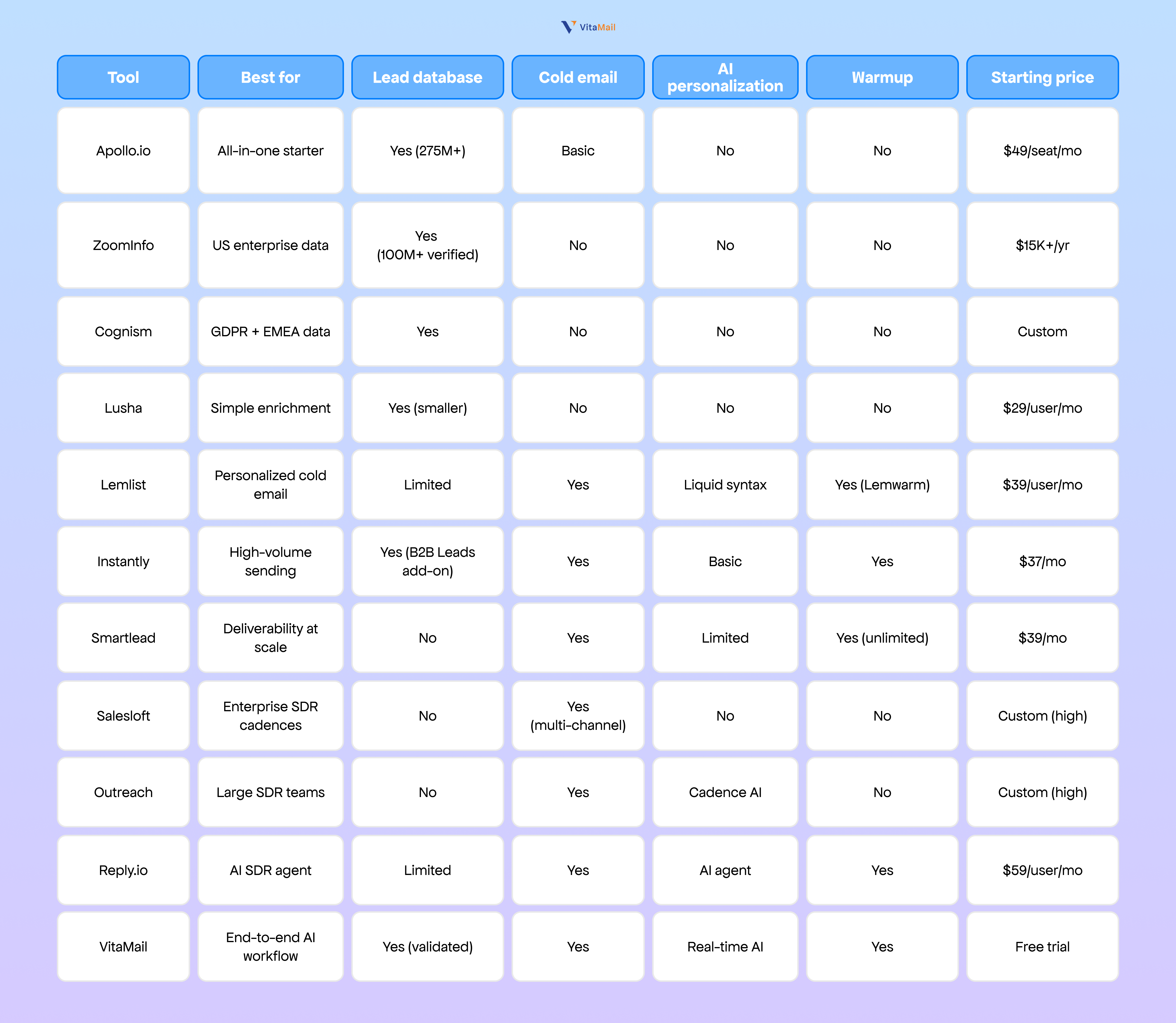
Apollo.io alternatives compared: feature and pricing matrix
The table below summarizes the nine alternatives plus Apollo as the baseline. Use it as a starting filter, not a final decision.
How to choose the right Apollo.io alternative for your team
The decision comes down to four scenarios.
Solo founder or 2-person team running first outbound experiments. Stay on Apollo or move to Lusha + Instantly. Budget matters more than feature depth. Tom Bergmann, founder of Birchvault (18 employees, pre-Series A), runs exactly this stack and gets to break-even on his first campaign before adding tools.
Agency or in-house team running 10K+ emails per month. Move to Smartlead for sending and pair with Apollo, Instantly B2B Leads, or Cognism for data. The deliverability infrastructure pays for itself the first time it prevents a domain from being blacklisted.
Mid-market team in EMEA or with GDPR exposure. Move to Cognism for data and Lemlist for sending. The compliance posture alone justifies the switch.
Mid-market team that wants AI personalization and one workflow. Move to VitaMail or Reply.io. If you want an AI SDR that handles replies, choose Reply.io. If you want a unified pipeline from website to validated leads to AI-personalized sending, choose VitaMail.
Selin Arslan, Marketing Director at Portlio (45-employee ecommerce SaaS), tested Apollo, Lemlist, and VitaMail in parallel for one quarter. Apollo got the leads in fastest. Lemlist had the best personalization controls. VitaMail required the least setup time because the validated lead list generation, warmup, and personalization happened in one onboarding flow rather than three separate tool integrations. Her team picked based on time-to-first-campaign, not feature count.
How VitaMail replaces the Apollo.io workflow
VitaMail is the right alternative for teams that want one workflow instead of a stack. The platform handles the full sequence:
- Reads your website URL and extracts your product, services, and value proposition
- Defines your ICP based on that analysis and refines it with your input
- Generates a validated lead list matched to the ICP, with email verification built in
- Runs domain health checks and automated warmup before any campaign starts
- Generates AI-personalized cold emails using each prospect's LinkedIn activity, recent company news, job postings, and tech stack
- Runs multi-touch sequences with automated follow-ups
- Monitors deliverability metrics in real time and pauses sending if bounce or spam thresholds are crossed
The honest framing: VitaMail does not have ZoomInfo's database depth or Salesloft's enterprise SDR analytics. It is built for B2B teams under 200 employees who want a single tool that goes from website to booked meeting without stitching together five subscriptions.
Conclusion
Pick the Apollo.io alternative that fixes the bottleneck causing the most pipeline loss right now, not the one with the longest feature list. If your data is stale, switch the database. If your sender reputation is fragile, switch the sending platform. If your personalization is generic, switch to AI-driven outreach. If your team is spending more time managing tools than sending campaigns, consolidate.
Apollo earned its position in the market by bundling three jobs at a low price. The alternatives in this article each do one of those jobs better. The right move depends on which job is currently holding your team back.