




A great newsletter screenshot looks like good design. A great newsletter performs on a Tuesday morning when your reader is half-awake, on mobile, scanning twelve other senders. Those are different problems, and most "best newsletter examples" articles only solve the first one.
The best email newsletter examples in 2026 share four traits: a single dominant idea per send, a subject line that signals specific value rather than novelty, a scannable structure that respects mobile reading, and one clear primary action. Seventeen newsletters meet that bar consistently in 2025 and 2026: Morning Brew, The Hustle, Lenny's Newsletter, Stratechery, Why We Buy by Katelyn Bourgoin, The Marketing Meta, Future Social, ARC by Ann Handley, Workweek, Dense Discovery, The Generalist, Fadeaway, Total Annarchy, Exec Sum, The Profile, Marketing Brew, and tldr.
This article tears down each of them against a repeatable five-part framework, then summarises the patterns so you can apply them to your own send this week.
What makes a newsletter worth studying
"It looks great" is the wrong evaluation criterion. Design is the easiest thing for an AI tool to copy and the least correlated with whether a reader opens send number 47.
The five-part teardown framework below is what actually predicts engagement. Every example in this article is judged against the same five questions.
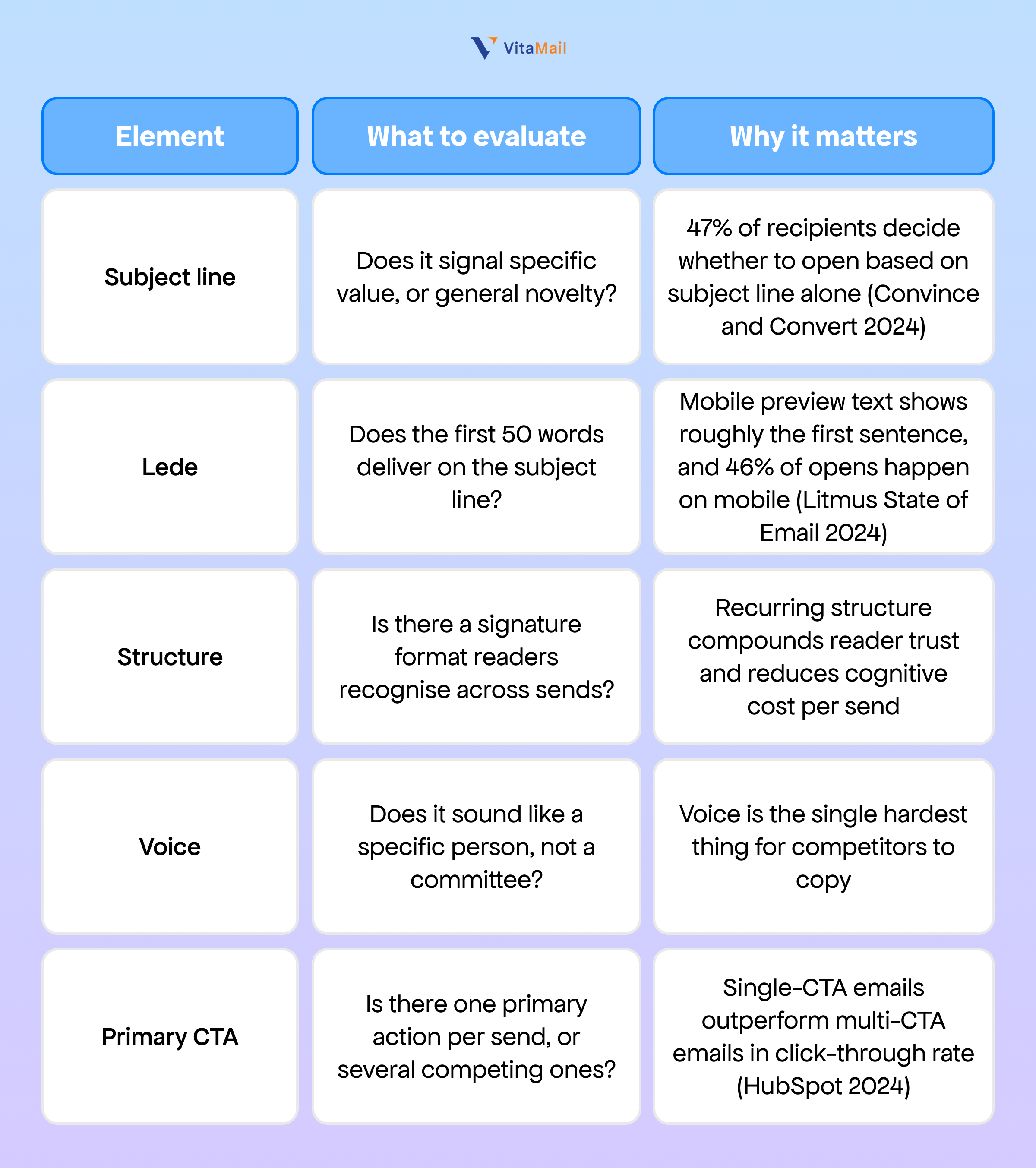
For benchmarks, the average B2B newsletter open rate sits between 21% and 24% across industries, with click-through rates between 2.0% and 2.6% (Mailchimp Email Marketing Benchmarks 2024, Campaign Monitor 2024). Newsletters that consistently exceed those numbers tend to do so by being relentless about the five elements above, not by chasing send-day optimisation.
If you write subject lines for cold outreach as well as newsletters, the principles overlap. The deeper breakdown sits in our guide to good cold email subject lines.
6 B2B newsletter examples worth copying
The B2B operator audience is the most demanding newsletter audience there is. These six earn opens from people whose inboxes are already full of pitches.
Lenny's Newsletter (product and growth)
Lenny Rachitsky, weekly, ~150,000 subscribers as of 2024.
Subject line. Specific, problem-led, often a question that maps directly to a question a PM has typed into Google in the last week. Example pattern: "What's a reasonable scope for a product manager's first 90 days?"
Lede. Almost always a one-paragraph framing of the question and why it matters now. No table of contents, no preamble.
Structure. A signature long-form essay format with numbered frameworks and screenshots from real companies. Recurring sections include "Featured jobs" and "Recommended reading."
Voice. Practitioner-to-practitioner. Lenny writes like a PM who survived Airbnb and is sharing notes, not a thought leader.
Primary CTA. Almost always a single CTA: subscribe to the paid tier or join the community. Sponsor mentions are clearly labelled and structurally separate.
Steal this: the subject-line-as-question pattern. If your subject line answers a question your reader actually has, your open rate stops depending on novelty.
Stratechery by Ben Thompson
Daily and weekly, paid, one of the original creator newsletters.
Subject line. The article title, no embellishment. Example: "Aggregation Theory." Stratechery has earned the right to use plain titles because the brand is the value proposition.
Lede. Direct argument in the first paragraph. Stratechery never warms up.
Structure. Pure long-form essay, often 2,000–3,000 words, with a clear three-act argument: the situation, the analysis, the implication.
Voice. Confident analyst. Ben Thompson uses the first person but the tone is closer to a research report than a personal letter.
Primary CTA. None on most free posts. Daily Update sends drive subscriptions through value, not buttons.
Steal this: the discipline of one argument per send. Most newsletters dilute their argument by trying to cover three topics. Stratechery covers one and goes deep.
The Marketing Meta
Weekly B2B marketing analysis newsletter.
Subject line. Always frames a tension: "Why your demand gen team should stop reporting on MQLs." The reader knows there is a take coming.
Lede. Names the conventional wisdom in sentence one, then says where it breaks.
Structure. Three-part structure repeated weekly: the conventional view, the counter-argument with data, the practical implication for the reader's team.
Voice. Senior practitioner with a mild contrarian streak.
Primary CTA. A single text link to a related deeper-dive resource.
Steal this: the tension-led subject line. A subject line that signals disagreement with conventional wisdom outperforms a generic update because it promises a specific point of view.
Future Social by Jack Appleby
Weekly social media strategy newsletter, free, ~70,000 subscribers.
Subject line. Specific tactical promise: "How Duolingo plans a TikTok in 30 minutes." The reader sees the value before opening.
Lede. Almost always a one-sentence framing followed by the case study.
Structure. Case study → tactical breakdown → "what to try this week." The "what to try this week" section is the structural signature.
Voice. Working creative director, not consultant.
Primary CTA. Sponsor placement plus one editorial link.
Steal this: the "what to try this week" recurring section. Readers stay subscribed to newsletters that produce action items, not just analysis.
Exec Sum by Litquidity
Daily finance and business news newsletter.
Subject line. Often irreverent and headline-led: "Banks behaving badly (again)." It signals personality first, content second.
Lede. Skips the warm-up entirely. The first item is usually the day's most-clicked story.
Structure. Repeating sections every send: top stories, markets, deal flow, "Buyside vs sellside," and a meme. The meme is not decoration. It is the differentiator.
Voice. Group chat between bankers, written for people who can take a joke.
Primary CTA. Sponsor at the top, premium tier at the bottom.
Steal this: the structural signature element. Exec Sum's meme is recognisable in two seconds and trains readers to scroll all the way down.
The Generalist by Mario Gabriele
Weekly long-form analysis of startups and markets.
Subject line. Company name plus framing: "Anthropic: the case for and against." The reader knows exactly what they are getting.
Lede. Three-sentence summary at the top of every essay, framed as "the argument."
Structure. Long-form essay with executive summary at the top, then deep dive, then "what this means for operators."
Voice. Patient, well-researched, never sensational.
Primary CTA. A single subscribe-to-paid CTA placed mid-essay, not at the bottom.
Steal this: the executive summary at the top. It gives skim readers the value upfront and earns the deep dive from readers who want it.
5 consumer and creator newsletter examples
Consumer newsletters compete for attention in inboxes that also contain Amazon order confirmations and family group chats. The bar for entertainment value is higher.
Morning Brew
Daily business news, ~4 million subscribers.
Subject line. Pop-culture hook plus business angle: "The CEO behind your favourite snack." Always signals it will be more fun than the Wall Street Journal.
Lede. A one-line "Good morning" plus a market summary in 30 words.
Structure. Top story, market roundup, three short stories, recommendations, brain teaser. Every section roughly the same length every day.
Voice. Friendly, witty, never condescending. Morning Brew sounds like a smart friend explaining the news over coffee.
Primary CTA. Sponsor at the top, referral programme at the bottom.
Steal this: the consistency of section length. Predictability is comfort. A reader knows it is a four-minute read every day, which makes opening it a smaller decision.
The Hustle
Daily business and tech news, owned by HubSpot.
Subject line. Curiosity gap with a number: "This $14 product made $80M last year." The number is the hook.
Lede. Single-sentence summary of why the top story matters.
Structure. Top story (long), three short bites, "meanwhile" section, sponsor.
Voice. Quick, slightly cheeky, never academic.
Primary CTA. Premium tier (Trends) once per send, integrated into copy rather than a button.
Steal this: the curiosity gap subject line with a specific number. A number gives the curiosity gap concrete edges and makes it harder to ignore.
Marketing Brew
Weekday marketing news from the Brew team.
Subject line. Industry-specific update: "How CMOs are spending their 2025 budgets." Promises a benchmark a marketer can use in a meeting.
Lede. Clear summary of the day's biggest marketing story.
Structure. Same recurring sections every send, including "Tracker" and "Stat of the day."
Voice. Trade publication with personality.
Primary CTA. Sponsor placement plus one event or report download.
Steal this: "Stat of the day." A single benchmark per send gives the reader something quotable in their next meeting, which makes the newsletter useful in a way other newsletters are not.
tldr
Daily tech news, ~1.2 million subscribers.
Subject line. Date plus headline cluster: "TLDR Newsletter: Apple's AI strategy, GitHub Copilot updates." No fluff. The subject line is a table of contents.
Lede. No lede. The first item is the first story.
Structure. Three sections (Big Tech and Startups, Science and Futuristic Technology, Programming and Design), each with three to four links.
Voice. Almost no voice. tldr competes on signal-to-noise, not personality.
Primary CTA. Sponsor at the top of each section.
Steal this: the discipline of "no lede." For a curation newsletter, the lede is just friction between the reader and the content they came for. Cut it.
Dense Discovery by Kai Brach
Weekly curated newsletter for creative professionals.
Subject line. Issue number plus a hint of the theme: "Issue 312: the quiet web."
Lede. A 200-word personal essay from Kai. This is the structural signature.
Structure. Personal essay, then curated sections: apps, books, websites, ideas. Each item gets one paragraph, no more.
Voice. Thoughtful, slightly melancholy, distinctly European.
Primary CTA. A single sponsor placement and one membership link.
Steal this: the personal essay lede. Even a curation newsletter benefits from a human voice at the top, because it gives the reader a reason to open this newsletter rather than a similar one.
6 niche operator newsletters with cult followings
These six are smaller than the consumer titans but read more carefully by their audiences than almost anything else in the inbox.
Why We Buy by Katelyn Bourgoin
Weekly behavioural science for marketers.
Subject line. Pattern: psychology principle plus practical hook. Example: "The IKEA effect (and why your free trial is failing)."
Lede. A single behavioural science finding stated plainly.
Structure. Principle → research citation → marketing application → action item.
Voice. Researcher who can write for practitioners.
Primary CTA. A single product or workshop link per send.
Steal this: the principle-plus-application pairing. Educational newsletters that translate research into action retain readers far longer than newsletters that only do one or the other.
ARC by Ann Handley
Long-form newsletter on writing and marketing craft.
Subject line. Often a phrase from the essay itself: "Write like you talk (but better)."
Lede. A personal anecdote that sets up the craft lesson.
Structure. Essay format, usually 1,500–2,000 words, with a "field notes" section at the end.
Voice. Warm, specific, slightly bookish. Ann Handley is the rare writer whose voice survives at scale.
Primary CTA. A single book or course link per send.
Steal this: the personal anecdote lede. Anecdotes anchor abstract craft lessons in concrete memory, which is why ARC essays are the kind people forward.
Total Annarchy by Ann Handley
Twice-monthly companion newsletter, more curation-led.
Subject line. Personal and disarming: "Hello from the corner of confused and curious."
Lede. A personal greeting that connects the issue's theme.
Structure. Three to five curated sections with a paragraph of commentary each.
Voice. Even more personal than ARC, which is the differentiator.
Primary CTA. Light. Total Annarchy is a brand-building send, not a conversion send.
Steal this: the disarming subject line that breaks the convention of "value-first" subject lines. It works because Ann's brand is built on warmth, and warmth is a competitive moat.
Workweek
Multi-author B2B newsletter network covering CFO, marketing, HR, and more.
Subject line. Author voice plus topic: "Anita Hossain Coles: the manager mistake nobody talks about." The author's name is the brand.
Lede. First-person framing of the working problem.
Structure. Personal essay with embedded data, ending in three takeaways.
Voice. Distinctly different per author, which is the entire point.
Primary CTA. Subscribe to the author's specific newsletter, not the network.
Steal this: the author-as-brand model. If your team has multiple writers, giving each a distinct voice and audience compounds faster than blending them into a single brand voice.
Fadeaway
Weekly newsletter on the creator economy.
Subject line. Specific creator plus tactic: "How MrBeast's editor structures a 10-minute video."
Lede. A two-sentence summary of the tactic.
Structure. Case study → tactical breakdown → "apply this to your channel."
Voice. Operator, not journalist.
Primary CTA. A single download or community link.
Steal this: the named-subject subject line. "MrBeast's editor" is more clickable than "video editing tips" because the specificity signals depth.
The Profile by Polina Marinova Pompliano
Weekly profiles of high performers.
Subject line. Person plus angle: "Toni Morrison on writing every day at 5 a.m."
Lede. A short framing of why this person matters this week.
Structure. Curated profile links, then a longer original profile, then "things I'm reading."
Voice. Earnest, well-read, slightly literary.
Primary CTA. A single premium tier mention per send.
Steal this: the named-person hook. Profile-led newsletters work because human stories carry abstract lessons that reference articles cannot.
What the best newsletters share (the patterns)
Strip away the design and the personalities, and the same five patterns recur across all 17 examples.
Pattern 1: One dominant idea per send. Stratechery, Lenny's, The Generalist, Why We Buy. None of them try to cover three topics. The discipline of "one idea per send" is the single hardest pattern to maintain and the single most reliable predictor of long-term engagement.
Pattern 2: Subject lines that promise specific value, not novelty. "How Duolingo plans a TikTok in 30 minutes" beats "This week in social media." A subject line that names the deliverable signals competence before the reader opens.
Pattern 3: A signature structural element readers recognise. Exec Sum's meme. Future Social's "what to try this week." Dense Discovery's personal essay. Marketing Brew's "Stat of the day." A signature element trains pattern recognition, and pattern recognition reduces the friction of opening send number 50.
Pattern 4: A consistent voice that sounds like a person. Ann Handley does not sound like Ben Thompson. Ben Thompson does not sound like Litquidity. The voice is what survives when the topic, the format, and the design all change.
Pattern 5: One primary CTA per send. The table below summarises the dominant CTA model for each of the 17 examples.
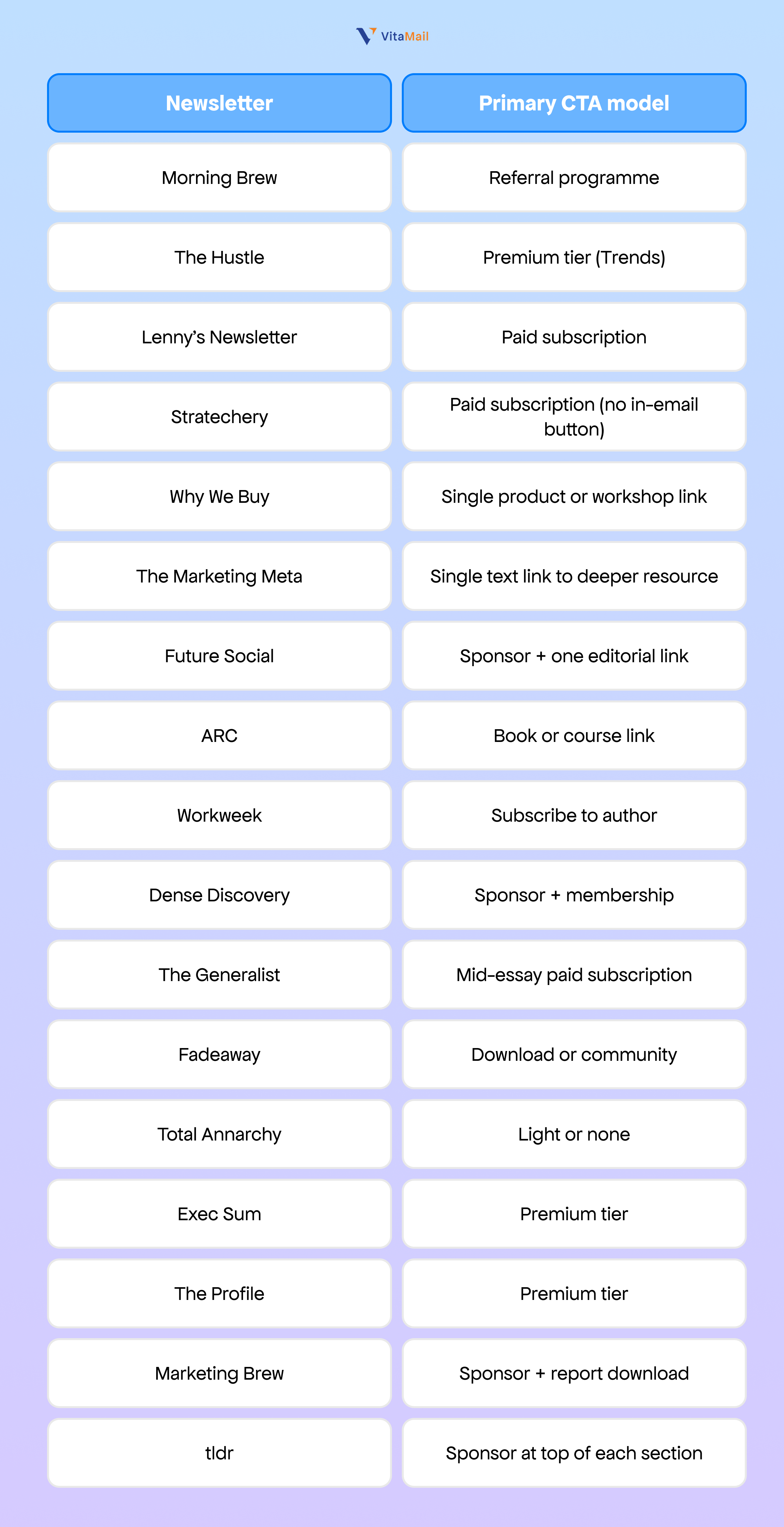
The pattern is consistent: one primary action, integrated into the editorial flow, never competing with three other CTAs in a row.
If you are building a newsletter that funnels into a broader sales process, the same single-action discipline applies to the complete cold outreach system that comes next.
How to apply these patterns to your own newsletter
Reading examples is not the same as copying patterns. Use this five-step audit on your last five sends.
- Pull your last five sends and write each subject line in a column. For each one, mark whether it signals specific value or general novelty. If three or more are general novelty, that is your first thing to fix.
- Read the first 50 words of each send on your phone. If the lede does not deliver on the subject line within those 50 words, rewrite the lede.
- List the recurring sections of your newsletter. If there are no recurring sections, choose one signature element to introduce in your next four sends.
- Read your last send aloud. If it sounds like a press release, rewrite it in your own voice. The test: would a colleague who knows you recognise it as your writing?
- Count the CTAs in your last send. If there are more than two, cut to one primary CTA and demote the rest to plain text links.
For benchmarks, B2B newsletters in 2024 averaged a 21–24% open rate and 2.0–2.6% click-through rate (Mailchimp Email Marketing Benchmarks 2024, Campaign Monitor 2024). Tuesday and Thursday remain the highest-engagement send days for B2B audiences (HubSpot Email Marketing Report 2024). Optimal length sits between 200 and 500 words for general newsletters and longer for paid analysis newsletters where depth is the value (Mailchimp 2024).
Common failure mode: copying a structural element from a much larger newsletter without the audience to support it. Morning Brew can devote a full section to a brain teaser because it has 4 million subscribers. A 2,000-subscriber newsletter that copies the brain teaser dilutes its single dominant idea. Adopt patterns that fit your scale.
The deeper send-day, length, and engagement breakdown sits in our guide to cold email performance benchmarks — most of the principles transfer directly.
How VitaMail helps newsletter publishers grow their list through cold outreach
Newsletters grow through three channels: paid acquisition, organic referrals, and direct outreach to potential subscribers and partners. The third channel is the one most operators run badly.
VitaMail handles the cold outreach side of that growth motion. It reads your newsletter's website, defines the ICP of who would actually subscribe (based on the topic, the depth, and the audience signals), and builds a validated lead list of people who match. It runs domain warmup so your sending reputation supports outreach volume, generates AI-personalised emails using each prospect's LinkedIn activity and company context, and pauses sending automatically if deliverability thresholds are crossed.
To be clear about scope: VitaMail is for the cold outreach that grows your list, the partner outreach that gets you guest features, and the sponsor outreach that monetises the list. It is not a replacement for your newsletter sending platform (ESP). Use Beehiiv, Substack, Ghost, or ConvertKit for the newsletter itself.

Conclusion
The best email newsletter examples are not templates to copy. They are patterns to apply: one dominant idea per send, subject lines that promise specific value, a signature structural element, a consistent human voice, and one primary CTA. Copy the patterns, not the screenshots.
If your newsletter growth depends on more than referrals, cold outreach to ICP-fit subscribers and partners is the scaling channel most operators underuse. VitaMail builds the ICP, the validated list, the warmed domain, and the personalised outreach in one workflow, so growth does not depend on whichever team member has time to send manually this week.