

You can spot great copywriting in the wild. It’s the ad that makes you laugh, the email that feels like it was written just for you, or the website that convinces you to "Add to Cart" in seconds.
But what separates good copy from great copy?
It’s not just about clever wordplay. Great copywriting is a blend of psychology, strategy, and data. It’s the engine of digital marketing, turning casual browsers into loyal customers.
The problem is, "just write a good copy" isn't actionable advice.
This guide changes that. We're moving beyond theory to dissect real-world copywriting examples, from high-converting landing pages to viral social media posts. You’ll get scannable frameworks, advanced AI prompts, and the data-backed strategies brands use to drive success.
What Makes Great Copywriting?
Before we dive into the examples, let's set the foundation. Great copywriting isn't art; it's salesmanship in print. Its one and only goal is to drive a specific action—click, subscribe, buy, or share.
Essential Elements of Effective Copy
Whether it's a 280-character tweet or a 3,000-word landing page, all effective copy shares four core elements:
- Clarity: Is the message simple and easy to understand in seconds? If you have to read a sentence twice, it’s failed.
- Conciseness: It respects the reader's time. It uses the fewest words possible to make the most powerful point.
- Compelling: It hooks the reader. It uses a strong voice, triggers an emotion (curiosity, urgency, joy, fear of missing out), and presents a "can't-miss" value proposition.
- Credible: It builds trust. This is where social proof, data, and specific details come in. "Used by 10,000+ businesses" is more credible than "The best tool."
Knowing Your Audience (Personas/Research)
You cannot write compelling copy for a "general audience." You must write for one specific person. This is where audience research and personas are non-negotiable.
Pro Tip: The best copy isn't written; it's assembled. It's gathered from your audience's own words.
- Read customer support tickets.
- Scan product reviews (especially 3-star reviews).
- Interview your sales team.
- Analyze "Voice of Customer" survey responses.
When you use the exact words and phrases your customers use to describe their problems and desires, your copy doesn't feel like marketing. It feels like a solution.
Copywriting Examples by Type
The principles of copy are universal, but the application changes dramatically based on the format. Here are annotated copywriting examples across the most common digital marketing channels.
1. Web Copy (Homepage)
A homepage has to do the heaviest lifting. It must instantly answer three questions:
- Where am I?
- What can I do here?
- Why should I do it?
Brand Example: Slack
- Headline: Made for people. Built for productivity.
- Sub-headline: Connect your people, tools, and partners in one place. Slack is the digital HQ that helps you get more done, faster.
- CTA: Try for Free / Talk to Sales
Annotation:
- The headline (Made for people) addresses the user experience, while Built for productivity hits the business benefit. It speaks to both the end-user and the decision-maker.
- The sub-headline clearly explains what it is ("digital HQ") and what it does ("Connect your people, tools...").
- The dual CTAs perfectly segment the audience: users who want to try it (bottom-up adoption) and teams who want to buy (top-down sales).
2. Landing Page Copy
A landing page has one job: conversion. Unlike a homepage, it's focused on a single offer and should have all non-essential links (like navigation) removed.
Brand Example: ClickUp
- Headline: One app to replace them all.
- Sub-headline: All your work in one place: Tasks, Docs, Chat, Goals, & more. Finally, a tool that does everything you need.
- CTA: Get Started - It's Free
Annotation:
- Aggressive Value Prop: The headline is a classic example of a powerful Unique Value Proposition (UVP). It directly calls out the pain point: using too many different tools.
- Feature Rundown: The sub-headline lists the features (Tasks, Docs) to justify the "replace them all" claim.
- Frictionless CTA: Get Started - It's Free removes any "risk" or "cost" barrier. It’s an irresistible, low-friction next step.
3. Product Copy (E-commerce)
Product copy (or "product descriptions") must bridge the gap between a 2D screen and a 3D product. It needs to sell the experience, not just the item.
Brand Example: Bombas
- Product Title: Men's Performance Running Ankle Sock
- Bullet Points:
- Honeycomb Arch Support
- Seamless Toe
- Strategic Zone Cushioning
- Airflow Venting
- One pair purchased = one pair donated.
Annotation:
- Sensory Language: The copy uses highly specific, tactile language. You can almost feel "Honeycomb ArchSupport" and "Seamless Toe." This builds perceived value and justifies the premium price.
- Feature-Benefit Combo: "Airflow Venting" (feature) implies your feet stay cool and dry (benefit).
- Mission-Driven: The final bullet isn't about the product at all; it's about the mission. This is a powerful trust signal and a key differentiator that builds brand loyalty.
4. Ad Copy (PPC & Social)
Ad copy has to stop the scroll (on social) or earn the click (on search). It must be disruptive, relevant, and have a crystal-clear call to action.
Example: Google Search Ad (PPC)
- Headline 1: FreshBooks Accounting
- Headline 2: Simple Software for Freelancers
- Headline 3: Try 30 Days Free
- Description: Stop wasting time on spreadsheets. Send professional invoices, track expenses, & get paid faster with FreshBooks. Easy to use. No experience needed.
Annotation:
- Audience Call-out: for Freelancers immediately qualifies the audience.
- Problem-Solution: Stop wasting time on spreadsheets (Problem) -> Send invoices, track expenses (Solution).
- Benefit-Driven: get paid faster is the core benefit every freelancer wants.
- Risk-Reversal: Try 30 Days Free is the clear, no-risk CTA.
Example: Facebook Ad (Social)
- [Image/Video: A satisfying video of a dirty patio being power-washed]
- Hook (First Line): Your patio wishes you had this.
- Body: Don't spend $500 on a professional. The [Product Name] pressure washer erases years of dirt and grime in minutes. It's lightweight, powerful, and 30% off this week only.
- CTA: Shop Now & Save
Annotation:
- Visual Hook: The video does the heavy lifting, and the copy supports it.
- Curiosity & Problem: Your patio wishes... is a playful, engaging hook.
- Benefit + Data: erases...dirt...in minutes (Benefit) and 30% off this week only (Urgency).
- Specific CTA: Shop Now & Save is much stronger than just "Shop Now."
5. Social Media Copy
Social media copy is all about brand voice and engagement. The goal isn't always a direct sale; it's often to build a community and stay top-of-mind.
Brand Example: Wendy's (Twitter)
- [Screenshot of a witty Wendy's tweet]
- Tweet: Roasting competitors is our second-favorite thing to do. Roasting beef is our first.
Annotation:
- Pure Brand Voice: This is the "Sassy Friend" persona perfected. It’s funny, on-brand, and memorable.
- Engagement-First: This type of copy isn't selling a burger; it's selling the brand. The goal is retweets, follows, and brand recall. It makes Wendy's a cultural icon, not just a fast-food chain.
6. Marketing Copy (Case Study & Blog Post)
Case Study (Headline/Sub-headline):
- Headline: How [Company X] Scaled Their Lead Gen by 214% with [Our Product]
- Sub-headline: See the exact 3-step process [Company X]'s marketing team used to triple their qualified pipeline without increasing their ad spend.
Annotation:
- Specific Numbers: 214% and 3-step process build immediate credibility and curiosity.
- The "Without" Statement: ...without increasing their ad spend is a powerful clause that tackles a common objection (that results must cost more).
Blog Post (Intro):
- Hook (Problem): You hit "publish" on your new blog post. And then... crickets. You know your content is good, but no one can find it.
- Agitate (Pain Point): All that work feels wasted. You're starting to wonder if SEO is even worth it.
- Solution (The Article): The truth is, great content is only half the battle. This guide breaks down the 7-step promotion strategy our team uses to get 10,000+ views on every new article.
Annotation:
- PAS Framework: This intro uses the classic Problem, Agitate, Solution (PAS) framework.
- Empathy: You know your content is good... shows empathy and builds rapport.
- Specific Promise: 7-step strategy and 10,000+ views makes the article feel like an actionable, proven playbook. This is similar to the strategies found in an email marketing beginner's guide.
Winning Copywriting Techniques
The examples above don't just happen. They are built on proven techniques and frameworks.
Benefits vs. Features (with Table)
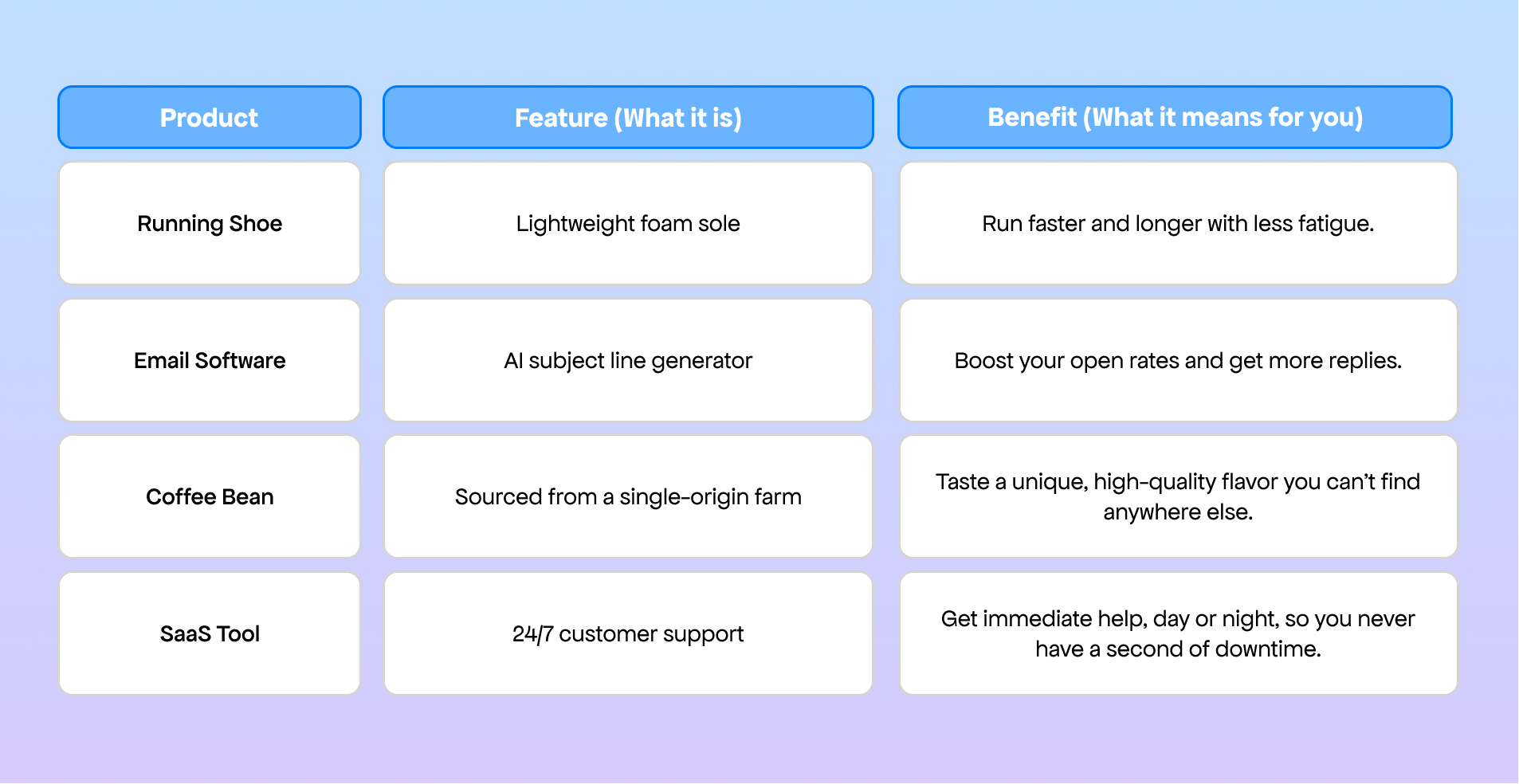
This is the most important concept in copywriting.
- Features are what your product does. (e.g., "This laptop has 16GB of RAM.")
- Benefits are what the customer can do with it. (e.g., "Run all your apps at once without ever seeing that spinning beachball.")
Customers don't buy features; they buy better versions of themselves.
Here’s a quick-reference table:
Writing Compelling Headlines
Your headline is your first impression. If it fails, the rest of your copy doesn't get read.
- Be Ultra-Specific: "How to Get More Subscribers" is weak. "How I Got 1,284 New Subscribers in 30 Days" is strong.
- Use Data: Semrush studies show headlines with 10-13 words tend to get the most traffic and shares.
- Focus on the UVP: What is the one big promise? (e.g., ClickUp's "One app to replace them all.")
- Use Formulas (Sparingly):
- The "How-To": How to [Achieve Desired Outcome] Without [Common Pain Point]
- The "Listicle": 7 Copywriting Techniques That Will Double Your Conversion Rate
- The "Ultimate Guide": The Ultimate Guide to Writing Ad Copy That Converts
- The "Question": Are You Making These 5 Common SEO Mistakes?
Your email subject line is the most important headline you'll write. Before you test, get dozens of high-performing ideas.

Calls to Action (CTAs)
Your Call to Action (CTA) must be clear, singular, and action-oriented. Never be vague.
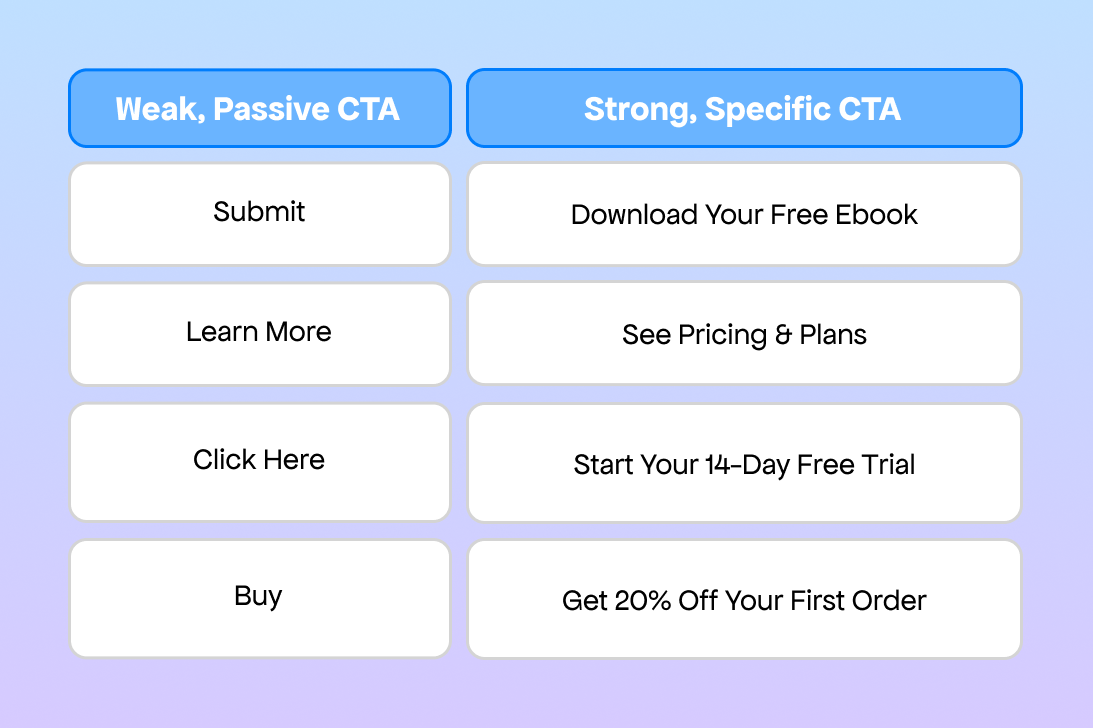
A strong CTA is specific, highlights the benefit (Get 20% Off), and uses an action verb (Start, Download, Get).
Personalization & Segmentation
Personalization goes beyond Hi, [First_Name]. True personalization uses data to deliver a hyper-relevant message.
- Email Example: A Shopify store sends an email.
- Weak (Generic): "Check out our new arrivals!"
- Strong (Segmented): "Hi [Name], we saw you were looking at our running shoes. Our new [Shoe Model] just dropped in your size. Here’s a 10% off code."
- Website Example: A SaaS tool (like HubSpot) can change its homepage headline based on your industry, which it knows from your IP address or a self-selection tool.
Don't let personalization go to waste.
Segmentation is powerful, but only if your emails actually reach the inbox. A personalized email sent to an invalid address still bounces. Ensure every message in your segmented list is valid with Vitamail's powerful email verification tools.
Use of Visuals & Formatting
This is the "meta" technique. How your copy looks is as important as what it says. A wall of text will never get read.
- Use short paragraphs: 1-3 sentences, max.
- Use bullet points and numbered lists: (Like this one!)
- Use bold and italics: To emphasize key points and guide the reader's eye.
- Use blockquotes: > To highlight testimonials or key takeaways.
- Use images and screenshots: To break up text and provide visual proof.
AI Copywriting Tips & Prompts
Generative AI is a powerful co-pilot. It’s fantastic for first drafts, A/B testing variations, and overcoming writer's block. The key is in the prompt. For instance, you can use it to create AI-powered email subject lines.
Structuring Effective AI Prompts
Don't just say, "Write an ad." Use a structured prompt.
The R-T-F-C-C Framework:
- Role: "Act as a 10-year veteran, direct-response copywriter."
- Task: "Write 3 Facebook ad variations."
- Format: "Use this structure: 1-line hook, 3-sentence body, 1 CTA."
- Context: "The product is a new AI-powered email marketing tool called 'ApolloMail.' The main benefit is saving marketers 10 hours a week by writing email drafts automatically. The audience is busy marketing managers at B2B tech companies."
- Constraints: "The tone should be professional, exciting, and benefit-driven. Do not use emojis. Avoid clichés like 'game-changer.'"
Examples of A/B Test Prompts
Prompt:
"Act as a conversion copywriter. I need to A/B test a headline for a landing page. The product is a project management tool for creative agencies.
- Variation A (Control): Should be clear and descriptive.
- Variation B (Competitor-Focused): Should highlight why we are better than Asana or Trello.
- Variation C (Problem-Focused): Should focus on the pain point of missed deadlines and scope creep.
Generate 2 options for each variation."
Real Brand Examples & Case Studies
Theory is good. Proof is better. Let's dissect the copy that built empires.
Campaign Dissections (Dropbox, ClickUp, Bombas)
1. Dropbox: Simplicity at Scale
- The Copy: Dropbox's original landing page was legendary. It featured a simple 2-minute explainer video and a single CTA: "Download Now." Their early slogan, "Your files, anywhere," is a masterclass in clarity.
- The Result: The explainer video is credited with increasing sign-ups by 10% and adding millions of users.
- The Takeaway: Don't oversell. If your product is innovative, the clearest, simplest explanation of what it does is often the most powerful.
2. ClickUp: The Aggressive Challenger
- The Copy: "One app to replace them all." This headline is a direct assault on competitors like Asana, Jira, and Slack. It positions ClickUp as the single source of truth, tapping into the deep frustration of "tool fatigue."
- The Result: This aggressive, benefit-driven positioning has fueled their growth, helping them become one of the fastest-growing SaaS companies.
- The Takeaway: Know your enemy. If you are a challenger brand, use your competitor's well-known weaknesses in your copy to position yourself as the superior solution.
3. Bombas: Mission as a Product
- The Copy: "One pair purchased = one pair donated." This is Bombas's core UVP, and it's on their homepage, their product pages, and their checkout.
- The Result: This mission-first copy built a "feel-good" brand that customers are proud to support. It justifies their premium price and creates lifetime loyalty that goes beyond product features.
- The Takeaway: People want to buy from brands that align with their values. If you have a mission, make it a central part of your copy.
Social Proof and Conversion Data
Social proof builds trust and overcomes skepticism.
- Testimonials: Use direct quotes that highlight a specific benefit.
- Weak: "I love this product!"
- Strong: "[Product] helped us cut our meeting time by 5 hours a week. It paid for itself in the first month."
- Customer Logos: "Trusted by teams at Google, Netflix, and Spotify."
- Key Statistics (Social Proof):
- "Join 1.2 million other freelancers using [Tool]."
- "Rated 4.9/5 stars by 25,000+ happy customers."
- "As seen in Forbes, TechCrunch, and The Wall Street Journal."
- Case Study Data:
- "HubSpot reports its AI tools save marketers an average of 2.5 hours per week." (This is a real stat you can use to sell AI features).
Testing & Optimization
A great copy is never "done." It is always being tested and improved.
A/B Testing Copy
A/B testing (or split testing) is the process of comparing two versions of your copy to see which one performs better. You can learn more about A/B testing best practices here.
- What to test (one at a time):
- Headline: Variation A (e.g., "Save Time") vs. Variation B (e.g., "Stop Wasting Time").
- CTA Button: Color (e.g., Green vs. Red) or Text (e.g., "Get Started" vs. "Start Your Free Trial").
- Body Copy: Short-form (3 bullet points) vs. Long-form (3 paragraphs).
- Social Proof: Testimonial at the top vs. Testimonial near the CTA.
Before/After Example:
A SaaS company tested its CTA button text.
- Before (Control): Sign Up
- After (Variation): Start My Free 30-Day Trial
- Result: The "After" variation, which is more specific and highlights the "Free Trial," increased conversions by 31%.
Measuring Performance
You can't improve what you don't measure. Track these key metrics:
- Click-Through Rate (CTR): (Clicks / Impressions) - Measures how compelling your ad or headline is.
- Conversion Rate (CVR): (Conversions / Clicks) - Measures how effective your landing page or product copy is at closing the deal.
- Bounce Rate: (Users who leave after viewing one page) - A high bounce rate might mean your ad copy set an expectation that your landing page copy didn't meet. You can learn more about average bounce rates by industry.
- Time on Page: Measures engagement. Are people actually reading your copy?
Is a high bounce rate killing your reputation?
Great copy doesn't matter if it's sent to a dead email. A high bounce rate (see soft vs hard bounces) is the #1 reason email providers send your campaigns to spam.
Before you send your next campaign, clean your list.

Advanced Content & SEO (Advanced Strategy)
This is what separates professional copy from amateur content.
Accessibility & Inclusive Language
Your copy isn't great if it excludes people.
- Write at an 8th-grade level. Use tools like the Hemingway App to simplify your language. Avoid jargon and complex corporate-speak.
- Use descriptive link text. Instead of Click Here, use Read the 2024 Marketing Report. This helps users with screen readers understand the context.
- Avoid ableist or exclusive language. (e.g., "lame," "crazy"). Be mindful of using inclusive examples and imagery that reflect a diverse audience.
Schema & SEO Technical Brief
Copywriting isn't just for humans; it's for search engines, too. You can "markup" your copy with schema to give Google more context and earn Rich Snippets.
- FAQPage Schema: If you have an FAQ section (like the one below), wrap it in FAQPage schema. This can make your questions and answers appear directly in the Google search results, taking up more space.
- Product Schema: On an e-commerce page, use Product schema to tell Google the price, rating, and availability. This is what generates the star ratings and price in search results.
- HowTo Schema: If your blog post is a step-by-step guide, HowTo schema can display those steps on the search page, making your listing far more compelling.
Data-Driven Performance Analysis
Go deeper than just "it worked."
- Negative Constraints: Know what not to say. Make a list of "stop words" for your brand. This could include overused clichés ("game-changing," "level-up"), weak words ("maybe," "perhaps"), or competitor names you don't want to mention.
- Attribution Analysis: Did the ad copy (high CTR) or the landing page copy (high CVR) drive the conversion? If you have a high CTR on an ad but a low CVR on the landing page, your message is mismatched. The ad copy is making a promise that the landing page copy isn't keeping.
Key Takeaways & Next Steps
Great copywriting is a skill, not a talent. It's built on a foundation of:
- Deep Audience Knowledge: Using your customer's own words.
- Proven Frameworks: Focusing on benefits, not features (AIDA, PAS).
- Specifics & Proof: Using data, testimonials, and case studies.
- Constant Testing: Always trying to beat your control.
The best way to learn is by doing. Pick one piece of copy on your own website—your homepage headline, a product description, or your email CTA.
And when you're ready to send that copy, make sure it lands. Vitamail provides the validation and deliverability tools you need to turn great copy into real conversions.