



Choosing between double opt-in vs single opt-in is one of the most critical decisions you'll make when building your email list. This choice directly impacts your compliance with regulations like GDPR and CAN-SPAM, your email deliverability rates, spam complaints, and the overall effectiveness of your email verification strategy. Many marketers remain confused about which method serves their business best, some prioritize rapid list growth while others focus on quality and long-term performance. In this comprehensive guide, we'll clarify the differences between these email opt in methods, examine their impact on deliverability and compliance, and help you determine which approach aligns with your business goals.
What Is Double Opt-In?

Double opt-in is a two-step verification process where subscribers must confirm their email address before being added to your mailing list. Here's how it works:
- A user submits their email address through your signup form
- They receive an automated confirmation email
- The email contains a unique verification link
- The user must click the link to complete the subscription
- Only after clicking the verification link is the email address added to your active list
This process creates a clean list validation system that filters out typos, fake addresses, and unengaged users. The double opt in email benefits include verified consent, higher engagement rates, and better protection against spam complaints. Essentially, you're confirming that the person not only entered their email address but also has access to that inbox and intentionally wants to receive your emails.
What Is Single Opt-In?

Single opt-in is a streamlined process where users are immediately added to your email list after submitting their email address through a signup form. There's no confirmation step required. The moment someone clicks "Subscribe" or "Join," they're on your list and will start receiving emails.
While this method enables faster list growth and removes friction from the signup process, it comes with single opt in risks that can significantly impact your sender reputation and deliverability over time. Without verification, you have no way to confirm the email address is valid, belongs to the person who submitted it, or that the subscriber genuinely wants your emails.
Double Opt-In vs Single Opt-In: Deliverability & Compliance Comparison
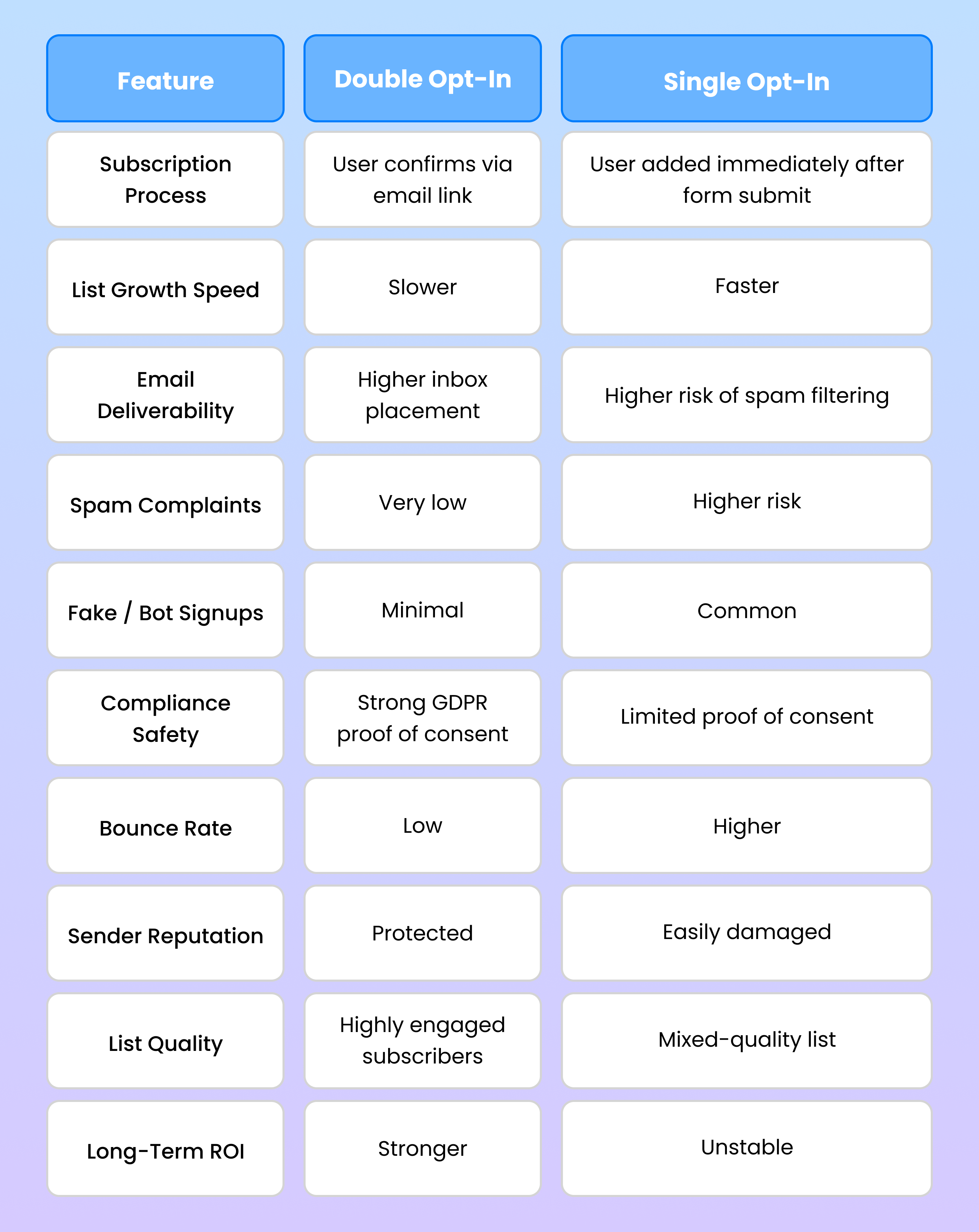
When deciding between double opt in vs single opt in, it helps to see the differences side by side. Below is a simplified infographic-style breakdown comparing compliance, deliverability, risks, and long-term performance.
Opt In Email Deliverability Impact
Your choice between these methods has profound implications for email deliverability. Let's examine the key factors:
Spam Traps
Single opt-in leaves you vulnerable to spam trap addresses. These are email addresses specifically set up by ISPs and anti-spam organizations to catch senders with poor list hygiene. Since you're not verifying addresses, spam traps can easily end up on your list, damaging your sender reputation instantly. Double opt-in virtually eliminates this risk because spam traps cannot click confirmation links.
Bounce Rate
With single opt-in, you'll inevitably collect addresses with typos (gmail.con instead of gmail.com), fake emails (test@test.com), and non-existent domains. These hard bounces hurt your sender reputation with ISPs. Double opt-in catches these issues before they affect your metrics because the confirmation email either bounces or goes to an invalid address that can't complete verification.
Fake Emails & Bot Signups
Automated bots and malicious actors frequently submit fake email addresses to forms. Single opt-in accepts these without question, inflating your list with worthless addresses that will never engage. Double opt-in requires human interaction to click the verification link, effectively filtering out bot signups.
Sender Reputation
Every metric mentioned above feeds into your overall sender reputation score with major ISPs like Gmail, Outlook, and Yahoo. Poor sender reputation leads to your emails landing in spam folders or being blocked entirely. Double opt-in maintains a cleaner reputation by ensuring only engaged, verified subscribers receive your emails.
Legal & Compliance Considerations
The regulatory landscape makes the choice between double opt-in and single opt-in even more critical.
GDPR Compliance
Under the General Data Protection Regulation (GDPR), you must demonstrate clear, affirmative consent to process personal data. While single opt-in can technically meet this requirement if implemented correctly, double opt-in provides stronger proof of consent. The confirmation email and clicked verification link create an audit trail showing the subscriber actively confirmed their subscription.
CAN-SPAM Requirements
The CAN-SPAM Act requires that you have permission to email recipients, though it doesn't specify the method. However, double opt-in gives you better protection if your practices are ever questioned, as you have clear proof the recipient requested your emails.
Proof of Consent
If a subscriber ever claims they didn't sign up for your emails (which happens frequently), double opt-in provides irrefutable evidence. You can show exactly when they submitted their email, when they received the confirmation email, and when they clicked to verify. With single opt-in, you only have a timestamp of the form submission, which could have been done by anyone.
Audit Protection
For businesses operating in regulated industries or serving global markets, double opt-in is significantly safer. During audits or compliance investigations, having comprehensive proof of verified consent protects your business from penalties and legal challenges.
Why Double Opt-In Is Safer in Regulated Markets
If you serve European customers, healthcare subscribers, financial services clients, or operate in any heavily regulated industry, double opt-in should be your default choice. The slight reduction in list growth is far outweighed by the legal protection it provides.
Double Opt In Email Benefits (Why Many SaaS Companies Prefer It)
Leading SaaS companies overwhelmingly choose double opt-in for good reasons. Let's explore the concrete advantages:
Higher Engagement Rates: Double opt-in subscribers are significantly more engaged because they've taken an extra step to confirm their interest. Studies consistently show that double opt-in lists have 2-3x higher open rates and click-through rates compared to single opt-in lists. These subscribers genuinely want to hear from you.
Lower Spam Complaints: Since subscribers have explicitly confirmed they want your emails, spam complaints drop dramatically. Fewer people will hit the "Report Spam" button when they consciously chose to receive your content. This protects your sender reputation and keeps you out of spam folders.
Stronger Sender Reputation: By filtering out fake addresses, typos, and unengaged users before they receive any emails, double opt-in maintains consistently high engagement metrics. ISPs notice when your emails are opened, clicked, and not marked as spam—rewarding you with better inbox placement.
Better Inbox Placement: The combined effect of higher engagement, lower complaints, and better sender reputation means your emails actually reach the inbox. A 50% smaller list with 90% inbox placement delivers far better results than a large list with 40% inbox placement.
Cleaner Database: Your email list remains clean by design. You're not paying to store and send emails to invalid addresses. Every contact on your list is verified and reachable, making your data more valuable for segmentation and analysis.
Lower Email Verification Costs: While you should still periodically verify your email list, double opt-in subscribers require less frequent verification since they're confirmed at the point of entry. This reduces your ongoing email verification expenses.
Higher Long-Term ROI: Although single opt-in might grow your list faster initially, double opt-in delivers superior return on investment over time. Engaged subscribers convert at higher rates, remain subscribed longer, and have higher lifetime value. Quality consistently outperforms quantity in email marketing.
Single Opt In Risks You Should Know Before Choosing It
While single opt-in offers faster list growth, the risks can severely damage your email program if not properly managed.
Fake Emails: Without verification, you'll collect numerous fake email addresses like "asdf@asdf.com" or "no@no.com." These never convert and inflate your list size without providing any value.
Typos: Users frequently make typos when entering their email addresses. With single opt-in, these typos become hard bounces when you send your first email. Common mistakes include "gmial.com," "yahooo.com," or swapped letters in their username.
Disposable Email Addresses: Many users employ temporary email services (like Guerrilla Mail or 10 Minute Mail) to access gated content without receiving ongoing emails. Single opt-in accepts these addresses, adding subscribers who will never see your subsequent campaigns.
Higher Bounce Rates: The combination of fake emails, typos, and invalid addresses creates elevated bounce rates that damage your sender reputation. Most email service providers will suspend your account if bounce rates consistently exceed 5-10%.
Spam Trap Exposure: As mentioned earlier, spam traps pose a severe threat to single opt-in lists. Hitting even a single pristine spam trap can result in immediate blacklisting by major ISPs.
Poor Opt In Email Deliverability: The cumulative effect of all these issues is degraded deliverability. Even your engaged subscribers might not receive your emails because ISPs view you as a risky sender based on your overall metrics.
Compliance Vulnerability: If you ever face a complaint or regulatory inquiry, proving genuine consent becomes much harder with single opt-in. You can't definitively prove the subscriber wanted to be on your list, especially if someone else submitted their email address maliciously or by mistake.
Double Opt-In vs Single Opt-In for Different Business Types
The optimal choice often depends on your specific business model and goals.
SaaS Companies
Recommended: Double Opt-In
SaaS businesses should almost always use double opt-in. Your customers typically engage with your product over months or years, making subscriber quality far more important than list size. Double opt-in ensures your onboarding emails, feature announcements, and educational content reach genuinely interested users who are more likely to convert to paid customers. The higher engagement rates directly correlate with better trial-to-paid conversion, lower churn, and higher customer lifetime value.
eCommerce Brands
Recommended: Double Opt-In (with exceptions)
For most eCommerce brands, double opt-in is the better choice. It builds a list of engaged shoppers who are more likely to open promotional emails, click through to your store, and make purchases. However, if you're running aggressive paid advertising campaigns where you're acquiring customers at high volume and speed matters more than quality, you might use single opt-in with robust email verification immediately after signup.
The key is to implement strong list hygiene practices: verify all new addresses within 24 hours, remove hard bounces immediately, and monitor engagement closely. Consider double opt-in for your organic traffic and single opt-in with instant verification for paid campaigns.
B2B Lead Generation
Recommended: Double Opt-In
B2B marketers should prioritize double opt-in without exception. In B2B contexts, you're often dealing with longer sales cycles, higher-value deals, and more sophisticated buyers. A small list of verified, engaged contacts is infinitely more valuable than a large list full of dead ends. Double opt-in also protects you from the common B2B problem of competitors or malicious actors submitting fake information to access your content.
Additionally, B2B senders face stricter scrutiny from corporate email filters. Maintaining impeccable sender reputation through double opt-in ensures your emails reach decision-makers' inboxes rather than being filtered out by enterprise security systems.
Content Creators & Newsletters
Recommended: Double Opt-In
For content creators, bloggers, and newsletter publishers, double opt-in aligns perfectly with your goals. You want readers who are genuinely interested in your content, not inflated subscriber counts. Double opt-in builds an audience that actually opens your emails, reads your content, and engages with your work.
High open rates and engagement not only improve your deliverability but also make your newsletter more valuable for potential sponsors or advertisers. Many newsletter monetization platforms specifically look at engagement metrics when determining ad rates or partnership opportunities.
Email Opt In Methods & Email List Building Best Practices
Regardless of which opt-in method you choose, implementing these email list building best practices will improve your results:
- Clear Consent Language: Use transparent, specific language in your signup forms. Instead of vague text like "Join our list," explain what subscribers will receive: "Get weekly marketing tips and exclusive resources delivered to your inbox." This sets proper expectations and reduces future unsubscribes.
- Transparent Privacy Policy: Link to your privacy policy directly on your signup form. Explain how you'll use subscribers' email addresses, whether you share data with third parties, and how subscribers can opt-out. Transparency builds trust and improves compliance.
- Avoid Pre-Checked Boxes: Never use pre-checked boxes for email consent. This practice violates GDPR and other regulations, and it degrades list quality by adding subscribers who didn't actively choose to join.
- Welcome Email Sequence: After someone subscribes (and confirms, if using double opt-in), send a well-crafted welcome email or short sequence. This sets the tone for your relationship, delivers immediate value, and increases the likelihood they'll engage with future emails. Welcome emails typically have 4-8x higher open rates than regular emails.
List Hygiene Strategy: Implement ongoing list maintenance practices:
- Remove hard bounces immediately
- Identify and remove spam traps
- Suppress chronic non-openers after 6-12 months
- Regularly verify your entire list (quarterly for active senders)
Email Verification Tools: Use professional email verification services like VitaMail to validate addresses before sending. Verification identifies invalid emails, spam traps, role-based addresses (like info@ or sales@), and other problematic contacts that hurt deliverability.
Sunset Policies: Create a systematic process for removing unengaged subscribers. While it feels counterintuitive to remove contacts from your list, keeping unengaged subscribers damages your sender reputation. Send a re-engagement campaign first, then remove anyone who doesn't respond.
Segment Inactive Users: Before removing unengaged subscribers, segment them into a separate suppression group. This allows you to exclude them from regular sends while occasionally attempting targeted re-engagement. Some subscribers may re-engage with the right offer or message.
By combining the right email opt in methods with these best practices, you'll build a high-performing, compliant email program that delivers consistent results.
When Should You Use Double Opt-In vs Single Opt-In?
Here's a practical decision framework to guide your choice:
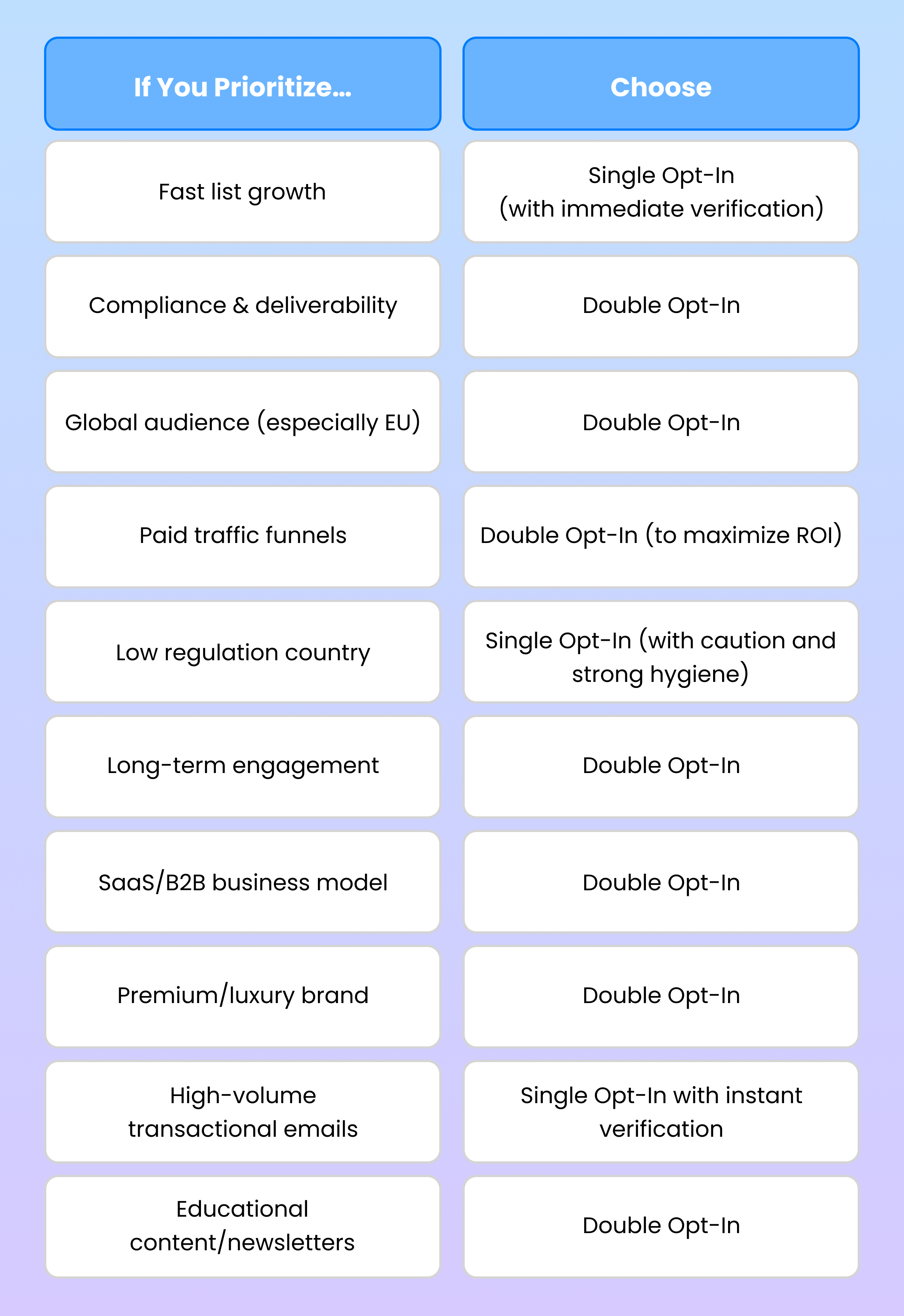
The Reality Check: Even if you choose single opt-in for speed, you should immediately verify all new addresses using an email verification service. This hybrid approach single opt-in plus instant verification can provide faster growth while maintaining decent list quality. However, it still can't match the engagement levels of true double opt-in.
Final Verdict: Double Opt-In vs Single Opt-In – Which One Wins?
After examining the double opt-in vs single opt-in debate from every angle, the verdict is clear for most businesses: double opt-in is the superior choice for long-term success.
Yes, single opt-in will grow your list faster initially. You'll see higher conversion rates on your signup forms and reach your subscriber count goals more quickly. But this speed comes at a significant cost: lower engagement, higher spam complaints, worse deliverability, compliance risks, and ultimately, lower revenue per subscriber.
Double opt-in delivers safer, cleaner, and higher ROI results over time. Your subscribers are genuinely interested, your sender reputation remains strong, your emails reach the inbox, and your compliance posture is unassailable. For SaaS companies, B2B marketers, content creators, and any business focused on building real customer relationships, double opt-in is the clear winner.
The fundamental principle is this: deliverability always matters more than list size. A 5,000-person double opt-in list that achieves 90% inbox placement and 40% open rates will outperform a 20,000-person single opt-in list with 60% inbox placement and 15% open rates every single time.
Focus on quality over quantity, prioritize engagement over numbers, and implement double opt-in as your default email list building strategy. Your future self—and your email metrics—will thank you.
Protect Your Email Deliverability with Smart Verification
You've learned why choosing the right opt-in method matters for compliance and deliverability. But here's the reality: poor opt-in choices and inadequate list hygiene destroy sender reputation faster than most marketers realize.
Whether you choose double opt-in or single opt-in, one truth remains constant: clean lists outperform large lists every single time. Invalid emails, spam traps, and unengaged subscribers don't just sit harmlessly on your list—they actively damage your ability to reach the inbox.
Professional email verification reduces your bounce rate before you send a single campaign, identifies spam traps before they blacklist you, and removes invalid addresses that would waste your sending budget and hurt your reputation.