



You've heard the terms drip campaign and nurture campaign used interchangeably. They're not the same, and using the wrong one at the wrong time is quietly costing you conversions.
When you're comparing a drip campaign vs. nurture campaign, you're really asking two questions: How well do I know this subscriber right now? And what action do I want them to take next? The answers determine everything about how you build your email automation.
This guide covers everything you need to make that call with confidence: precise definitions of both campaign types with real-world examples for B2B and B2C, a definitive side-by-side comparison table, a practical decision framework, step-by-step setup guides, the hybrid strategy that top email marketers use to combine both, the five most common mistakes to avoid, and how AI is transforming both campaign types in 2025.
What Is a Drip Campaign? (Definition, Examples + How It Works)
A drip campaign is a series of pre-written, time-based emails sent automatically on a fixed schedule. Each email goes out at a set interval (Day 1, Day 3, Day 7) regardless of what the recipient does. Drip campaigns are triggered by a single entry event, such as signing up to a list, and every subscriber in the same segment follows the same path.
Think of a drip campaign as a broadcast on a timer. The content is crafted in advance, the schedule is locked in, and the emails go out whether the recipient opened the last one or not. That predictability is both its greatest strength and its primary limitation.
How a Drip Campaign Works
The mechanics are straightforward: a subscriber hits a trigger event (signs up, registers for a webinar, downloads a lead magnet) and enters a pre-defined email sequence. Each email fires at a fixed interval, and the path is identical for every subscriber in that segment. There is no branching based on what the subscriber does after receiving each email.
The 5 Most Common Drip Campaign Types
Welcome series -- introduces new subscribers to your brand over 3-7 emails; consistently the highest-performing drip type by open rate because subscriber intent peaks immediately after sign-up.
Onboarding sequence -- guides new product users to their first meaningful outcome; reduces churn by ensuring users experience early value before interest fades.
Email course / educational series -- delivers structured content over days or weeks; builds authority and warms cold leads without asking for anything in return upfront.
Re-engagement / win-back drip -- reaches subscribers who have gone quiet with a fixed sequence of re-engagement messages designed to either revive interest or clean the contact from your list.
Seasonal / promotional drip -- delivers time-sensitive campaign content on a pre-set schedule, from product launches to holiday sales. Everyone on the list gets the same sequence on the same timeline.
Drip Campaign Examples
B2C example: A skincare brand sends a 5-email welcome series to every new subscriber. Email 1 delivers a discount code, Email 3 highlights bestsellers, and Email 5 asks for preferences to enable better personalization going forward. Every new subscriber receives the same sequence with the same content and same timing, regardless of how they engage.
B2B example: A SaaS company sends a 6-email onboarding drip to every new trial user. Email 1 is a getting-started guide. Emails 2-4 cover core features. Email 5 is a check-in from a Customer Success manager. Email 6 presents the upgrade offer. All trial users receive this in sequence, regardless of which features they've actually used.
Performance benchmark: Businesses using segmented drip campaigns report up to 80% higher click-through rates compared to broadcast emails. However, drip performance naturally declines across a sequence. Day 1 open rates typically run 50-60% higher than Day 7 emails, which is why front-loading your most important content is not optional.
Drip campaigns are the right starting point when you know who someone is (new subscriber, new customer, event registrant) but not yet what they're interested in or where they sit in the buying journey. Once you have those behavioral signals, it's time to look at nurture campaigns.
What Is an Email Nurture Campaign? (Definition, Examples + How It Works)
An email nurture campaign is a behavior-triggered email sequence that adapts based on what a subscriber does: what links they click, which pages they visit, what products they view, or where they are in the buying journey. Unlike drip campaigns, nurtures respond dynamically to individual actions, creating a different experience for every subscriber based on their specific behavior.
A nurture campaign is not set-and-forget the same way a drip is. It requires behavioral data infrastructure (page tracking, click tracking, purchase history) and branching logic that routes subscribers down different paths depending on what they do, or don't do, after each touchpoint.
How a Nurture Campaign Works
A nurture campaign is triggered by a behavioral event (a cart abandonment, a product page visit, a whitepaper download, a purchase) rather than a list entry. Once triggered, the subscriber's path through the sequence changes based on their subsequent actions. If they click on a discount offer in Email 1, they move to a conversion-focused branch. If they don't open Email 1 at all, they receive a different follow-up with a new angle, a different subject line, or an alternate offer.
The 5 Most Common Nurture Campaign Types
Abandoned cart flow -- re-engages shoppers who added items to cart but didn't complete checkout. Consistently the highest-ROI email flow for eCommerce brands and the clearest example of behavioral email at work.
Post-purchase / cross-sell flow -- follows a completed purchase with onboarding, product education, and related product recommendations timed to the delivery window, when customer satisfaction is at its peak.
Lead scoring / sales qualification flow (B2B) -- routes leads through progressively intent-revealing content and passes MQLs to sales automatically when a behavioral score threshold is reached.
VIP / loyalty nurture flow -- delivers personalized rewards, early access, and exclusive content to top-spending customers based on purchase behavior, reinforcing the relationship that drives lifetime value.
Browse abandonment flow -- triggers when a subscriber visits a product page but doesn't add to cart. Lighter-touch than cart abandonment, but it captures earlier-stage intent before it evaporates.
Nurture Campaign Examples
B2C example: An apparel retailer sends an abandoned cart email 1 hour after checkout abandonment. If the subscriber clicks through but still doesn't buy, they receive a second email 24 hours later with a 10% discount. If they purchase after Email 1, they immediately exit the cart flow and enter a post-purchase nurture sequence. Every subscriber's path is shaped by exactly what they do; no two subscribers follow the identical route.
B2B example: A prospect downloads a whitepaper on your pricing page, which is a high-intent signal. This triggers a nurture sequence: Email 1 delivers a relevant case study, Email 2 invites them to a product demo, and Email 3 connects them with a sales representative. If the prospect books a demo after Email 1, they skip Emails 2 and 3 entirely and move directly to a sales handoff notification. The flow adapts in real time.
Performance benchmark: The performance gap between drip and nurture flows is significant and measurable. Top-performing nurture flows achieve click rates of 12.22%, compared to the 2.5-4.0% typical of time-based drip campaigns. That gap is the direct result of behavioral relevance. A subscriber who just abandoned a $200 cart is far more likely to engage with a personalized recovery email than with the next email in a generic onboarding sequence.
Drip Campaign vs. Nurture Campaign: Key Differences at a Glance
The simplest way to understand the difference is to compare them directly. Here's how drip campaigns and nurture campaigns stack up across the dimensions that matter most to email marketers.
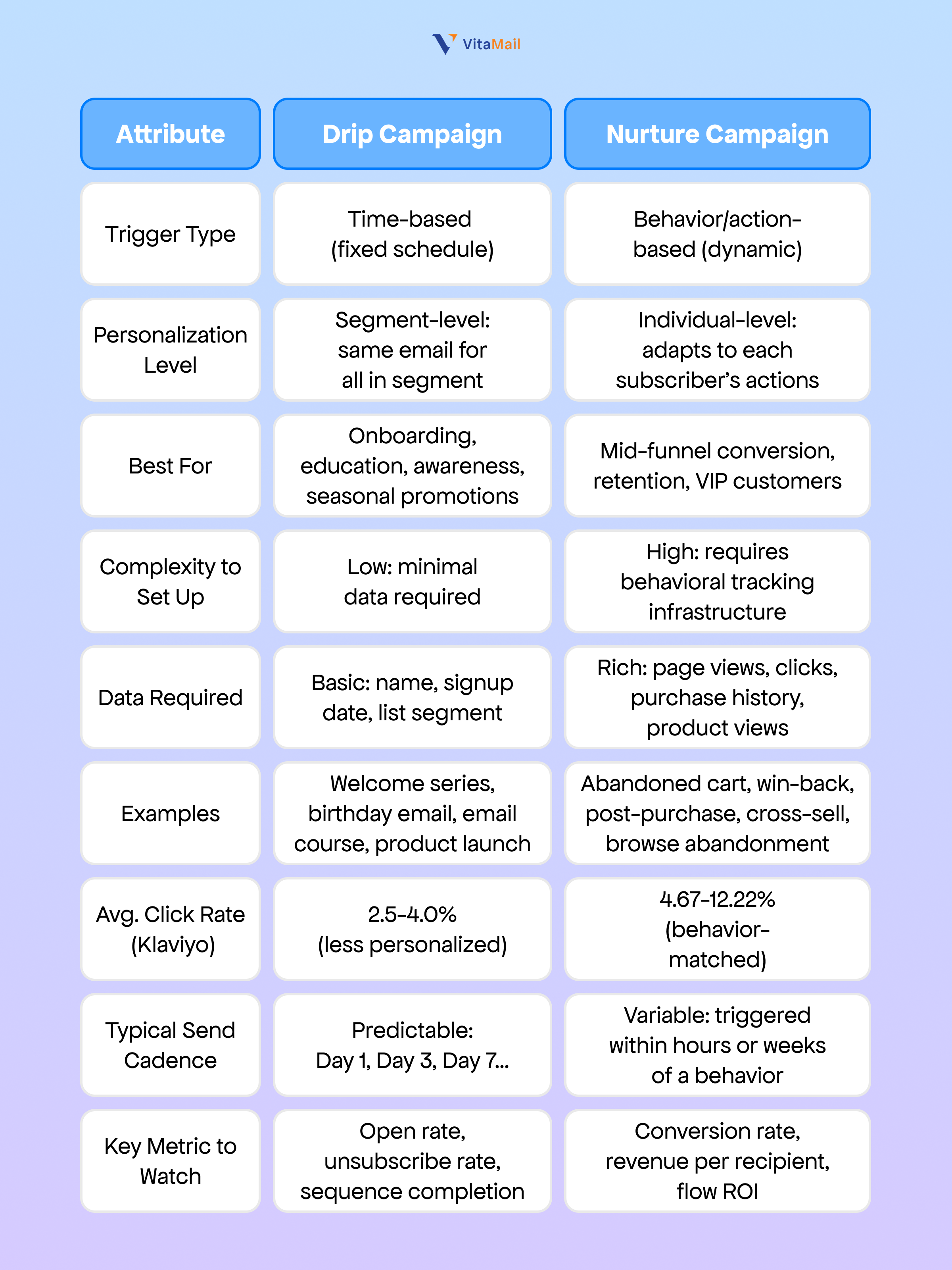
The key takeaway: neither campaign type is better than the other in absolute terms. They serve different goals at different stages of the subscriber journey. Your job as an email marketer is to know when each is appropriate, and that's exactly what the next section covers.
When to Use a Drip Campaign vs. a Nurture Campaign (Decision Framework)
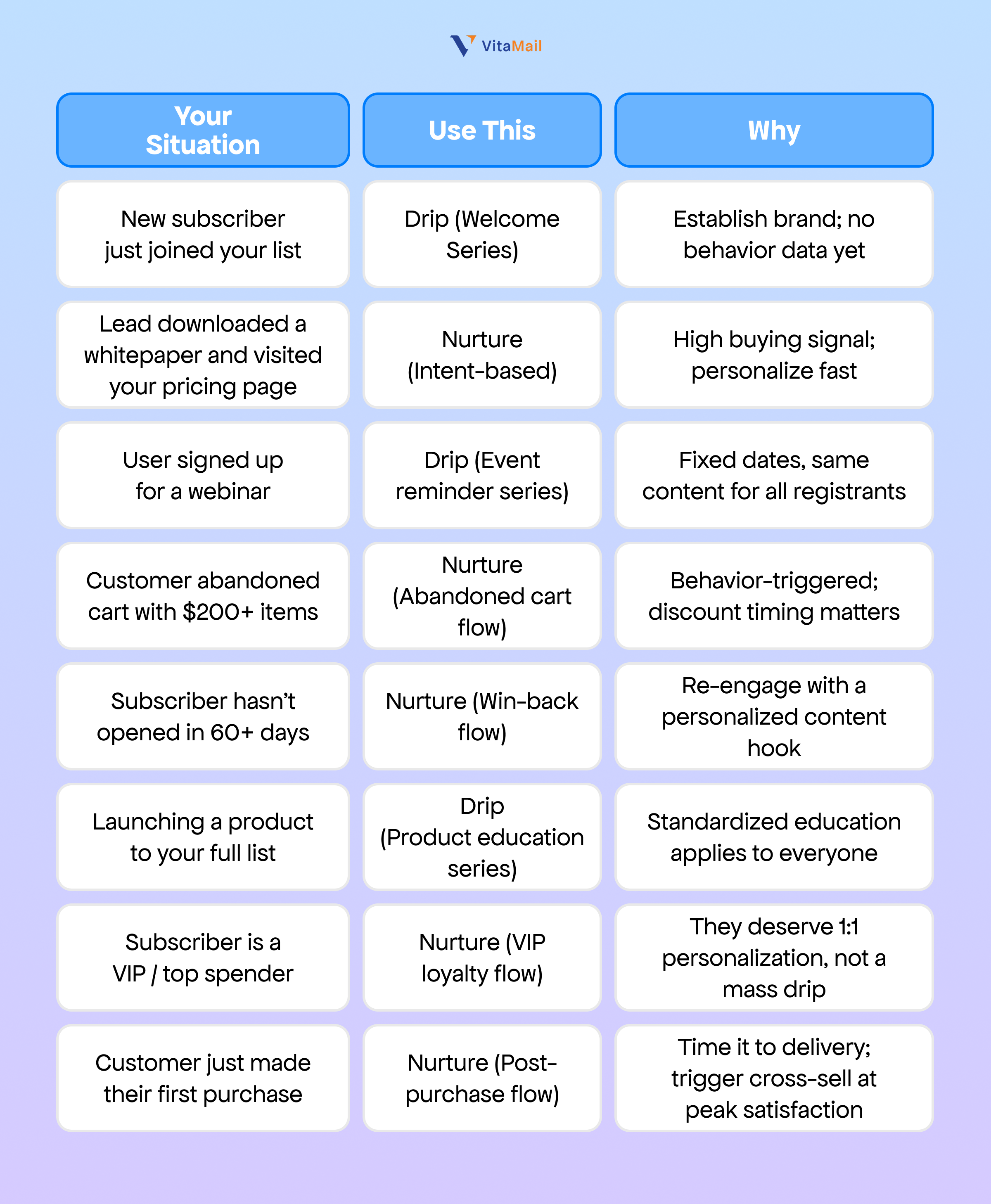
The most common question marketers ask when building email automation is: "When do I send a drip and when do I send a nurture?" Here's a practical decision framework that removes the guesswork.
The 3-Rule Decision Checklist
Rule 1: If you know nothing specific about this subscriber's behavior or intent yet, use a drip.
Rule 2: If you have behavioral signals (page visits, email clicks, purchases, content downloads) that reveal where this person is in the buying journey, use a nurture.
Rule 3: If the content should be the same for everyone in a segment, use a drip. If the content should differ per individual based on what they've done, use a nurture.
How to Set Up a Drip Campaign in 5 Steps
Setting up a drip campaign is within reach for any email marketer, regardless of technical experience. The complexity comes from crafting compelling content, not from the automation itself. Here's the full process from strategy to launch.
Step 1: Define Your Audience Segment
Decide who enters this drip and what action triggers entry. Entry triggers are typically list-based events: a new subscriber joins, a user completes registration, a contact downloads a lead magnet. Define your segment precisely. "All new subscribers" is a valid starting point, but "all new subscribers who signed up via the homepage pop-up" gives you audience context that makes your content more relevant and your messaging more coherent from the first email.
Step 2: Map Your Email Sequence
Plan the full sequence before writing a single word. Decide how many emails the drip will contain and what day each email fires. For a 5-email welcome series, a standard cadence is Day 1, Day 3, Day 6, Day 10, Day 14. Document the goal for each email (awareness, education, social proof, conversion, feedback) so there's no overlap and every email earns its place in the sequence.
Sequence length guidance: Most high-performing drip sequences run 4-7 emails over 2-4 weeks. Sequences shorter than 4 emails often leave value on the table; sequences longer than 7 emails see diminishing open rates without the behavioral adaptation that a nurture flow provides. After your drip ends, move engaged subscribers into a nurture flow based on the signals they gave during the drip.
Step 3: Write Your Content
Lead with education and value; close with conversion. The first 1-2 emails should deliver on the promise that got the subscriber to opt in. Emails 3-4 should build authority, share social proof, and address the most common objections your audience holds. The final email should make a clear, direct offer or ask. Every email should have a single primary call to action; multiple CTAs compete with each other and measurably reduce click rates.
Step 4: Set Your Timing
Minimum recommended gaps between drip emails: 2 days for high-engagement sequences like welcome and onboarding, 3-5 days for educational series where subscribers need time to absorb the content. Avoid sending every day unless the content provides immediate, session-by-session utility such as a daily email course. Monitor Day 1 vs. Day 7 open rates closely. The consistent decline across a sequence means your most important content must appear early.
Step 5: A/B Test and Monitor
Run subject line A/B tests on your highest-volume drip emails first. A 5% improvement in open rate on a welcome email compounds across your entire subscriber acquisition funnel. Monitor unsubscribe rate per email closely; any single email triggering more than 0.5% unsubscribes needs immediate revision. Track sequence completion rate (the percentage of subscribers who receive all emails without unsubscribing or being suppressed) as your primary health metric for the overall drip.
VitaMail Tip: VitaMail's campaign builder lets you map your drip sequence visually, set per-email send times, and configure exit conditions so subscribers who convert automatically leave the drip. Connect it to your segmentation tool to ensure only the right subscribers enter each flow at the right moment.
How to Set Up an Email Nurture Campaign in 5 Steps
Nurture campaigns require more planning than drip campaigns because you're building branching logic, not a linear sequence. The payoff (in click rates, conversion rates, and revenue per recipient) is significantly higher. Here's how to set one up correctly.
Step 1: Choose Your Trigger Event
A nurture campaign should be triggered by a behavioral signal that reveals intent. High-signal triggers include adding a product to cart, visiting a pricing page, clicking a product link in a previous email, completing a purchase, downloading a high-intent content asset, or reaching a VIP spend threshold. The stronger and more specific the trigger, the more precisely you can personalize the nurture flow that follows. Weak or vague triggers produce nurture flows that feel irrelevant to subscribers because the triggering behavior wasn't specific enough to inform the messaging.
Step 2: Map Your Branching Logic
Before writing any content, draw your flow on paper or in your automation tool. Ask: "What happens if the subscriber clicks Email 1's CTA? What happens if they don't open Email 1 at all?" Every email in a nurture sequence should have at minimum two branches: an engaged path and a non-engaged path. Subscribers who take the desired action move to a higher-intent sequence or exit the flow with a conversion logged. Those who don't engage receive a follow-up with a new angle, different framing, or an alternate offer.
Step 3: Write Personalized Content for Each Branch
The power of a nurture campaign is its specificity. Write the content for each branch with that branch's subscriber explicitly in mind. An abandoned cart email to someone who left $200+ in their cart should feel meaningfully different from a browse abandonment email to someone who only visited a product page. Reference what you know about the subscriber's behavior, but do so in a way that feels helpful and contextual rather than intrusive.
Step 4: Set Your Triggers and Delays
Nurture campaigns use two types of delays: time-based delays (wait 1 hour after the trigger event, then send Email 1) and action-based delays (wait until the subscriber clicks the CTA, then send Email 2). Abandoned cart flows perform best with Email 1 sent within 1 hour of abandonment, as urgency is a significant driver of recovery. B2B lead nurture flows typically use longer delays of 2-3 days between emails to reflect longer consideration cycles and avoid appearing aggressive.
Step 5: Track Conversion at Each Step and Prune Underperforming Branches
Monitor your nurture flow at the individual email level, not just the aggregate. If Email 3 of a 5-email flow is generating the majority of your conversions, test sending Email 3 earlier in the sequence. If Email 4 has an elevated unsubscribe rate, the content is misaligned with subscriber expectations at that stage; revise the messaging or remove the email. Nurture flows should be treated as living infrastructure, not a one-time build.
Key Metrics to Track for Your Nurture Flow
Flow conversion rate -- the percentage of subscribers who enter the flow and complete the goal action (purchase, demo booking, form fill). This is the headline number for any nurture campaign.
Revenue per recipient -- total flow revenue divided by unique recipients. This is the definitive ROI metric for eCommerce nurture flows and the number that justifies the investment in behavioral tracking infrastructure.
Click-to-open rate (CTOR) -- measures engagement quality among openers. A low CTOR indicates the content isn't compelling even when the subject line is working. The problem is in the email body, not the deliverability.
Unsubscribe rate per email -- flag any single email triggering more than 0.5% unsubscribes immediately. It is hurting both your list quality and your sender reputation with every send.
Time-to-conversion -- how many days from trigger to purchase or goal completion. This tells you whether your sequence is too long, too short, or well-calibrated to your audience's decision timeline.
The Hybrid Approach: How to Use Drip and Nurture Campaigns Together
Asking whether to use a drip or a nurture campaign is often the wrong question. The most effective email programs use both, and the secret is knowing how to connect them. Think of it as the graduation model: subscribers start in a drip and graduate into a nurture when they show intent.
The 4-Stage Graduation Model
Stage 1: Drip Welcome Series. A new subscriber enters a time-based welcome sequence of 5 emails over 14 days. Content focuses on brand introduction, core value propositions, and educational material. All new subscribers follow the same path. At this stage you're building familiarity and collecting the behavioral signals you'll use in the stages that follow.
Stage 2: Intent Trigger into Nurture. If a subscriber clicks a product-specific link in any of the welcome drip emails, they automatically exit the drip and enter a product-specific nurture flow. The click is the behavioral signal you've been waiting for; it reveals interest in a specific category, product type, or use case. Now you can personalize.
Stage 3: Purchase into Post-Purchase Nurture. When a subscriber converts during the nurture flow, they exit it immediately and enter a post-purchase sequence covering order confirmation, delivery updates, product onboarding, cross-sell opportunities, and a loyalty program invitation timed to the post-delivery satisfaction window.
Stage 4: Re-engagement Drip. If a subscriber completes the welcome drip without engaging (no opens, no clicks, no purchases) and goes 60+ days without any email activity, they enter a win-back drip. This is a fixed, last-chance sequence designed either to re-engage the subscriber with a compelling offer or to cleanly remove them from your active list and protect your sender reputation.
The handoff from drip to nurture is triggered by intent signals: product page visits, email link clicks, form fills, or any behavioral event your platform tracks. Your marketing automation platform should allow you to set exit conditions on drip flows that automatically move subscribers into behavior-based sequences the moment those signals fire.
The B2B Version of the Hybrid Model
In B2B, the graduation model maps directly to the sales funnel. Cold outreach or content downloads trigger a drip sequence that delivers educational content and builds awareness. When a prospect's lead score reaches a threshold (determined by email engagement, page visits, and content downloads), they exit the drip and enter an MQL nurture sequence preparing them for a sales conversation. When they book a demo or request a quote, a sales handoff notification fires and the prospect exits automated email entirely, entering a rep-managed sales flow.
5 Mistakes That Kill Drip and Nurture Campaign Performance
Even well-designed email automation fails when these five mistakes are present. Each one is common, each one is fixable, and none of the top-ranking articles on this topic currently address them.
Mistake 1: Using a Drip When You Have Intent Data
If a subscriber is currently in Email 4 of your onboarding drip and simultaneously visits your pricing page, continuing to send the next scheduled drip email is a significant missed conversion opportunity. A pricing page visit is one of the highest-intent behavioral signals you can capture. It should immediately trigger an exit from the drip and entry into a conversion-focused nurture flow. Set behavioral exit conditions on all drip flows so that high-intent signals always take priority over the preset schedule.
Mistake 2: No Exit Conditions on Drip Flows
If someone converts (makes a purchase, books a demo, fills out the target form) during a drip campaign, they must exit that flow immediately. Sending Email 4 of a product awareness drip to someone who made a purchase yesterday is irrelevant at best and actively brand-damaging at worst. Every drip campaign should have a conversion exit condition configured before the campaign goes live. Without it, you're optimizing open rates while actively annoying your best customers.
Mistake 3: Over-Emailing in Nurture Flows
Behavioral triggers can stack in ways that aren't obvious until a subscriber starts receiving daily (or multiple-per-day) emails. A subscriber who visits a product page, abandons a cart, and opens but doesn't click a previous email might trigger three separate nurture flows simultaneously. Always configure global frequency caps (maximum emails per day and per week per subscriber) at the account level. These caps operate across all flows and prevent trigger stacking from overwhelming subscribers and damaging your sender reputation.
Mistake 4: Ignoring List Health Before Entering Nurture Flows
Sending a high-volume nurture flow to a segment full of unengaged subscribers is a deliverability risk that compounds with each send. Before launching a nurture campaign, suppress contacts who haven't opened any email in the past 90 days. This protects your sender reputation, keeps your flow's engagement metrics clean and meaningful, and ensures the behavioral data powering your nurture flows reflects genuinely interested subscribers rather than dead weight dragging down your inbox placement.
Mistake 5: Building Nurture Flows Without Behavioral Tracking in Place
A nurture campaign is only as smart as the data feeding it. If your behavioral tracking (page visit tracking, click tracking, purchase event integration) isn't set up and validated before you launch a nurture flow, the branching logic has nothing to branch on. Your nurture flow will function like an expensive, complex drip campaign and it will confuse subscribers who receive content that doesn't reflect their actual behavior. If your data layer isn't ready, run a drip campaign. It's a legitimate and effective strategy during the build-out phase. Don't launch a nurture campaign on incomplete data infrastructure.
How AI Is Transforming Drip and Nurture Email Campaigns in 2026
The line between drip campaigns and nurture campaigns is blurring, and artificial intelligence is doing the blurring. In 2025, AI features built into leading email platforms are giving traditionally static drip campaigns a degree of behavioral intelligence that used to be exclusive to fully built-out nurture flows.
Predictive Send-Time Optimization
AI-powered send-time optimization analyzes individual subscriber engagement patterns and delivers each drip email at the time that specific subscriber is most likely to open it, not at a fixed time set for the entire list. A drip campaign that fires "Day 3 at 10 AM" becomes a campaign that fires "Day 3 at the moment this specific subscriber typically opens email." That's a meaningful personalization layer added to what is otherwise a time-based, fixed-content sequence, and it requires no changes to your content or branching logic.
AI-Powered Subject Line Optimization
Generative AI tools can now produce and test dozens of subject line variants simultaneously, using historical engagement data to predict which variant will perform best for a given audience segment. The impact is measurable for both campaign types, but the stakes are often higher for nurture flows where a single email can be responsible for a conversion that justifies the entire cost of the automation infrastructure.
Predictive Segmentation and Propensity Scoring
The most significant AI development for email automation in 2025 is predictive segmentation: the ability to identify which subscribers are likely to purchase, churn, or upgrade before they exhibit those behaviors explicitly. This allows you to trigger a nurture flow proactively, before the behavioral signal fires, based on patterns in your subscriber data that predict future behavior. A subscriber who matches the behavioral profile of someone likely to abandon cart in the next 7 days can be entered into a pre-emptive nurture sequence that addresses purchase hesitation before it solidifies into abandonment.
The Future of Email Automation
The future of email automation isn't drip vs. nurture; it's adaptive sequences that blend both models dynamically based on real-time signals. Every subscriber will start in a flow that behaves like a drip but becomes increasingly personalized as behavioral data accumulates. The distinction between the two campaign types will matter less at the execution level, but the strategic clarity of knowing when to use each will matter more, not less, as the tools become more powerful.
Conclusion: Drip and Nurture Campaigns Are Partners, Not Competitors
Drip campaigns and nurture campaigns are not competitors in your email strategy; they're partners in a well-built automation program. Drips scale your onboarding and education. Nurtures personalize your conversions and retention. The decision rule is simple: no behavioral data yet, start with a drip; behavioral signals present, use a nurture.
The marketers who drive the best results aren't choosing one over the other. They're building systems where subscribers flow naturally from drip to nurture based on what they do, not just when they joined. The comparison table, the decision framework, and the 4-stage graduation model in this guide give you the infrastructure to build that system starting today.
Ready to Build Your First Drip or Nurture Campaign?
VitaMail gives you the automation tools, behavioral triggers, and deliverability infrastructure to run both without stitching together multiple platforms. Set up your welcome drip, configure behavioral exit conditions, and launch your first nurture flow all in one place.
Start Free with VitaMail at https://vitamail.vitanur.com/