


A healthy email list is the heartbeat of any successful SaaS marketing strategy. For companies that utilize a free trial model, list hygiene becomes even more critical. You're nurturing leads who are actively testing your product, and every email interaction must be optimized to drive conversion.
An unclean list costs you money, skews your analytics, and harms your sender reputation. Here is a comprehensive list cleaning strategy tailored for SaaS businesses offering free trials.
1. 🔍 The Importance of List Cleaning for SaaS
Why is list cleaning a non-negotiable for SaaS, particularly those with free trials?
- Protecting Sender Reputation: High bounce rates and spam complaints (often caused by dead or inactive email addresses) signal to ISPs that your emails are not valuable, leading to your legitimate emails landing in the spam folder—including critical trial onboarding emails.
- Accurate Analytics: A bloated list with non-existent or completely unengaged users distorts your open rates, click-through rates, and conversion metrics. You can't trust your data to make sound marketing decisions.
- Reduced Cost: Most email service providers (ESPs) charge based on the number of subscribers. Why pay to message people who haven't opened an email in a year?
2. 🛡️ Phase 1: Prevention and Verification (Onboarding)
The best cleaning strategy starts before a new subscriber even enters your main list.
A. Implement Double Opt-In
While it may add a tiny bit of friction, the double opt-in process drastically reduces spam bots and fake sign-ups. A user cannot receive your marketing emails until they click a verification link in an initial email.
B. Use an Email Validation Service
Integrate a real-time email validation API (like ZeroBounce, NeverBounce, etc.) into your free trial sign-up form. This prevents users from even submitting addresses with syntax errors or known disposable domains.
C. Separate Lists from Day One
Immediately segment your trial users based on their activity and status. Create the following initial lists:
- Trial Active: Currently using the product.
- Trial Expired/Churned: Trial period is over.
- Paying Customer: Converted to a subscription.
3. 🧹 Phase 2: Active Cleaning (Ongoing)
Focus on identifying and isolating users who are not engaging with your free trial or your emails.
A. Set Clear Inactivity Triggers
Define what "inactive" means for your business. For a SaaS free trial list, this should be an aggressive timeframe, perhaps 90 to 120 days of zero activity:
- Zero Email Engagement: No opens or clicks on any marketing/onboarding emails.
- Zero Product Usage: User has not logged into the app or performed a key action within the product.
B. Identify and Isolate Hard Bounces
A hard bounce means the email address is permanently invalid. Your ESP should automatically stop sending to these addresses, but it's crucial to regularly export this list and manually remove them from your database entirely.
- Note: A soft bounce is a temporary issue (e.g., inbox is full). Continue to message these users, but if an address soft-bounces consistently (e.g., 3-5 times), treat it like a hard bounce and remove it.
C. Run the Re-Engagement Campaign (The "Win-Back")
Before removing an inactive user, give them one last chance to stay. This is a sequence of 2-3 emails designed to elicit a reaction.
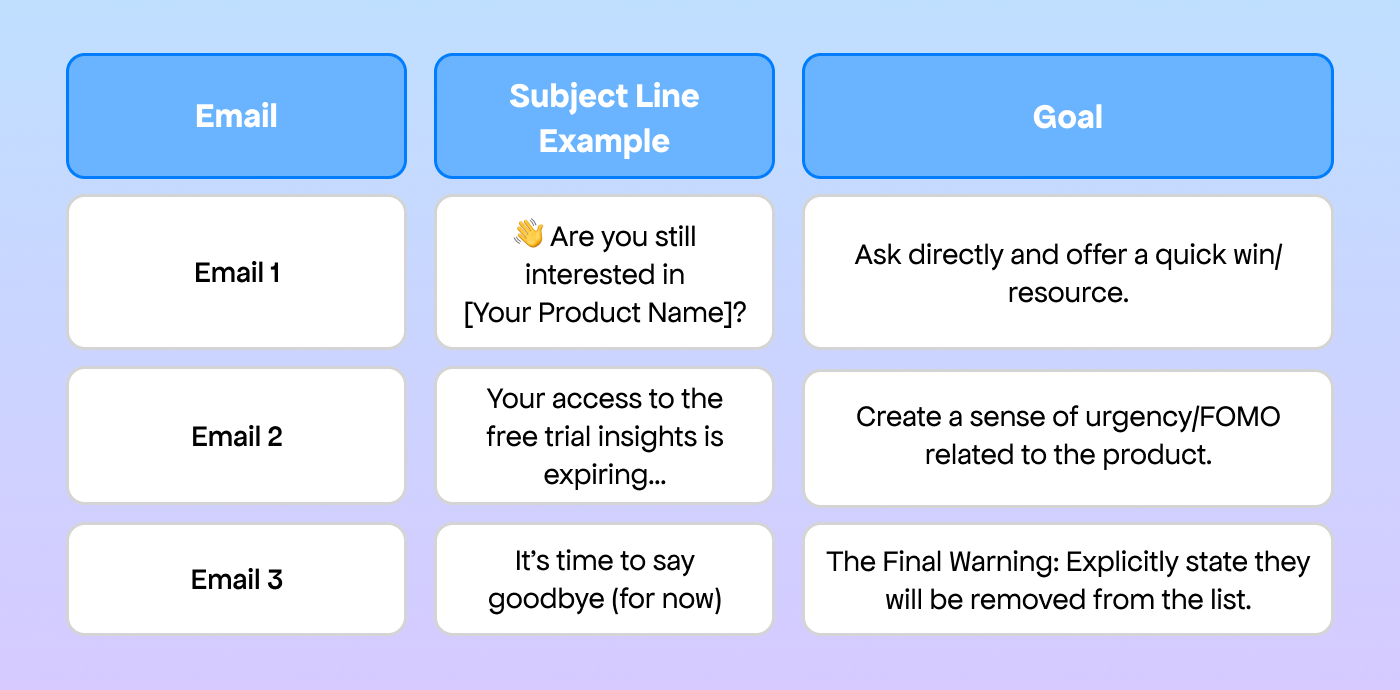
Crucial Action: Include a clear call-to-action (CTA) like, "Click here to keep receiving our tips/updates." Anyone who clicks remains on the list; anyone who ignores all three emails moves to the suppression list.
4. 🗑️ Phase 3: The Suppression List (Post-Cleanup)
Do not delete the email addresses of the users you deemed inactive or unengaged. Move them to a Suppression List (or Do Not Contact List).
A. What is the Suppression List?
This is a dedicated, separate list that your ESP is explicitly instructed never to send emails to.
B. Why Suppress, Not Delete?
- Compliance: You retain proof that the user was once on your list and that you opted them out, protecting you from future legal issues if they claim they never signed up.
- History: You maintain a record of the user's past actions and trial usage for future analysis.
- Accurate Analytics: Your main "Active" list now only contains people you are actually emailing, giving you precise metrics.
C. Schedule Regular Deep Cleans
Commit to a deep list cleaning process at least twice per year (every six months). This involves manually reviewing your segments, running the re-engagement campaign, and moving the resulting suppressed users to the Do Not Contact list.
🚀 Key Takeaways
For your SaaS free trial business, think of email list cleaning as a continuous growth strategy, not a one-time chore.
- Prioritize Quality Over Quantity: A small list of engaged users is infinitely more valuable than a huge list of dormant accounts.
- Automate Segments: Use email activity, product usage, and subscription status to automatically move users between segments.
- Be Decisive: Don't be afraid to remove unengaged users. You are cleaning your list for better performance, lower costs, and successful trial-to-paid conversions.
A clean list ensures that the right messages (like "Your trial is ending!") reach the right people at the critical moments, driving sustainable revenue growth for your SaaS company.