



Cold emails sent to undefined audiences see 3–5× lower reply rates than emails sent to a well-targeted list. The difference isn't the copy. It's who you're sending to.
An Ideal Customer Profile (ICP) is a detailed description of the company or person most likely to buy your product, get value from it, and become a long-term customer. For cold email, it determines who receives your outreach — and getting it wrong wastes your sending reputation and your time.
This post gives you a complete framework for building your ICP from scratch: the difference between ICPs and buyer personas, a 5-step process to define yours, real examples across three business types, and how to turn your ICP into better cold emails. Stick around until the end for a free ICP Definition Template you can start filling in today.
ICP vs buyer persona: what's the difference?
This is the most common point of confusion, so let's clear it up immediately.
Your ICP describes the ideal company or account you want to sell to. It's firmographic: industry, size, revenue, geography, tech stack. It answers the question "which companies should we target?"
A buyer persona describes the ideal individual within that company. It's psychographic: their goals, frustrations, priorities, and how they make buying decisions. It answers "who at that company do we write to, and what do we say?"
For cold email, you need both. Your ICP filters your target list. Your buyer persona shapes the message.
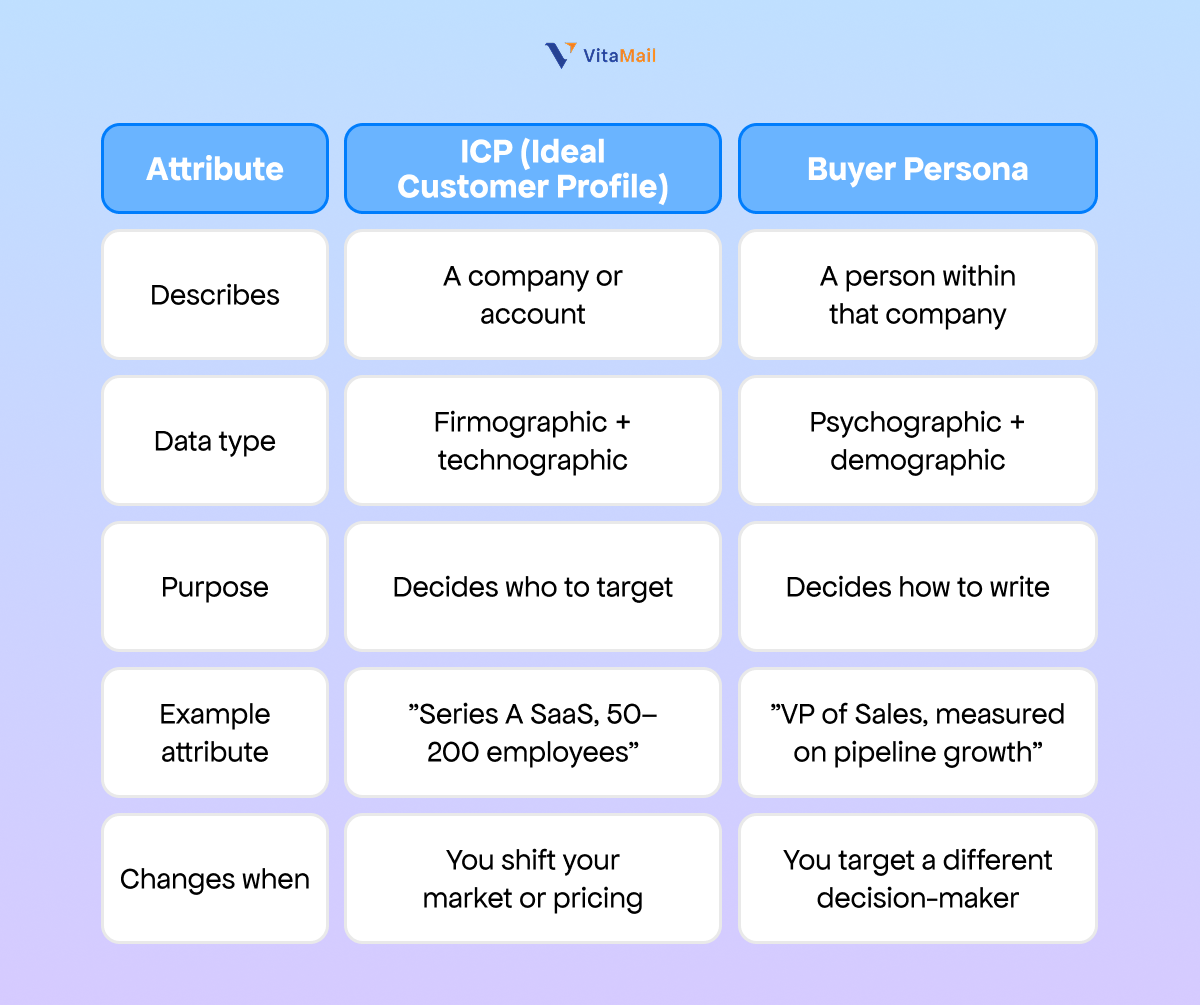
Think of the ICP as the city, and the buyer persona as the address.
Why your ICP is the most important part of cold outreach
Every part of your cold email campaign depends on your ICP. Your lead list, your personalisation, your offer, your sending volume — all of it flows from who you've decided to target. Get it right and the rest gets easier. Get it wrong and no amount of clever copywriting will fix it.
Here's why this matters mechanically: when you send cold emails to the wrong companies, those emails bounce, get ignored, or get marked as spam. That damages your sender reputation. Once your domain reputation drops, even emails to the right prospects end up in junk. You can check your domain health before sending to see where you stand — but prevention is better than diagnosis.
Companies with a documented ICP see 68% higher account win rates, according to research from SiriusDecisions (now part of Forrester). That's not a marginal gain. It's the difference between a pipeline that converts and one that stalls.
The cost of getting your ICP wrong
- You burn through sending domains faster because bounce rates and spam complaints spike with untargeted lists.
- Your sales team wastes hours on calls with prospects who were never going to buy, dragging down morale and quota attainment.
- You lose the ability to write personalised emails at scale because there's no shared pattern in your audience to build templates around.
If your reply rates are below 3% and your bounce rate is above 5%, your ICP is probably the root cause. Let's fix it.
How to define your ICP in 5 steps
This framework works whether you're a 5-person startup or a 500-person scale-up. Adjust the data sources to your stage.
Step 1: Start with your best current customers
Open your CRM and sort your customers by three metrics: lifetime value (LTV), time-to-value (how fast they onboarded and saw results), and churn (or retention). The overlap of high-LTV, fast-onboarding, low-churn customers is your ICP signal.
Look for 10–20 of your best accounts and list them. If you're pre-revenue or just launching, use hypothetical ideal clients: companies you've spoken to that got excited about your product, or competitors' case studies that match what you're building.
Don't skip this step. Gut instinct is useful, but data keeps you honest.
Step 2: Define firmographic attributes
Now look across those best customers and find what they have in common. Pull out:
- Industry or sub-vertical (e.g. not just "SaaS" but "B2B SaaS selling to mid-market")
- Company size by employee count and revenue range
- Geography (HQ location, or where they operate)
- Funding stage (bootstrapped, seed, Series A, PE-backed, public)
- Tech stack indicators (what CRM, email platform, or tools they use)
The goal is to describe a company type, not a single company. You're looking for the pattern.
Step 3: Identify the buying trigger
A buying trigger is the event or condition that makes a company need your product right now. Without a trigger, you're reaching out to companies that might be a fit but have no reason to act.
Strong buying triggers include: just hired a VP of Sales (they're building pipeline), raised a funding round in the last 6 months (they have budget and growth pressure), posted SDR job ads (they're scaling outbound), or switched to a competitor tool (they're actively evaluating).
Write down 2–3 buying triggers for your ICP. These will become filters in your lead sourcing and signals in your email personalisation.
Step 4: Define the buyer persona within the ICP account
Now move from the company to the person. Within the companies that match your ICP, who do you actually email? Define:
- Job title and seniority level (e.g. "Director of Marketing or above")
- Their primary pain point related to your product
- What they're measured on (KPIs, OKRs, quota)
- Common objections they raise in sales conversations
- Where they spend time online (LinkedIn, specific Slack communities, industry events)
Your buyer persona tells your copywriter who they're writing to. Without it, your emails will feel like they were written for "anyone at the company" — which means they resonate with no one.
Step 5: Validate and narrow
Here's the uncomfortable truth: a good ICP should feel uncomfortably narrow. If your ICP describes 500,000 companies, it's not an ICP. It's a market.
Narrow it until it describes 3,000–10,000 companies. You can always expand later once you've proven the messaging and the motion. Starting narrow lets you write more specific emails, build tighter lead lists, and learn faster from replies.
Test your ICP by asking: "Could I describe this company to a stranger and they'd be able to find ten real examples in five minutes?" If yes, it's specific enough.
Example ICP
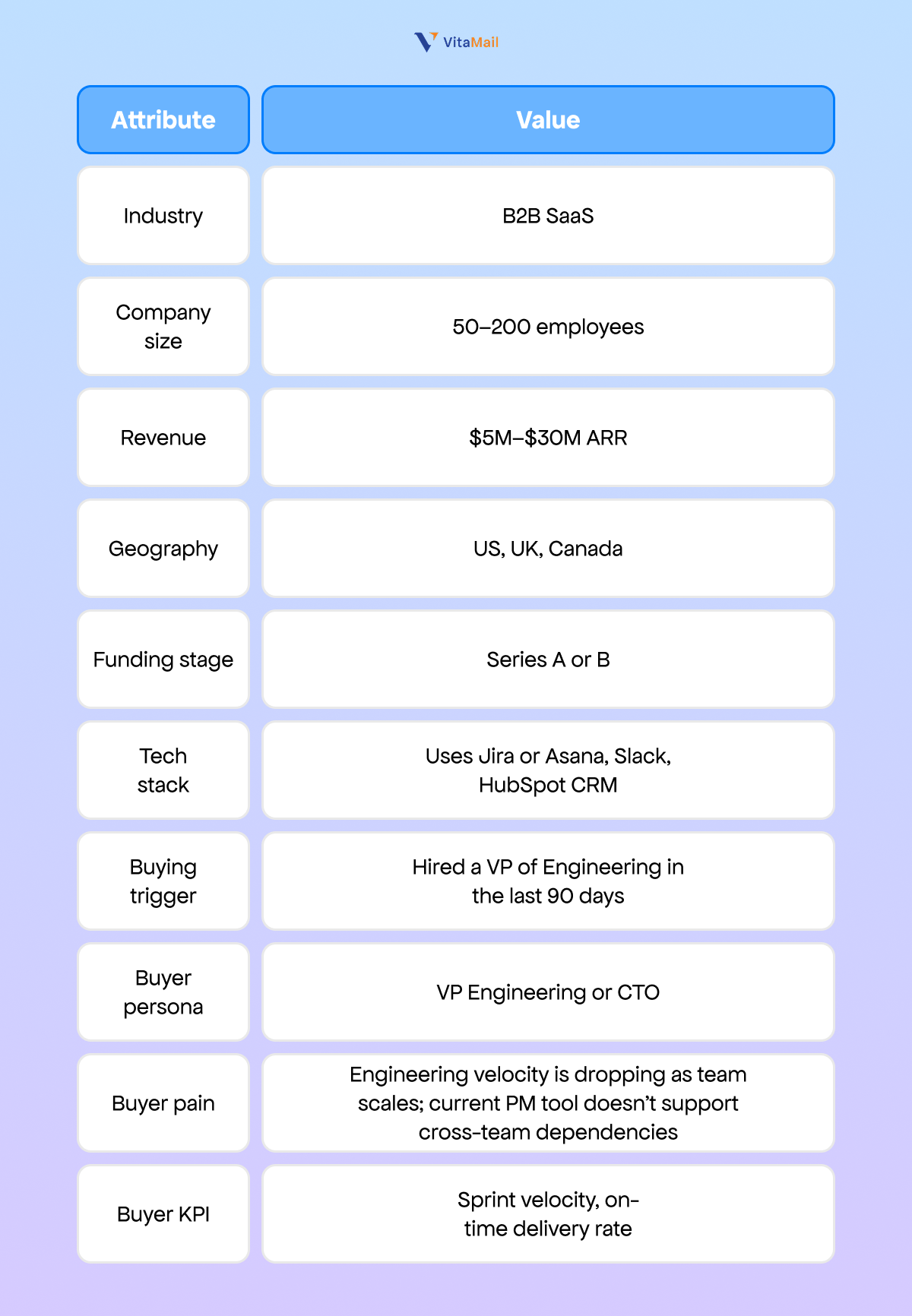
Company: CloudSync (fictional B2B SaaS, project management tool)
ICP Attributes To Define (The Complete List)
You don't need every attribute on day one. But knowing the full menu helps you build a sharper profile as you learn from outreach data.
Firmographic attributes
- Industry and sub-vertical
- Employee count (range)
- HQ country or region
- Annual revenue range
- Funding stage (bootstrapped, seed, Series A–D, PE-backed, public)
- Public vs private
- Years in business
Technographic attributes
- Current CRM (Salesforce, HubSpot, Pipedrive, none)
- Email platform (Mailchimp, Klaviyo, ActiveCampaign)
- Marketing automation stack
- Specific tools that signal readiness for your product (e.g. using Apollo but hitting limits, running Outreach without enrichment)
Behavioural and intent signals
- Recently hired a sales or marketing leader
- Raised funding in the last 6 months
- Posted SDR or BDR job ads
- Actively reviewing tools on G2 or Capterra
- Published content about a problem your product solves
Many of these signals can be inferred automatically. VitaMail's V5 reads your company website URL and suggests your ICP attributes based on your product or service, so you're not starting from a blank spreadsheet.
Who to exclude: defining your negative ICP
Your negative ICP is just as important. Explicitly exclude:
- Companies below a minimum size threshold (too small to afford you or too small to get value)
- Industries you don't serve or can't support
- Competitor users who are locked into long contracts
- Companies in regions you can't sell to (compliance, language, time zone)
Write these exclusions down. They'll save your lead list from noise and protect your sending reputation.
3 real ICP examples for different business types
Here's what a finished ICP looks like for three common business types. Use these as templates and swap in your own data.
Example 1: B2B SaaS: Project Management Tool
Company profile: Series A/B software companies, 50–200 employees, HQ in US/UK/Canada, currently using Jira.
Buyer persona: VP of Engineering or CTO. Measured on engineering velocity and release cadence. Frustrated with poor cross-team visibility in Jira.
Buying trigger: Hired a new VP of Engineering in the last 90 days, or engineering team grew by 30%+ in the last quarter.
Example 2: Marketing Agency: SEO & Content Services
Company profile: E-commerce DTC brands, $5M–$50M annual revenue, running Google and Meta ads but no organic/SEO programme. Shopify or WooCommerce.
Buyer persona: Founder or CMO. Measured on CAC and revenue growth. Knows they're over-reliant on paid channels but hasn't prioritised SEO yet.
Buying trigger: Rising ad costs in the last two quarters, or a competitor started ranking for their branded terms.
Example 3: Professional Services: Fractional CFO Advisory
Company profile: Manufacturing companies, 100–500 employees, PE-backed, no in-house finance director or CFO. Revenue $10M–$100M.
Buyer persona: COO or CEO. Measured on EBITDA and operational efficiency. Knows financial reporting is weak but doesn't want to hire a full-time CFO yet.
Buying trigger: Received PE investment in the last 12 months, or currently preparing for a follow-on round or exit.
Once you have your ICP defined, the next step is building a validated lead list that matches it exactly — without buying dirty data.
How to use your ICP to write better cold emails
Your ICP isn't a strategy document that lives in a Google Doc and never gets opened again. It's a working tool. Every attribute you defined should map directly to a personalisation variable in your email templates.
Here's how:
- Industry → opens the email with an industry-specific pain point ("Most Series B SaaS teams we talk to are struggling with...")
- Funding stage → frames urgency ("Now that you've closed your Series A, pipeline is probably top-of-mind...")
- Tech stack → creates an integration hook ("We plug straight into HubSpot, so there's no migration")
- Buying trigger → makes timing feel intentional ("Congrats on the VP of Sales hire — that's usually when outbound becomes a priority")
Watch how this changes an email:
Generic opener: "Hi [Name], I help companies grow their sales pipeline. Would you be open to a quick chat?"
ICP-personalised opener: "Hi [Name], most Series B dev-tools companies we work with see pipeline slow down right around the 100-employee mark — especially if outbound is still founder-led. Worth a 15-minute call to see if that's happening at [Company]?"
The second version only works because the sender knows the ICP: Series B, dev-tools, ~100 employees, founder-led sales. Every detail comes from the profile.
VitaMail V5 auto-generates personalised openers using the defined ICP, LinkedIn data, and recent company news — pulling these variables together without manual research per prospect.
Q: How do I use my ICP to write cold emails?
A: Map each ICP attribute to a personalisation variable in your email template. Your prospect's industry shapes the opening pain point, their tech stack informs your integration hook, and their funding stage sets the urgency of your pitch. The more precise your ICP, the more specific — and effective — your personalisation.
How VitaMail defines your ICP automatically
VitaMail's V5 workflow removes the blank-page problem from ICP definition. Here's how it works:
- You enter your company website URL.
- The AI reads your site — your product, pricing, positioning, and use cases.
- It suggests ICP attributes: industry, company size, geography, and buying triggers.
- You review, confirm, or edit the suggestions.
- Once confirmed, V5 matches your ICP against its lead database and begins building a validated list.
The whole process takes minutes, not days. You still own the final ICP, the AI gives you a starting point based on what your product actually does, not what you think your market might be.
Conclusion
Your ICP is the foundation of everything in cold outreach: your lead list, your email copy, your sending strategy, your reply rates. Define it with data, keep it narrow, and revisit it every quarter. If you do that, every other part of your end-to-end cold outreach workflow gets easier.
Ready to let AI define your ICP? Try VitaMail Now→