

![B2B Appointment Setting Services: A Founder's Guide [2026]](/_next/image?url=https%3A%2F%2Fss3.vitanur.com%2Fvitabucket%2F3c25fbb0-8024-42e7-b6bb-80ddc8a5e501.png&w=3840&q=75)


B2B appointment setting is the process of qualifying prospects and booking sales meetings on behalf of your sales team, usually through cold email, phone, and LinkedIn outreach. B2B appointment setting services are agencies or freelancers who do this work for you, typically charging by the hour, by the booked meeting, or on a monthly retainer. For most early-stage B2B SaaS founders, the real question is not "which agency should I hire," but "should I hire one at all, or build the motion in-house first?"
This guide answers that question. You'll get current pricing benchmarks, a side-by-side comparison of well-known providers, an original 5-stage framework for deciding when to outsource, and a step-by-step playbook for running appointment setting yourself with a stack that costs less than a single agency meeting. If you want to start booking meetings this week, our AI Email Generator will write your first outreach sequence in under five minutes.
Key Takeaways:
- Average cost per qualified B2B appointment runs $550 to $1,700, per Clutch's 2025 data.
- At $1,000 per appointment and a 20% close rate, outsourced meetings cost $5,000 per deal, which only works above roughly $30K ACV.
- Below $250K ARR, founders should run outbound themselves rather than outsource, since agencies can't learn your buyer for you.
- Hire your first SDR at $250K to $1M ARR before signing any agency contract.
- A DIY outbound stack costs $200 to $500 a month, so one agency-booked meeting can fund half a year of it.
- Google escalated cold email enforcement in November 2025, moving from delays to permanent rejections for senders who skip proper authentication.
What Is B2B Appointment Setting and How Does It Work?
B2B appointment setting is the function of identifying in-market business buyers, reaching out across channels, qualifying them against your ideal customer profile, and booking a meeting with a sales rep. It sits between lead generation and closing.
A typical appointment setting workflow looks like this:
- Build a target account list based on firmographics (industry, revenue, headcount) and persona fit.
- Enrich contacts with verified email addresses, direct dials, and LinkedIn profiles.
- Run multi-channel outreach across email, phone, and LinkedIn over a 2 to 4 week sequence.
- Qualify replies against a simple framework (BANT, MEDDIC, or your own).
- Book the meeting on the rep's calendar with full context written into the calendar invite.
The output is a qualified meeting that shows up on a sales rep's calendar. The input, on the cold email side, is a clean list, working domain infrastructure, and copy that reads like a real human wrote it. If your domain reputation is poor, none of the rest matters, because your emails will not land. That is why we built our Domain Health Checker as a free starting point.
How Much Do B2B Appointment Setting Services Cost in 2026?
Pricing varies more than any other B2B service category. The cheapest hourly setters bill $25 per hour. The most premium pay-for-performance retainers charge $16,000 per month with BANT-verified meeting guarantees.
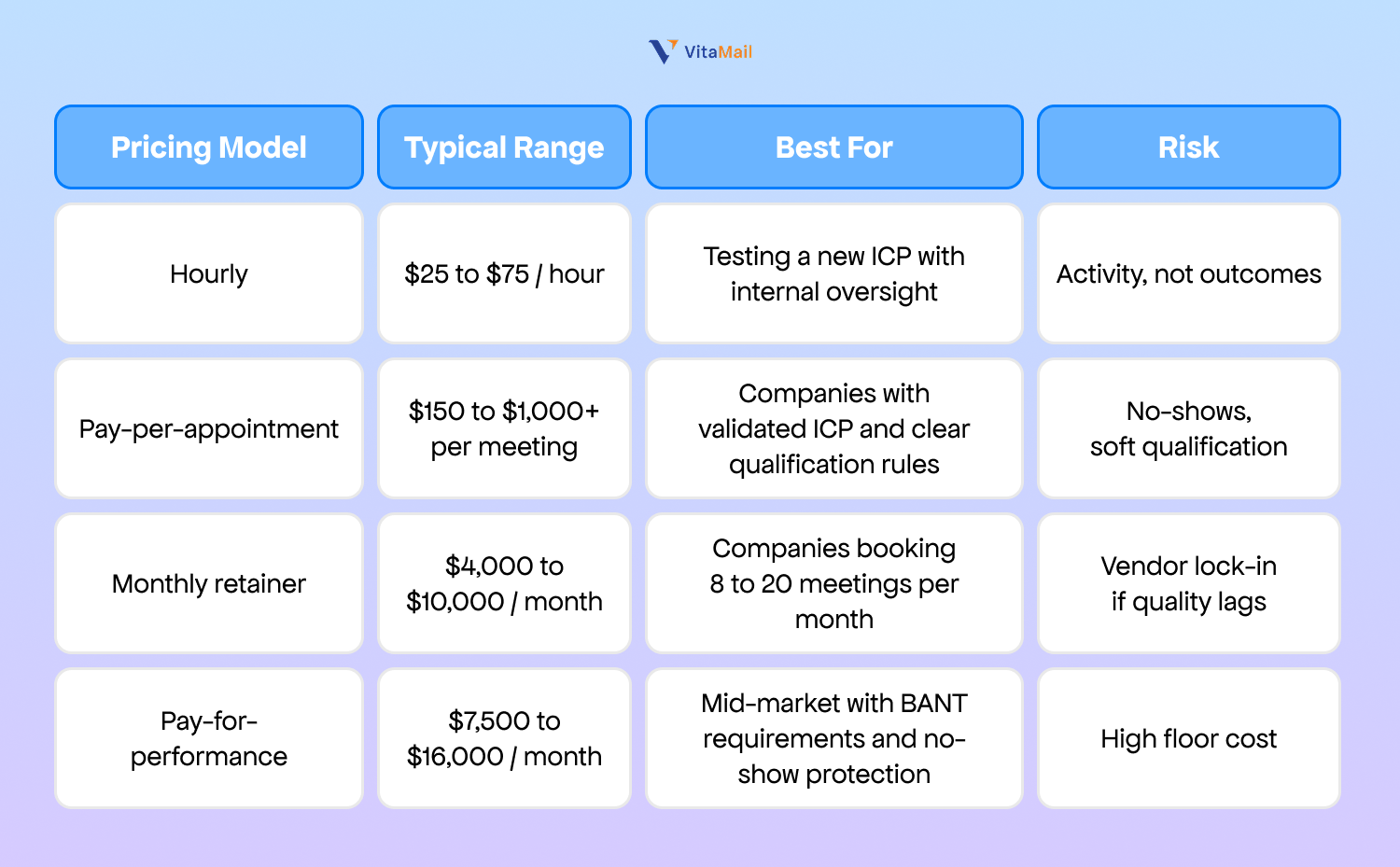
The cleanest benchmark comes from Clutch, the B2B services review platform. Their aggregated 2025 data placed the average cost per qualified B2B appointment between $550 and $1,700, depending on industry and qualification depth.
Run the math against your funnel. If your sales-qualified-to-closed-won rate is 20%, a closed deal costs you 5 appointments. At $1,000 per appointment, your customer acquisition cost from outbound is $5,000 before any rep time. That works at $30K ACV. It breaks at $5K ACV.
When Should an Early-Stage B2B SaaS Founder Outsource Appointment Setting?
Most agency landing pages tell you to outsource immediately. That advice is wrong for early-stage founders, and not because agencies are bad. It is wrong because you do not yet know what to outsource.
Here is an original framework we use internally to guide founders.
The Founder's Outbound Maturity Model
Stage 0: Validation ($0 to $50K ARR) Founder runs all outbound personally. The goal is not meeting volume. The goal is to learn which message gets which buyer to respond. You should send 20 to 40 manual emails per day, read every reply, and refine your ICP weekly. Do not outsource. You will lose the signal.
Stage 1: Systemization ($50K to $250K ARR) Founder builds a documented playbook: ICP definition, 3 to 5 tested email sequences, qualification criteria. Tooling matters now. Add a sending platform, email validation, and warmup. Volume goes from 40 to 200 emails per day across a few inboxes. Outsourcing is still premature.
Stage 2: First Hire ($250K to $1M ARR) Hire one in-house SDR or a fractional SDR who runs your documented playbook. Outsource only the parts you have systemized (list building, data enrichment). Keep messaging and qualification in-house. This is where most founders should be before signing an agency contract.
Stage 3: Scaling ($1M to $5M ARR) Build a small SDR team (2 to 4 reps) or partner with a specialized appointment setting agency that can plug into your existing motion. By now, you know your numbers cold: cost per meeting, meeting-to-opp rate, opp-to-closed-won rate.
Stage 4: Mature Outbound ($5M+ ARR) Run a full RevOps motion with multiple specialized teams, parallel agency partnerships for new segments, and an in-house data engineering function. Outsourcing here is strategic, not desperate.
If you are below Stage 3, the right move is almost always to build, not buy. Hiring an agency at Stage 0 or Stage 1 is paying someone to learn your business for you, then taking that knowledge with them when the contract ends.
Top B2B Appointment Setting Companies Compared
This is not an exhaustive list. These are providers commonly evaluated by B2B SaaS founders, with publicly available positioning. Verify current pricing on each provider's site before signing anything.
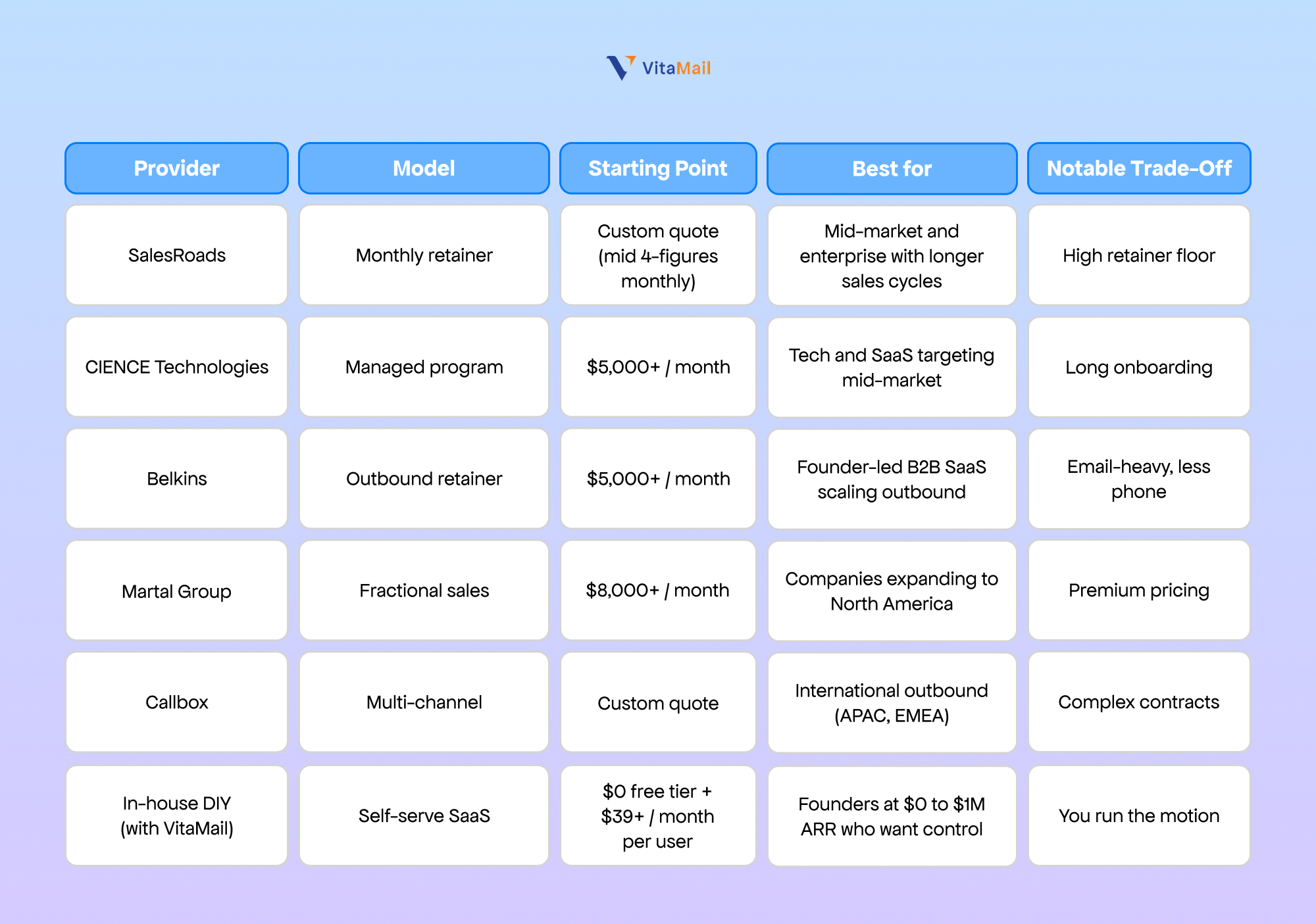
The honest read: at early stage, the DIY column wins on cost and learning velocity. At later stage, the agency columns win on speed to fill a calendar. There is no universal answer. There is only "what stage are you actually at."
How to Run B2B Appointment Setting Without an Agency: A 7-Step Playbook
If you decide to build in-house, this is the order of operations that works. Skip any step and the whole motion breaks.
- Define your ICP in one sentence. Industry, revenue band, headcount, job title, trigger event. If you cannot write it on a sticky note, you do not know it yet. Our ICP guide for cold email gives you the exact format.
- Set up sending infrastructure properly. Buy 2 to 4 secondary domains (not your main one). Set up SPF, DKIM, and DMARC on each. Warm up new inboxes for 14 to 21 days before sending real outreach. The domain infrastructure setup guide walks through the exact records.
- Build a verified list of 500 to 1,000 contacts. Pull from LinkedIn Sales Navigator or a contact database. Validate every email before sending. Sending to bad addresses kills your sender reputation fast, and Google now starts enforcing at a 0.3% spam complaint rate.
- Write three sequence variants. Each sequence has 3 to 5 emails over 14 days. Different angles: pain-led, social-proof-led, curiosity-led. Use plain text. No images, no logos, no marketing footer. See our cold email templates that get replies for working examples.
- Cap volume per inbox. Send 20 to 30 emails per inbox per day, no more. Calculate your daily send capacity by inboxes multiplied by 25. If you need 200 emails per day, you need 8 inboxes. Our breakdown of how many cold emails to send per day covers the math.
- Qualify every reply against your ICP. Not every positive reply is a meeting. A "tell me more" from someone outside your ICP wastes calendar time. Have a one-line qualifier ready before booking. Once a qualified meeting lands on the calendar, what happens during the call matters just as much. A bot-free meeting note-taker can help reps stay focused on the conversation while keeping a clean summary and action items ready for the CRM afterward.
- Track three numbers. Reply rate (target 5 to 12%), positive reply rate (target 1.5 to 3%), and meeting-booked rate (target 0.5 to 1.5% of total sent). If any number is below the floor, fix that step before doing more volume. The cold email follow-up frameworks post covers what to do after the first reply.
This stack costs $200 to $500 per month all-in. One booked meeting from a $1,000-per-appointment agency pays for half a year of it.
5 Mistakes Founders Make With B2B Appointment Setting
Mistake 1: Outsourcing before you have product-market fit signal. You cannot delegate "figure out who buys this." Fix: do the first 100 outbound conversations yourself.
Mistake 2: Treating all booked meetings as equal. A meeting with the wrong ICP is worse than no meeting because it eats rep time and skews your data. Fix: write a 3-line qualification standard and enforce it.
Mistake 3: Sending from your main domain. One spam complaint cascade can hurt the deliverability of your transactional emails (invoices, password resets, customer comms). Fix: always send cold outreach from secondary domains.
Mistake 4: Skipping email validation. Sending to invalid addresses spikes your bounce rate, which kills sender reputation, which puts everything in spam. Fix: validate every list before every send. Our Bulk Verifier handles this.
Mistake 5: Optimizing copy before fixing deliverability. If your domain is on a blacklist or your authentication is broken, no amount of A/B testing on subject lines will help. Fix: check deliverability first, then copy, then targeting.
How VitaMail Fits Into Founder-Led Appointment Setting
If you decide to run appointment setting in-house, you need three things working together: verified contact data, a sending platform that protects your deliverability, and an AI layer that helps you write outreach that does not sound like outreach.
VitaMail, an AI-powered cold email outreach platform with built-in email validation and domain health monitoring, was built specifically for early-stage B2B founders running their own outbound. Here is how the pieces map to the playbook above:
- If you are building lists, VitaMail's bulk email validation catches invalid and risky addresses before they damage your sender reputation. You upload, we tell you what's clean.
- If you are setting up infrastructure, VitaMail's domain health monitoring flags blacklist issues, missing DNS records, and authentication gaps in one dashboard. You don't need to remember to check.
- If you are writing sequences, VitaMail's AI email generator drafts personalized cold emails based on your ICP and offer in seconds. You stay in editor mode, not blank-page mode.
- If you are scaling sends across multiple inboxes, VitaMail handles rotation and pacing so no single inbox exceeds safe daily limits.
[SCREENSHOT: VitaMail dashboard showing domain health score, bulk verification results, and active campaign metrics side by side.]
The free tier covers founders running their first 100 sends per month. The paid tier (starting at $39 per user per month) covers the volume of a Stage 1 or Stage 2 founder. You can start free here.
What About Pay-Per-Lead Appointment Setting Models?
Pay-per-lead and pay-per-appointment sound founder-friendly because you only pay for results. The catch sits in the contract language. Most pay-per-appointment contracts let the agency define what counts as a "qualified" meeting, and the definition is usually looser than you expect. You end up paying for meetings that should never have been booked. If you go this route, write your own qualification definition into the contract: title, company size, explicit interest stated, and a 48-hour confirmation requirement.
Is Cold Email Still Effective for B2B Appointment Setting in 2026?
Cold email still works, but the rules changed. Gmail and Yahoo now reject emails from bulk senders who fail authentication, exceed spam thresholds, or lack one-click unsubscribe. The requirements took effect in February 2024, and Google escalated enforcement in November 2025, moving from temporary delays to permanent rejections. Microsoft followed with similar rules in 2025. What this means in practice: founders who set up SPF, DKIM, and DMARC correctly, validate their lists, and write human-sounding copy still book meetings. Founders who skip the infrastructure layer do not. The bar for "good enough" went up, not the ceiling on what is possible.
Conclusion: The Right Move at Your Stage
The single most useful question is not "which appointment setting service is best?" It is "what stage am I actually at?" If you are below $250K ARR, the right move is almost always to run outbound yourself, learn your buyer's language, and build a documented playbook before handing it to anyone, employee or agency. If you are between $250K and $1M ARR, hire your first SDR, not an agency. Above $1M ARR with a documented motion and known unit economics, agencies start to make sense.
Whichever path you choose, the infrastructure layer is the same: clean lists, healthy domains, and copy that sounds like a person. If you want to run that layer yourself, start with VitaMail's free tier and book your first cold email meeting this month, not next quarter.