


Lead generation for SaaS companies is the work of finding business buyers who match your ideal customer profile, capturing their interest, and qualifying them into a sales conversation. For early-stage B2B SaaS founders, the channels that move pipeline look nothing like the ones late-stage growth playbooks recommend. You don't have the budget for $802-per-customer paid search, the runway to wait nine months for SEO to compound, or the team to run a full account-based motion. You have a founder, maybe a co-founder, and a list of people who probably have your problem.
This guide breaks down what each lead gen channel actually costs for SaaS, when cold email beats paid ads (and when it doesn't), an original 4-channel stack we recommend by ARR stage, and the deliverability rules that quietly decide whether outbound works at all in 2026. If you want to draft your first cold email sequence in five minutes, our AI Email Generator handles the blank-page problem for you.
Key Takeaways:
- Cold email produces a reply for $5 to $15 in tooling cost, while a paid search click runs $4 to $20 and only converts 1 to 3% of the time.
- B2B customer acquisition costs jumped 40 to 60% between 2023 and 2025, making paid ads risky before you've validated your offer.
- Below $250K ARR, founders should run cold email as the primary channel: 30 to 50 manual emails a day teaches you your buyer fast.
- Paid ads only win once you have product-market fit signal and landing pages converting at 5% or higher.
- A working cold email motion costs $200 to $500 a month, roughly a tenth of one paid search customer.
- Track three numbers weekly: reply rate (5 to 12%), positive reply rate (1.5 to 3%), and meeting-booked rate (0.5 to 1.5%).
What Is Lead Generation for SaaS Companies?
Lead generation for SaaS companies is the function of producing a steady flow of in-market business buyers and routing them to sales or product-led signup. It usually splits into two motions:
- Inbound: SEO, content, paid ads, organic social, referrals. The buyer comes to you.
- Outbound: Cold email, cold calling, LinkedIn outreach, events. You go to the buyer.
The difference matters for early-stage SaaS because inbound takes time to compound. Organic search content typically needs 6 to 12 months to drive predictable lead volume, and paid ads need a validated landing page and offer before they don't burn cash. Outbound, specifically cold email, gives a founder feedback in the first week: who replies, who books, who closes.
Lead generation is not the same as demand generation. Demand generation creates awareness of a problem. Lead generation captures contact information from people who already have it. SaaS founders confuse the two and end up running awareness campaigns when they need pipeline this quarter.
What Does Lead Generation Actually Cost for B2B SaaS?
The cost of acquiring a B2B SaaS customer has climbed sharply. According to industry data aggregated by Phoenix Strategy Group in 2025, customer acquisition costs rose 40 to 60% between 2023 and 2025, driven by privacy changes, increased competition, and attribution challenges. The averages tell the story:
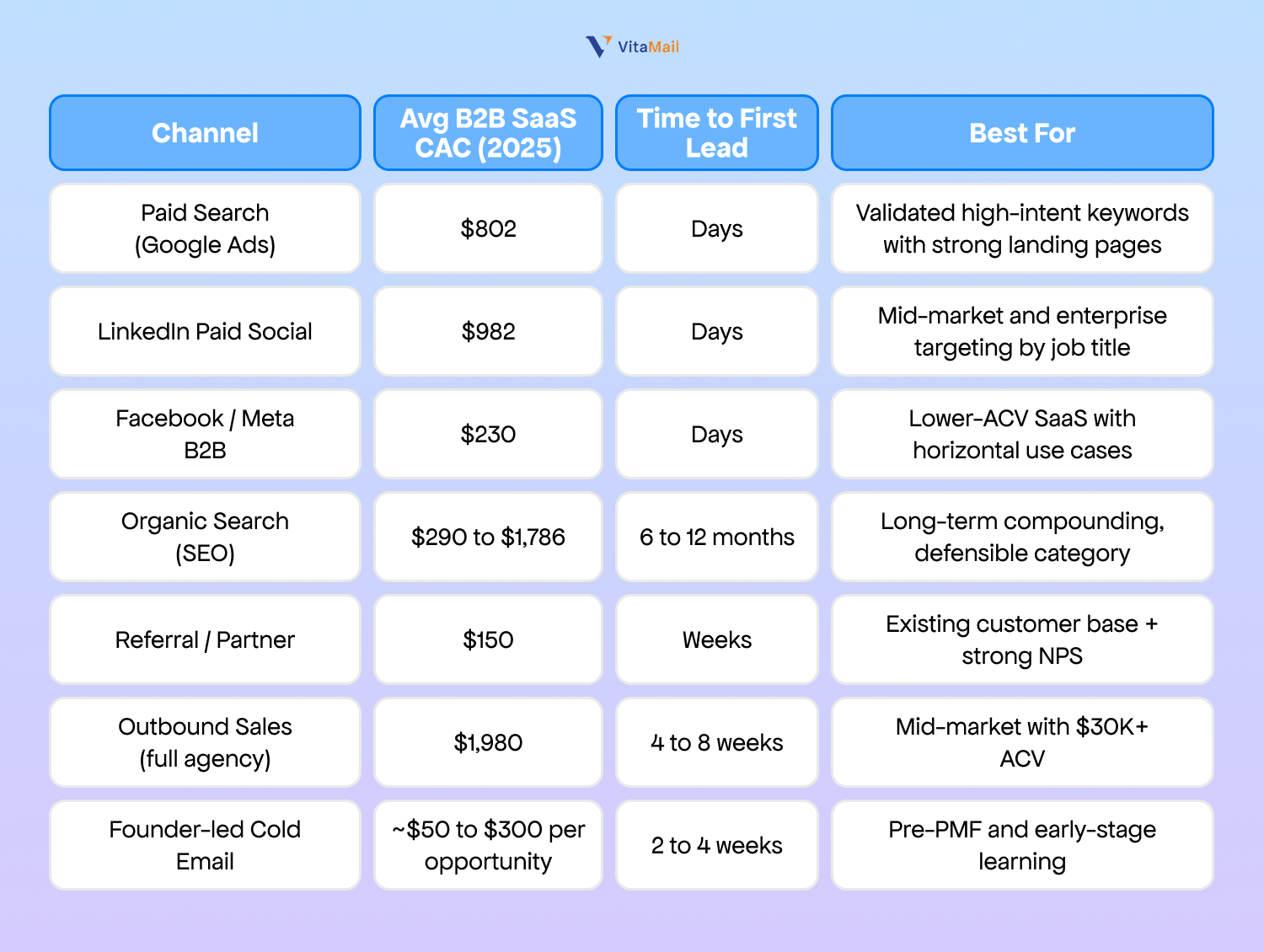
Sources: First Page Sage 2025 CAC by Channel Report, WordStream 2025 PPC Benchmark, Benchmarkit 2025 B2B SaaS Efficiency Survey.
Two takeaways for founders. First, founder-led cold email is the cheapest paid channel that produces a real conversation, not just a click. Second, paid search and paid social CACs assume you already have working landing pages and offer copy. If you don't, those numbers double.
Why Cold Email Beats Paid Ads for Early-Stage SaaS
This is the contrarian part. Most agency content recommends paid ads because agencies sell paid ads. Here is the honest case for cold email at early stage.
1. The cost-per-conversation is lower. A working cold email campaign produces a reply for roughly $5 to $15 in tooling cost (domains, inboxes, validation, sending platform). A paid search click costs $4 to $20 in B2B, and only 1 to 3% of clicks become a real conversation. The unit math is in cold email's favor when you measure conversations, not impressions.
2. The learning loop is faster. When you send 50 manual emails on Monday, you have replies by Wednesday. You learn which message lands, which segment cares, and which positioning sounds wrong out loud. Paid ads abstract this signal into click-through rate. CTR doesn't tell you why someone clicked.
3. The founder stays in the message. Pre-PMF, your message is the product. Cold email forces you to write the exact words a buyer needs to hear. Paid ads hide you from that work and replace it with creative testing against an algorithm that doesn't know your buyer.
4. The targeting is direct, not statistical. Cold email lets you reach a named person at a named company who matches your ICP exactly. Paid ads reach a probabilistic audience that resembles your buyer. The first is a list of 500 people. The second is a guess.
5. Deliverability has consolidated the channel. Since Gmail and Yahoo's 2024 sender requirements, sloppy cold email operators have left the channel. The senders who remain (those who validate lists, warm domains, write plain-text emails) face less competition in the inbox than they did in 2023. The requirements took effect in February 2024, and Google escalated enforcement in November 2025, moving from temporary delays to permanent rejections.
The founder math for cold email at $20K ACV looks roughly like this: a $200-per-month tooling stack, 2,000 emails per month at 5% reply rate equals 100 replies, 20% of replies book a meeting (20 meetings), 25% of meetings become opportunities (5 opps), 25% close at $20K (1.25 deals). That is $25,000 in new ARR for $200 in tooling plus founder time. The ratio shifts as you hire SDRs, but at founder stage, nothing else comes close.
When Paid Ads Actually Win
Cold email does not win in every situation. Paid ads beat cold email under four conditions:
- You have product-market fit signal. Paid amplifies what is already working. If your conversion rate from demo to closed-won is below 15%, ads amplify a leaky funnel.
- You have validated landing pages. Strong paid campaigns need landing pages that convert at 5% or higher. Building those takes design, copy, and iteration time.
- You sell to a category buyers actively search for. "Project management software" gets searched. "AI-powered field service compliance for HVAC contractors" does not. The first is paid territory. The second is outbound territory.
- You need speed for a known-converting offer. If you have a Black Friday SaaS deal that converts at 7% from cold traffic, paid ads scale that fast. Cold email cannot match paid's scaling velocity for high-volume offers.
For most early-stage B2B SaaS, conditions 1 and 2 don't apply yet, which is why cold email outperforms in that window. Once they do apply, paid becomes an accelerant on top of outbound, not a replacement for it.
The Founder's Lead Gen Stack: 4 Channels by ARR Stage
Most founders ask "which channel works?" The better question is "which channel works for me right now?" Here is a stack we recommend based on ARR stage.
Stage 0: Pre-Revenue to $50K ARR (Founder-Selling)
Primary: Cold email (100%) Why: You are learning your buyer. Nothing else gives you raw signal faster. Send 30 to 50 manual emails per day. Read every reply. Refine your ICP weekly.
Stage 1: $50K to $250K ARR (Founder-Led, Systemizing)
Primary: Cold email (70%) + LinkedIn organic (20%) + Referrals (10%) Why: Your playbook is starting to form. LinkedIn presence adds credibility when prospects search your name. Early customers refer if you ask.
Stage 2: $250K to $1M ARR (First SDR + Content Layer)
Primary: Cold email (50%) + Content/SEO (25%) + LinkedIn (15%) + Paid retargeting (10%) Why: SEO investment starts to compound. Paid retargeting captures site visitors at low CAC. Cold email still drives net-new pipeline.
Stage 3: $1M to $5M ARR (Multi-Channel Engine)
Primary: Inbound/SEO (35%) + Cold outbound (25%) + Paid (20%) + Partnerships (15%) + Events (5%) Why: You can afford to test paid at scale. Inbound starts to outweigh outbound on volume. Partnerships unlock new segments.
If you are below $250K ARR and spending more than 20% of your marketing budget on paid ads, you are likely paying to learn what cold email could have taught you for free. This is the most common pattern we see with founders we work with at VitaMail, an AI-powered cold email outreach platform with built-in email validation and domain health monitoring.
How to Run a Cold Email Lead Gen Motion for Your SaaS
If you are convinced cold email is the right starting channel, here is the order of operations. Skip a step and the math breaks.
- Define your ICP in one sentence. Industry, company size, role, trigger event. If you cannot fit it on a sticky note, you do not know it. Use our ICP guide for cold email to pressure-test your definition.
- Set up sending infrastructure on secondary domains. Buy 2 to 4 lookalike domains (not your main one). Set up SPF, DKIM, and DMARC on each. Warm up new inboxes for 14 to 21 days before any real outreach.
- Build a verified list of 500 to 1,000 contacts. Pull from LinkedIn Sales Navigator, a B2B database, or Apollo alternatives. Validate every email before sending. Bad addresses spike bounce rates and tank your sender reputation.
- Write three sequence variants. Each: 3 to 5 emails over 14 days, plain text, no images. Different angles per variant (pain-led, social-proof-led, curiosity-led). Pull working structures from cold email templates that get replies.
- Cap sends at 20 to 30 emails per inbox per day. Gmail and Outlook flag aggressive sending patterns. Spread volume across multiple inboxes instead of pushing one harder.
- Qualify every reply against your ICP before booking. A "tell me more" from someone outside your ICP wastes calendar time and skews your data. Use a one-line qualifier in your reply.
- Track three numbers weekly. Reply rate (target 5 to 12%), positive reply rate (target 1.5 to 3%), meeting-booked rate (target 0.5 to 1.5% of total sent). The full campaign setup guide walks through the dashboards.
Total monthly cost for this stack: $200 to $500. That is one-tenth of a single paid search customer acquisition at the 2025 B2B benchmark.
5 Mistakes Early-Stage SaaS Founders Make With Lead Generation
Mistake 1: Hiring an agency before learning your buyer. You cannot delegate "figure out who buys this." Agencies execute on a thesis. They do not develop one for you.
Instead: Run the first 100 outbound conversations yourself. Document what works. Hand the documented playbook to your first hire.
Mistake 2: Throwing $5,000 at Google Ads with no landing page test. Paid traffic to a bad landing page just lights money on fire faster. A 1% conversion rate at $50 per click is $5,000 per signup.
Instead: Validate landing page copy with cold email replies first. If "do you have X problem" gets agreement from your ICP via email, then test that angle in paid.
Mistake 3: Sending cold email from your main company domain. One spam complaint cascade can put your customer billing emails into spam folders. SaaS founders learn this the expensive way.
Instead: Always use secondary domains for outbound. Keep your main domain reserved for transactional and customer email.
Mistake 4: Skipping email validation. Sending to invalid addresses pushes your bounce rate above 2%, which damages sender reputation, which puts everything else in spam.
Instead: Validate every list before every send. Our Bulk Verifier catches catch-alls, role-based addresses, and invalid mailboxes.
Mistake 5: Optimizing for volume before fixing deliverability. Sending 500 emails per day from a cold domain with no warmup, no SPF, and no DMARC means 0 of them reach the inbox. Volume without infrastructure is theater.
Instead: Run a deliverability audit before increasing send volume. Fix the pipes, then turn up the tap.
How VitaMail Supports Founder-Led SaaS Lead Generation
If you decide to run cold email lead generation in-house, three things need to work together: clean lists, healthy domain infrastructure, and copy that does not read like a sales pitch.
VitaMail was built for this exact stack. Here is how the pieces line up:
- If you are building lists from Apollo, LinkedIn, or a B2B database, VitaMail's bulk validation flags invalid, role-based, and risky addresses before they damage your sender reputation. You upload a CSV, we tell you what's safe to send.
- If you are setting up secondary sending domains, VitaMail's Domain Health Checker verifies SPF, DKIM, DMARC, and blacklist status in one view. You don't need to learn DNS records from scratch.
- If you are writing your first sequence and staring at a blank page, VitaMail's AI Email Generator drafts personalized cold emails based on your ICP and offer. You move from blank page to first draft in under two minutes.
- If you are sending across multiple inboxes, VitaMail handles rotation and pacing so no inbox crosses safe daily limits.
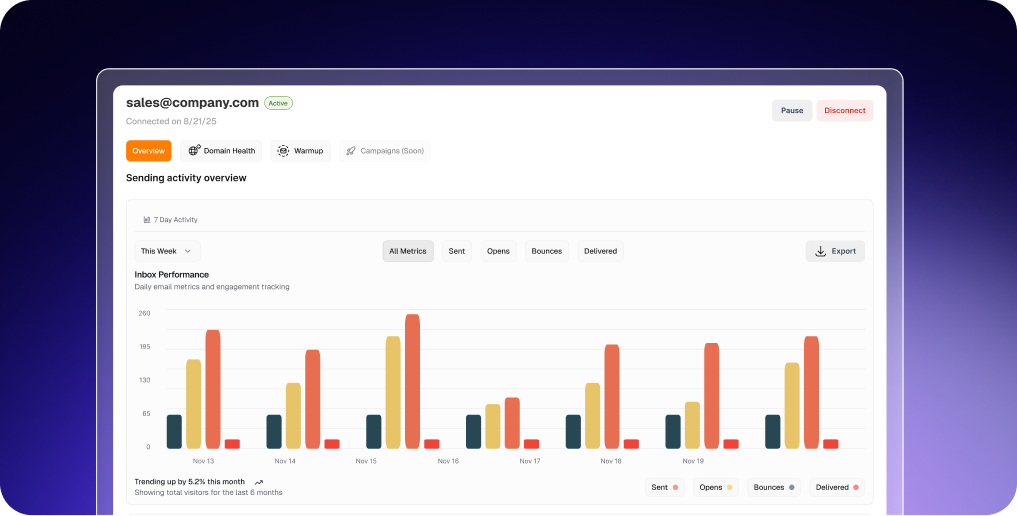
[SCREENSHOT: VitaMail dashboard showing domain health score, bulk verification results, and active cold email campaign metrics in one view.]
We have a free tier for founders running their first 100 sends per month. Paid plans start where most early-stage SaaS founders are, well below the cost of a single LinkedIn ads customer. You can register for free here and have your first sequence ready to send today.
What About Inbound Marketing for SaaS Lead Generation?
Inbound works, but the timeline matters. SEO content compounds over 6 to 12 months before it produces predictable lead volume, and only if the content is built on a defensible keyword strategy. For pre-PMF SaaS, inbound is the wrong primary channel because the feedback loop is too slow to inform product decisions. We recommend founders publish 1 to 2 strong articles per month from day one (so the content exists when it starts ranking) but treat outbound as the channel that funds the next 12 months. Once you cross $250K ARR, the balance flips.
How Does Lead Generation Connect to Product-Led Growth?
Product-led growth (PLG) and lead generation are not opposites. PLG handles the bottom of the funnel by letting users self-serve into the product. Lead generation handles the top by getting the right users to the signup page in the first place. A SaaS with PLG still needs traffic and pipeline. Cold email at early stage drives qualified signups into a PLG motion, then the product takes over. The two work together; founders who pick one and ignore the other leave growth on the table.
Conclusion: Pick the Channel That Fits Your Stage
Lead generation for SaaS companies is not about finding the universally "best" channel. It is about matching the channel to where you are right now. At pre-revenue to $250K ARR, cold email beats paid ads on cost, learning speed, and direct buyer access. At $250K to $1M ARR, you layer in content and LinkedIn. Above $1M ARR with validated messaging, paid ads become a force multiplier on a working motion.
The mistake is starting with paid ads. The fix starts with the channel that teaches you what your buyer actually responds to, then scaling what works. If you want to run that channel yourself, start using VitaMail today and book your first meeting from cold email this month, not next quarter.