



Lead generation for recruitment agencies is the systematic process of identifying hiring companies, reaching the decision-makers who control external recruiting spend, and converting them into paying clients. Most staffing and recruiting firms still depend on referrals and inbound job board traffic. The firms growing fastest in 2026 have one thing in common: they've built a repeatable outbound system on top of those referral channels.
This guide is the complete playbook. You'll get the 5-step system that works across recruiting specialties (executive search, IT staffing, healthcare, legal, finance), the cold email templates that actually book client meetings, and the deliverability infrastructure that keeps your emails out of spam. If you run a recruiting firm without an internal SDR and can't justify $5,000 per month for an outsourced lead-gen agency, this is built for you.
VitaMail, the AI-powered cold email outreach platform with built-in email validation and domain health monitoring, was designed for exactly this kind of operator: the founder or director still doing sales themselves, who needs a system that runs without hiring three more people. You can start a free trial or grab the free domain health checker to audit your sending setup before you read further.
We'll cover: why recruiting outbound is its own discipline, how cold email compares to LinkedIn for client acquisition, the 5-step system, three battle-tested email templates, the tech stack that costs under $300 per month, compliance, and the specialty-specific playbooks if you want to drill deeper.
Key Takeaways:
- Cold email beats LinkedIn InMail, paid ads, and cold calling on cost-per-meeting for nearly every recruiting niche
- The 5-step outbound system works across specialties: define ICP, source data, write the sequence, build infrastructure, convert replies
- Email decision-makers, not job posters. Heads of Talent and CEOs control recruiting agency budgets, not the recruiters listed on Indeed
- Domain warmup is non-negotiable in 2026. Google and Yahoo's February 2024 sender requirements broke unwarmed cold email programs overnight
- A solo recruiter can run a profitable outbound program in 2-3 hours per week using AI copy generation, automated sequencing, and pre-validated lists
- A 3-5% reply rate translates to 1-2 booked meetings per 100 emails, which justifies the cost even at modest placement values
Why recruiting agencies need a different outbound approach
Recruiting is not B2B SaaS. Your buyers are not searching for a "recruiting agency" the way they search for a CRM. They have an unfilled role, they're frustrated with their current process, and they're already ignoring three other recruiters who pitched them last week. Generic cold email playbooks fail in this niche for three reasons.
The buyer has a recurring need, not a one-time purchase. A Head of Engineering at a Series B startup will hire 4-6 engineers this year. If you book one meeting and prove you can deliver, you have a multi-placement account for 18 months. The lifetime value math in recruiting forgives a lot of outbound mistakes that would sink a SaaS team.
The decision window is short. Hiring is urgent. If a company has an open role and you reach them in the right week, they will reply within hours. If you reach them two weeks late, they've already signed with another firm. Your sequencing has to account for this rhythm.
The real objection is "we already have one we like." Cold email for recruiting rarely needs to convince the buyer they need the category. It needs to give them a reason to take a second meeting, when they already have a recruiter they're working with. That changes everything about your copy.
This is why recruiting-specific outbound matters. The frameworks below are built for this reality.
The state of recruiting outbound in 2026
Three shifts have changed the rules of recruiting client acquisition in the last 24 months.
LinkedIn InMail reply rates have collapsed. Hiring managers are getting hit with dozens of templated InMails per week from recruiters, sales reps, and SaaS vendors. The platform that used to be the default channel for recruiter outreach is now the most saturated.
Google and Yahoo introduced new bulk sender requirements in February 2024 (read the announcement). If you send more than 5,000 emails per day to Gmail addresses without proper SPF, DKIM, and DMARC, your messages go straight to spam. Most recruiting agencies were not ready. The ones that adapted captured the share the unready ones lost.
AI has made personalization cheap. Two years ago, sending 50 personalized emails per day required two SDRs. Today, one operator with the right tools can do the same volume in less than two hours. The recruiting agencies treating this as a productivity unlock are pulling away from the ones still hand-typing every message.
The opportunity is real, but only for firms that build their infrastructure correctly. We'll show you how.
Cold email vs LinkedIn vs cold call for recruiting agencies
If you're choosing where to put your outbound budget, this is the comparison that matters.
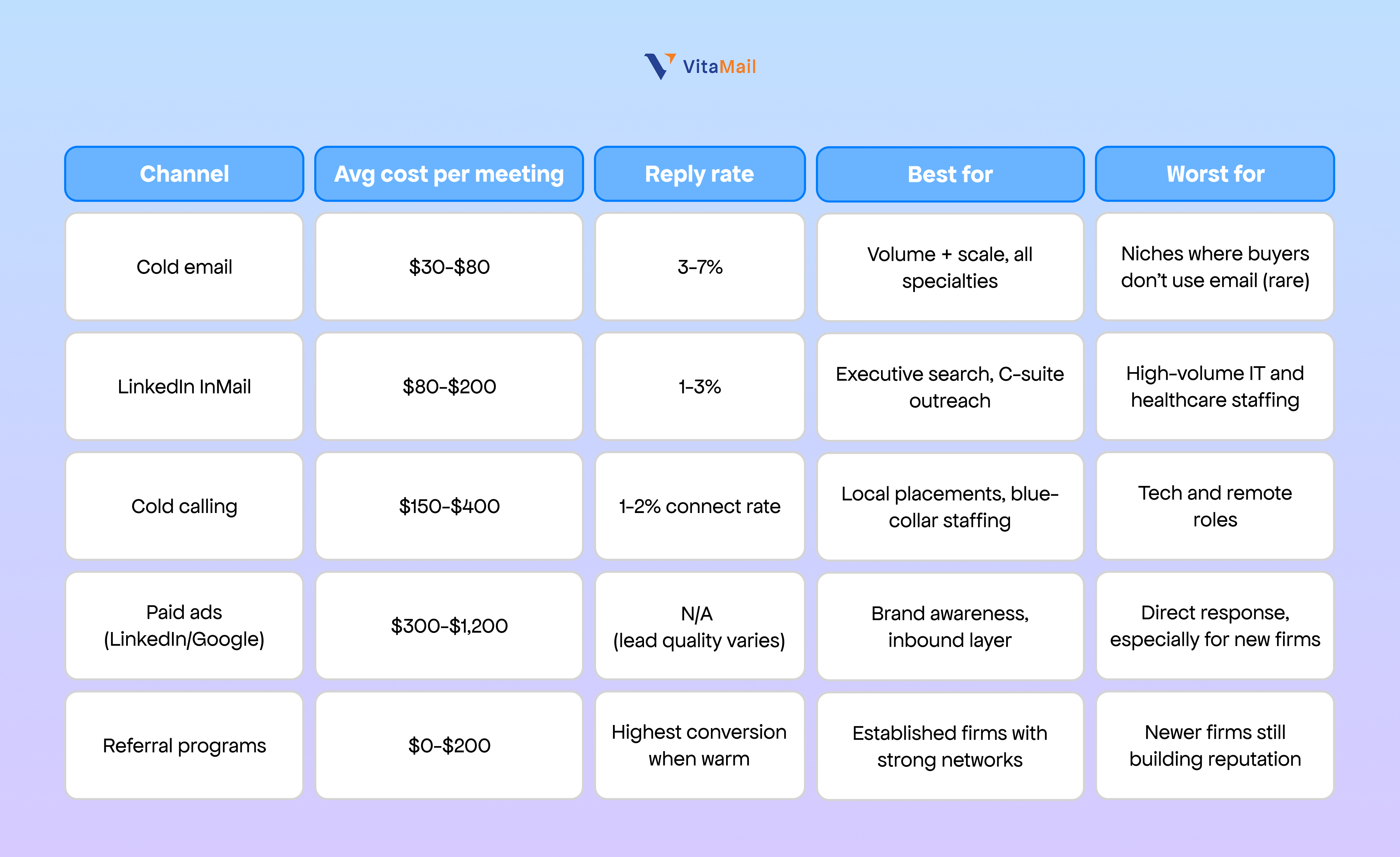
The data is consistent across recruiting subsegments. Cold email is the highest-leverage channel for staffing and recruiting firms in 2026, especially for IT, finance, engineering, and SaaS-focused recruiting. The rest of this guide focuses on doing cold email right.
The 5-step recruiting outbound system
Every successful recruiting outbound program we've seen follows the same five layers. Skip a layer and the system breaks.
Step 1: Define your ICP at the company level, then at the buyer level
Most recruiting firms define their ICP too loosely. "B2B SaaS companies" is not an ICP. It's a category.
Your real ICP has three layers:
- Company filters: Industry, headcount range, funding stage, growth rate, location
- Trigger events: Recent funding, new VP hire, recent layoffs in a competitor, job posting velocity, leadership change
- Buyer titles: Who actually signs the contract (usually Head of Talent, Director of People, VP HR, or CEO at smaller companies)
For example, a strong IT staffing ICP might look like: US-based Series B SaaS companies with 50-300 engineers, that posted at least 3 engineering jobs in the last 30 days, where the buyer is the Director of Engineering or VP of Engineering.
You need every one of those filters to write a relevant first email. For a full framework, read our ICP guide for cold email.
Step 2: Source clean data on the decision-makers
You have two ways to build your contact list.
Option A: Use VitaMail's built-in ICP prospect finder. Define your ICP filters (industry, headcount, funding stage, decision-maker titles, trigger events) and VitaMail pulls fresh contact data in real time, validated as it's pulled. No separate Apollo or ZoomInfo subscription. No stale CSV exports that decay 30% per year. No re-enrichment workflows. You define the ICP once, and the data refreshes every time you run a search.
Option B: Bring your own list. If you already have a contact list from LinkedIn Sales Navigator, an ATS export, or a referral pool, upload it into VitaMail and the bulk email verifier will catch invalid, catch-all, and disposable addresses before they hit your sequence.
Either way, validate every email before sending. A single invalid email raises your spam score and damages your domain reputation, which is the asset your whole outbound program depends on.
Step 3: Write the sequence (not just one email)
A single cold email almost never converts. The recruiting buyers you want are busy. They miss the first email and reply on the third or fourth touch.
A standard recruiting outbound sequence:
- Day 1: Personalized first email referencing a specific trigger (new hire, funding, job posting)
- Day 4: Soft bump with a case study or proof point
- Day 9: Value-add follow-up (industry insight, candidate profile, market data)
- Day 15: Direct ask with a low-commitment CTA ("15-minute call?")
- Day 22: Breakup email ("Should I close the loop?")
Each email under 80 words. Each one earns the right to send the next. For the full framework, see our cold email follow-up frameworks guide.
Step 4: Build deliverability infrastructure before you send a single email
This is where 70% of recruiting agencies fail. They buy a tool, plug in their main domain, and start blasting. Three weeks later, their domain reputation is destroyed and every email goes to spam.
Do this before sending:
- Buy 2-3 secondary domains for outbound (e.g., yourfirm-careers.com, yourfirm-talent.com). Never send cold email from your main domain.
- Set up SPF, DKIM, and DMARC on each domain. See our DMARC, DKIM, and SPF explainer.
- Warm up each domain for 3-4 weeks before live sending. Start at 10-20 emails per day, ramp gradually. Read our email warmup guide.
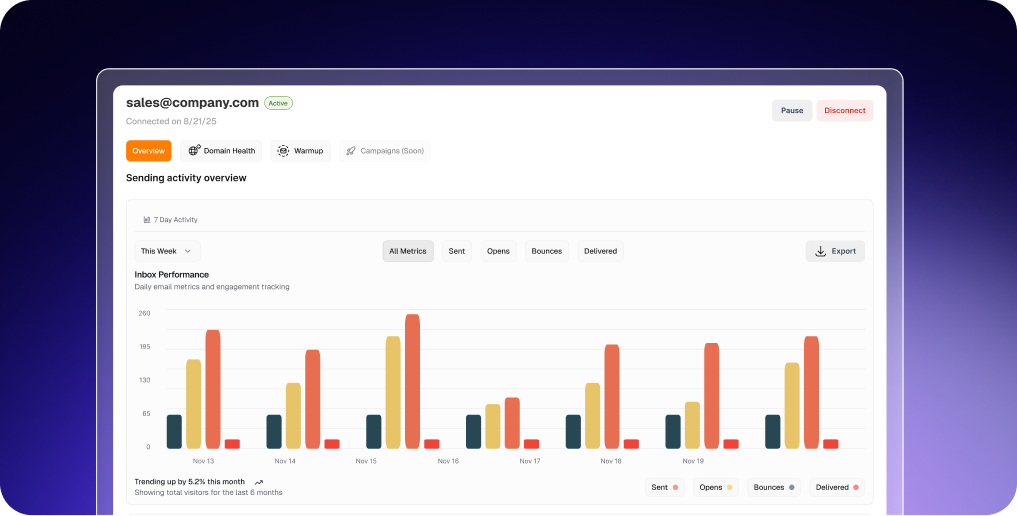
- Monitor domain reputation weekly using Google Postmaster Tools and VitaMail's domain health checker.
- Stay under 50 emails per inbox per day. Use multiple inboxes per domain to scale safely.
Most recruiters resist this step because it feels like overhead. Every recruiter who skipped it eventually rebuilt their infrastructure from scratch.
Step 5: Convert replies into booked meetings
Most cold email guides stop at "they replied." The reply is where the real work starts.
Three reply types you'll see:
- "Send more info" → Respond within 2 hours with a 5-sentence pitch and a Calendly link. Speed wins here.
- "We're not hiring right now" → Don't push. Ask if you can stay in touch and send one piece of value per quarter. These convert at 12-18 months.
- "Tell me about your placements in [specialty]" → They're qualifying you. Send 2-3 specific examples with anonymized data, then ask for the meeting.
Your follow-up speed and quality on replies matters more than your first email. A 24-hour response time on a positive reply kills more deals in recruiting than any other single mistake.
Three cold email templates for recruiting agencies
These are real frameworks. Use them as starting points, not copy-paste scripts.
Template 1: Trigger-based client outreach (new funding or hiring spike)
Subject: 12 senior eng hires by EOY?
Hi [First name],
Saw [Company]'s Series B announcement last week. Congrats.
Most of the companies we work with at this stage are trying to close
8-12 senior engineering hires before year-end, and the bottleneck
is usually sourcing, not closing.
We've placed [N] senior engineers at [Comparable company] and
[Comparable company] in the last 6 months, all with a 90-day
replacement guarantee.
Worth a 15-minute call this week to see if we're a fit?
[Your name]
Template 2: Re-engagement of past clients or warm leads
Subject: Where things landed with [past role]
[First name],
Don't know if you remember, but we spoke about your [role] search
back in [month]. Curious how it played out.
We've just placed a [similar role] at [comparable company] who has
the exact profile you were looking for then. If you're hiring
again, I have 2-3 candidates worth a look.
15 min next week?
[Your name]
Template 3: Pattern-break for highly competitive niches
Subject: [First name], 17 senior PMs in 90 days
[First name],
I'll keep this short. You're getting pitched by every recruiter on
LinkedIn this week. Most of them haven't placed a single PM at a
Series B SaaS company.
We've placed 17 senior PMs across [Company], [Company], and
[Company] in the last 90 days. Same playbook. Same outcomes.
If you're hiring PMs, reply with "send" and I'll send three CVs
that match your stack. No call required.
[Your name]
For more variations, see our cold email templates that get replies or use VitaMail's free AI email generator to customize these for your niche.
The tech stack for recruiting outbound under $300/month
You do not need to spend $2,000 per month to run a serious outbound program. A lean stack:
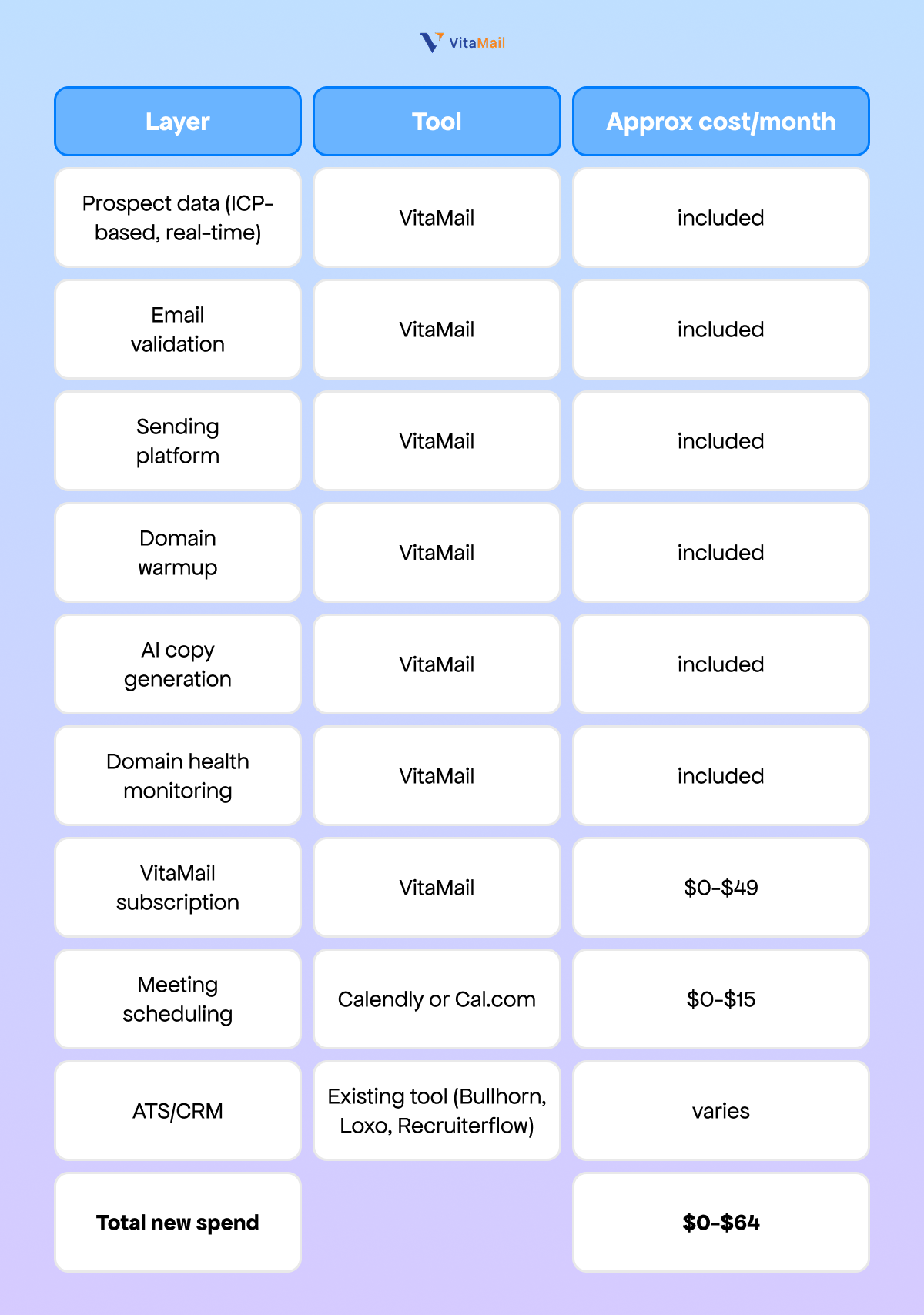
The trick is consolidating. Most recruiters bolt together separate tools for data, sending, warmup, validation, copy, and monitoring and end up at $800 per month with six logins and no integrated reporting. VitaMail pulls fresh decision-maker data based on your ICP, validates it on the way in, runs the sequence, warms your domain, and monitors deliverability on one platform. If you're currently paying for Apollo and considering whether to keep it, read our breakdown of Apollo alternatives.
Compliance for recruiting outbound
Recruiting outbound is B2B cold email, which sits in a more permissive regulatory space than B2C. That said, three rules matter.
CAN-SPAM (US): Every email must include a physical address and an unsubscribe option, and your subject line cannot be misleading. Read our CAN-SPAM Act requirements guide.
GDPR (EU): If you're emailing EU-based decision-makers, you need a documented legitimate interest justification. For recruiting, this generally holds if you're contacting business decision-makers about business matters.
State-specific rules in the US: A few states (notably California with CCPA) have additional disclosure requirements. The safest approach is a clear physical address and one-click unsubscribe on every email.
For multi-region operations, read our email marketing laws by country guide.
Beyond the law, the practical compliance issue is candidate-side outreach. If you're emailing candidates (not hiring companies), the rules tighten significantly in some jurisdictions. Most recruiting outbound discussed in this guide is client-side, which is the simpler regulatory case.
How VitaMail helps recruiting agencies run this system
VitaMail consolidates the middle layers of the stack above. Validation, sending, warmup, AI copy, and domain health monitoring run on one platform with one bill.
For recruiting specifically:
- ICP prospect finder pulls fresh decision-maker data in real time using your filters (industry, headcount, funding stage, titles, trigger events), so you skip the separate Apollo or ZoomInfo subscription and the stale CSV problem
- Bulk email validation catches invalid and catch-all addresses before they damage your sender reputation
- AI email generator writes recruiter-specific outreach using your ICP and trigger data
- Automated sequences run the 5-step cadence above without manual intervention
- Domain health checker monitors your sending domains daily so you catch reputation issues before they tank your deliverability
- Multi-domain support lets you scale across 2-3 secondary domains the way the system requires
Conclusion
Lead generation for recruitment agencies is not a mystery. The firms that win at it follow a clear system: tight ICP, clean data, sequenced emails, real deliverability infrastructure, and fast reply handling. Everything else is execution.
If you're running a recruiting firm and don't have an outbound program yet, the cost of waiting is one quarter of unclaimed revenue. Start with one domain, one inbox, 30 emails per day. Scale from there.
Start a free VitaMail trial and run your first 100 emails through the platform this week. Or grab the free domain health checker and audit your current setup before sending anything.